
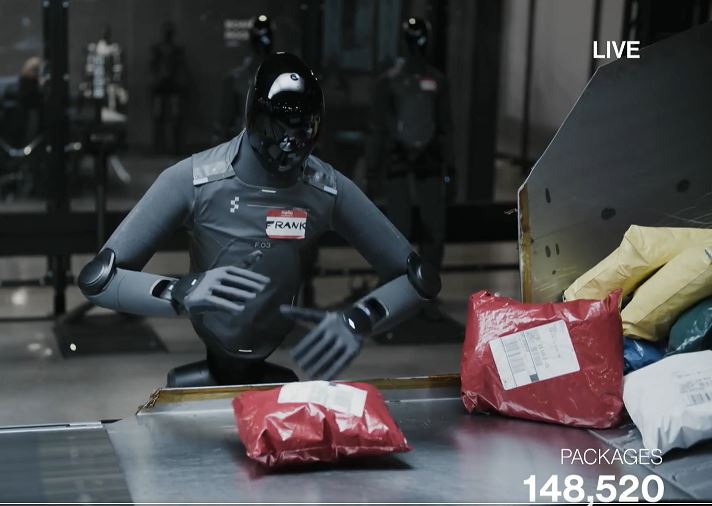
Stop for a moment. Not to watch a robot video, not to check a press release. Just stop and actually think about what happened this week. Because if you read it as just another tech demo — another company showing off another prototype in a controlled environment — you will have missed something important. Something that, in a few years, people will point to the way we now point to the first iPhone announcement or the first time a machine beat a world chess champion.
What Figure AI streamed live starting on May 13, 2026, from their facility in San Jose, was not a controlled lab experiment with cherry-picked clips. It was unedited, continuous, and real. Three humanoid robots — Figure 03 units — sorted packages on a conveyor belt for 81 hours straight, without a single human touching a box or adjusting a robot. By the time they stopped, they had processed 100,000 packages. The internet named the robots Bob, Frank, and Gary. A fourth, Rose, joined the shift partway through. Nobody told them to take a break. Nobody needed to.
This is a spectacular new milestone. A genuine one. And it should give humanity a great deal to think about — not because the robots are coming for us, but because this kind of event forces a question we have been avoiding: what do we do when machines can simply do this better than we can?
The Compound Interest of Technological Progress
There is a passage in The Three-Body Problem that has stayed with me since I first read it. The idea is deceptively simple: technological civilizations don't advance linearly — they advance on compound interest. Each breakthrough becomes the foundation for the next, which arrives faster, which enables the one after that faster still. The curve is not a slope. It is an exponential, and from inside it, the near term always feels slow while the long term arrives before anyone was ready.
Those of us who have spent careers in robotics understand this viscerally. I have watched robots struggle to open doors, struggle to pick up eggs without crushing them, struggle to walk across an uneven floor without falling. And I have watched all of those problems get solved, one by one, in less time than anyone predicted. The gap between "technically possible in a lab" and "deployed at scale in a warehouse" used to be a decade. Then five years. Then two.
What Figure AI demonstrated this week is the compound interest arriving. Not gradually. Not theoretically. Live. In real time. Watched by over ten million people.
"There's absolutely no teleoperation into this." — Brett Adcock, Figure AI CEO, Bloomberg Television, May 15, 2026
What Actually Happened: The Facts
The demo began after robotics veteran Scott Walter publicly challenged Figure AI to prove their autonomous labor claims. Brett Adcock's response was two words: "We'll do it live." And they did.
The task sounds simple on the surface: pick a package from a jumbled pile, find the barcode using onboard cameras, reorient the package so the barcode faces downward toward the conveyor scanner, place it. Repeat. Indefinitely.
That description understates the difficulty significantly. The packages arrived in arbitrary orientations. The barcodes were on different faces of each box. The robots had to visually locate a small printed label on an object of unpredictable shape, calculate the correct grip, manipulate the package into the right orientation mid-air, and place it with sufficient precision to register on the scanner — all in 2.6 seconds per package. That is roughly 1,385 packages per robot per hour. Consistently. For more than three consecutive days.
The entire operation ran on Helix-02, Figure AI's vision-language-action model unveiled in January 2026. Every inference computation ran onboard each robot. No cloud connection. No human operator in a remote chair with a VR headset. No safety net.
| Metric | Figure 03 — May 2026 Livestream |
|---|---|
| Start date | May 13, 2026 |
| Robots deployed | 3 (Bob, Frank, Gary) + Rose (joined mid-stream) |
| AI model | Helix-02 (vision-language-action) |
| Inference location | Fully onboard — no cloud, no teleoperation |
| Throughput per package | 2.6 seconds (~1,385 packages/robot/hour) |
| Packages at 24 hours | 28,000+ |
| Packages at 72 hours | 88,000 |
| Packages at 81 hours | 100,000 |
| Mechanical failures | Zero |
| Human interventions | Zero |
| Peak concurrent viewers | 10 million+ |
| Figure AI valuation | ~$39–40 billion |
Why Barcode Orientation Is the Important Detail
Every piece of industrial machinery that exists today for this kind of task was built around a specific assumption: the package arrives in a predictable orientation. Conveyors, scanners, sorters — the entire architecture of modern logistics infrastructure is designed around the constraint that you need to know, in advance, where the barcode will be.
That constraint has shaped warehouses, packaging standards, label placement regulations, and billions of euros of capital expenditure for forty years. What Figure 03 demonstrated is that the constraint no longer has to exist. A robot with good enough vision and dexterity can take any package, in any orientation, and make it right. The sorting problem — one of the oldest, most expensive, most labour-intensive problems in logistics — has just become a software problem. And software scales.
This is not a curiosity. This is a fundamental shift in the economics of warehouse automation. The moment you don't need to engineer your packaging, your conveyor layout, or your labeling process around robot limitations, the entire calculation changes. Facilities that could never justify automation because of the variety and unpredictability of their inventory now can.
What This Means for Human Beings
I want to be direct about something that too many robotics commentators sidestep: yes, this will displace jobs. Package sorting, bin management, pick-and-place tasks in warehouses — these are among the most common forms of physical labour in developed economies. The people who do them are not going to be retrained as robot technicians overnight, and it is dishonest to pretend otherwise.
But that is not the only story here. And focusing only on displacement means missing the larger, more difficult, and ultimately more important question that this technology forces onto every business leader, every investor, every policymaker: which tasks are worth automating, at what cost, and what does a viable economic model look like when physical labour is no longer the constraining variable?
The human role is shifting — not disappearing. The judgment calls that used to be about "how do we get people to do this reliably" are becoming "how do we decide what to automate, what capital expenditure makes sense, and how do we build a business plan around a world where the variable cost of repetitive physical tasks trends toward zero."
That is not a trivial question. It is, in many ways, a harder question than the engineering one that Figure AI just answered. Because a robot can be optimized. A business model requires wisdom about markets, about people, about risk, about the second and third-order effects of replacing human labour with machines that don't get tired, don't ask for raises, and don't need healthcare.
The engineers at Figure AI solved the sorting problem. The rest of the problem — deciding which operations to transform, at what pace, with what investment, and with what obligation to the workforce being displaced — is a human problem. And it is arriving faster than most boardrooms are prepared for.
Closer Than the World Thinks
The reaction to this livestream was split, as these things always are. Millions watched, equal parts amazed and unsettled. A faction on social media insisted the robots were remotely operated — pointing to a moment where one Figure 03 appeared to touch its head, interpreted as a VR headset gesture. Robotics expert Ayanna Howard raised legitimate questions about placement precision. One Reddit comment noted, with dark humor, that the robots were "stealing jobs from warehouse workers and streamers."
The skepticism is healthy. It is also, in the long arc, irrelevant. Every significant technology debut in the last thirty years has been met with the same pattern: a segment of observers insisting it is fake, staged, or limited in ways that will prevent deployment at scale. The argument is occasionally correct in the short term and almost universally wrong in the medium term.
The people who work in this field — who have spent years watching the benchmark tasks fall, one after another — are not surprised by what Figure AI demonstrated. They are surprised by how fast it happened. The compound interest is working. The curve is bending upward. And the distance between "impressive demo" and "deployed in the warehouse next to yours" is no longer measured in decades.
"Silicon Valley's latest binge-watch is a humanoid warehouse worker." — DnYUZ, May 15, 2026
That headline was meant to be amusing. It is also, if you think about it carefully, the most important sentence written about robotics this year. Because when a humanoid robot sorting packages becomes entertainment — when people watch it the way they watch a football match or a cooking show — something has changed in the cultural relationship between humans and machines. We have moved from fear and speculation to something more like familiarity. And familiarity is usually the last step before adoption.
One hundred thousand packages. Eighty-one hours. Zero failures. Zero human interventions.
Stop and think about that. Then start thinking about what comes next — because whatever you imagine, the compound interest suggests it will arrive sooner.
Figure 03 is one of the most closely watched humanoid robots in the industry. See how it compares to the field.
- Figure 03 — full review and specs
- Agility Robotics Digit — the only other humanoid already deployed in logistics
- Boston Dynamics Atlas — the benchmark for locomotion and dexterity