
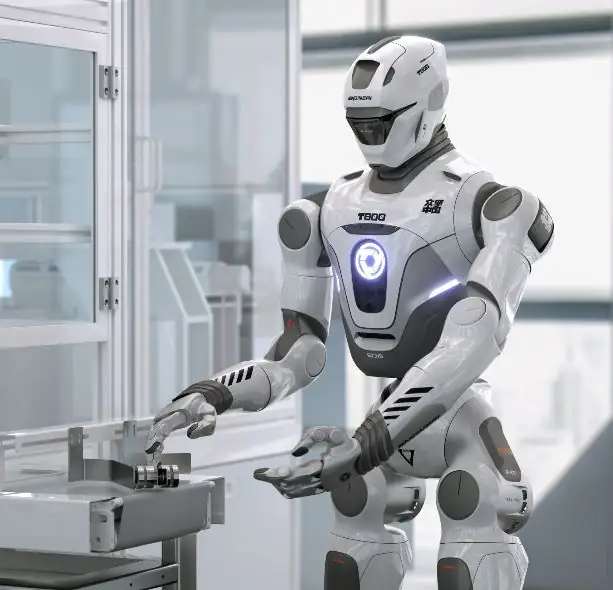
Let me get the obvious out of the way. Yes, they named it T-800. Yes, everyone on the Engine AI marketing team knew exactly what they were doing. And no, I do not think that was a mistake — because the single cleverest thing you can do when you are launching a humanoid robot into a world that has been conditioned by forty years of Terminator films to be terrified of exactly that is to lean into the name, disarm the fear, and then show what the machine actually does.
What the T-800 actually does is walk through your neighbourhood at 2 a.m. and make sure nobody has a reason to break into your car. That is not science fiction. That is a service model whose roots go back to 17th-century Seville, and it might be the most credible near-term commercial use case the humanoid robotics industry has yet produced.
"We did not name it after the Terminator. We named it after the idea that a machine that walks among us at night is not the villain — it is the guardian." — Engine AI, launch press release
What the T-800 Actually Is
Engine AI, the Chinese robotics company that drew serious attention with its SE01 humanoid, has spent the last eighteen months engineering a robot explicitly designed for outdoor, low-light, all-weather operation. The result is the T-800: a 180 cm, 72 kg humanoid with an IP67-rated chassis, a sensor array built around 360° night vision, and a battery life long enough to run a full patrol shift without recharging.
Where most humanoid robots are designed for controlled indoor environments — factory floors, warehouses, domestic interiors — the T-800's engineering brief started from the outside. The joints are sealed. The feet have textured rubber soles rated for wet cobblestone and uneven pavement. The vision system combines standard 4K cameras with dual thermal infrared sensors that render heat signatures in total darkness. This is not a repurposed warehouse robot — it is a robot built to own the night.
| Specification | Engine AI T-800 |
|---|---|
| Height | 180 cm (5'11") |
| Weight | 72 kg |
| Degrees of Freedom | 44 DoF total |
| Walking Speed | up to 2.4 m/s (8.6 km/h) |
| Payload | 30 kg |
| Battery Life | 10 h active / 18 h patrol mode |
| Vision | 6× 4K cameras + 2× thermal infrared (360° coverage) |
| Weather Rating | IP67 — rain, dust, splashing |
| Connectivity | 5G + WiFi 6E + LTE failover |
| Onboard AI | Edge processing + optional cloud sync |
| Emergency Protocol | Direct API integration with police / security dispatch |
| Expected Price | ~$38,000 (commercial lease also available) |
| Launch | June 2026 |
The Serenos of Seville, and Why History Already Solved This Problem
Here is something most people outside of Spain do not know. For roughly three centuries — from the mid-1600s until the 1980s — Spanish cities had a figure called the sereno: a night watchman who patrolled residential streets after dark, carrying a lantern, a staff, and a ring of master keys.
The sereno's job was beautifully simple. If you came home late and your building was locked, you would whistle a short pattern from the street — each sereno knew the residents on his route by their whistle code — and within a minute or two, a man in a grey cape would materialise from the darkness, open your door with his lantern raised, and bid you goodnight. He was not just a locksmith. He was a presence. A pair of eyes on the street. A reason for anyone planning trouble to think twice.
The sereno disappeared not because the idea failed, but because the economics changed. Cities grew too fast, buildings got intercoms, and the cost of employing a human being to walk through the dark every night became impossible to justify. But the underlying need never went away. Women walking home alone at 1 a.m. have the same unease today that they had in 1960. Parked cars in unlit streets get broken into with the same predictability. The problem did not change — only the solution became economically unviable.
The T-800 is, in the most literal sense I can offer, a mechanical sereno. It walks a programmed route. It carries sensors instead of a lantern. It recognises the people on its route — not by their whistle, but by their face and gait. And its mere presence on a street at 2 a.m. does the same thing the grey-caped man used to do: it tells anyone planning something to reconsider.
Why Deterrence Is the Real Product
Most conversations about security robots fixate on the response capability — what the robot does after something happens. That is the wrong frame. The T-800's primary value is not reactive. It is preventive.
Studies on urban crime prevention consistently show that perceived surveillance reduces opportunistic crime by 30–50%. The key word is "perceived." A camera mounted on a lamppost is largely ignored because everyone knows it is static, the footage is rarely reviewed in real time, and the response time to an incident is measured in minutes at best. A 180 cm humanoid robot actively walking the street is a different psychological signal entirely. It moves. It turns its head. It stops and looks. The calculation for anyone considering a smash-and-grab changes instantly.
When deterrence fails, however, the T-800's connectivity becomes the second line of defence. The robot streams footage continuously to a monitoring platform. Its onboard AI flags anomalies — loitering, sudden movement patterns consistent with aggression, a person on the ground. When a threshold is crossed, it can automatically notify the nearest police unit via direct API integration, transmitting GPS coordinates and a live video feed before a human operator even sees the alert. The response time gap that makes static CCTV largely useless closes dramatically.
The Business Opportunity: Night Escort as a Service
The most immediately compelling commercial model for the T-800 is what I am calling Night Escort as a Service (NEaaS) — and yes, I am aware that acronym needs work, but the concept is solid.
The model works like this: a municipality, a residential community, a university campus, or a commercial district subscribes to a robotic patrol service. Instead of buying a robot outright, they pay a monthly fee that covers the robot, its maintenance, its connectivity, and access to a 24/7 monitoring dashboard. The robot learns the geography of its assigned area, the faces of the regular residents, and the typical patterns of activity. It patrols autonomously through the night, and when a registered user requests an escort — via a smartphone app — the robot walks with them from point A to point B, recording the entire journey and maintaining a live connection to emergency services.
Think about what that means for a university campus at 11 p.m. For an elderly person leaving a pharmacy after dark. For a parking garage exit at the end of a late shift. These are precisely the moments where the old sereno was most valued — and precisely the moments that no existing technology addresses with the same immediacy.
Gated communities and urban residential blocks subscribe as a collective. The T-800 learns resident faces and patrols shared spaces, car parks, and perimeter fences throughout the night.
Campus security is a persistent problem. A T-800 on a patrol route eliminates the dead zones between buildings where static cameras have no reach and lone students feel most exposed.
Night-shift security is expensive and inconsistent. One T-800 can cover the perimeter of a mid-size hotel continuously — something three rotating human guards cannot match on the same budget.
Residents who wander at night or patients at risk represent a constant low-level staffing burden. The T-800's thermal sensors detect a person on the ground from 30 metres in complete darkness.
Vehicle theft and break-ins spike sharply in low-traffic overnight windows. A visible patrol reduces insurance premiums, reduces incidents, and creates an evidence trail when incidents do occur.
Cities can deploy T-800 units on high-risk pedestrian corridors — train station exits, late-night commercial streets — offering on-demand escort to any citizen via a free city app.
The Police Integration Layer
The T-800's most technically significant feature is not its hardware — it is the emergency dispatch API. Engine AI has developed an open integration protocol that allows the robot to connect directly to a city's emergency response infrastructure. When an incident is detected, the robot does not merely record. It acts as a first-responder relay: transmitting live video, exact GPS coordinates, and an AI-generated incident summary to the nearest available unit.
This matters more than it might seem. The most common failure mode of existing urban CCTV systems is not the hardware — it is the human bottleneck in the monitoring chain. Cameras record everything and alert nothing. The T-800 flips this: it patrols actively, identifies anomalies in real time with edge-AI processing, and escalates autonomously when thresholds are crossed. The human dispatcher receives a pre-triaged alert with context, not raw footage they have to review after the fact.
Several Spanish municipalities have already opened pilot discussions with Engine AI, according to sources familiar with the programme. The connection to the sereno heritage is not lost on local officials. One city councillor I spoke with put it well: "We abolished the serenos because we could not afford them. Now we can afford something better."
What I Think Is Missing
I have been doing this long enough to know that every compelling robot use case has a gap between the demo reel and the reality of deployment. For the T-800, there are three things I want to see answered before I move from impressed to convinced.
Legal framework. Who is liable when a T-800 incorrectly flags a person as a threat? When its footage is used in a prosecution and the defence challenges the AI's anomaly detection? The technology is ahead of the regulatory environment in every European country where Engine AI hopes to sell, and the gap matters commercially.
Social acceptance. The sereno was human. He was part of the community. He knew your name. A robot walking your street at night may be technically superior in every measurable way and still fail because the people it is meant to protect do not feel comfortable around it. Engine AI's field pilots need to measure sentiment, not just incident rates.
Adversarial behaviour. What happens when someone decides to attack the robot itself? The T-800 is not designed to fight back. Its deterrence model depends on people believing there is a human watching the feed in real time — which, at scale and at 3 a.m., may not always be true.
My Verdict: The Right Robot at the Right Moment
Every robot launch I cover, I ask myself the same question: is this a solution in search of a problem, or a genuine answer to something that has actually been broken for a long time? For Tesla Optimus, I am a cautious believer. For the T-800, I am considerably less cautious.
Night security is a genuinely broken market. Human guards are expensive, inconsistent, and largely ineffective in low-traffic overnight periods. Static CCTV is everywhere and prevents almost nothing. The gap in between — a mobile, intelligent, always-on presence that can both deter and respond — has been waiting for a viable technology for thirty years.
Engine AI has built a robot that is weatherproof, has a genuine patrol-shift battery life, sees in total darkness, and can call for help faster than a human dispatcher. And they are launching it into a market where even a modest reduction in overnight crime creates an immediate, quantifiable return on investment for whoever subscribes to the service.
The serenos of Seville carried a lantern and a set of keys. The T-800 carries six 4K cameras, two thermal sensors, and a direct line to the police. Three centuries of urban security logic point to exactly this product. I do not think it is a coincidence that the best near-term robot business case anyone has found looks, when you strip away the technology, exactly like a job that worked perfectly well until we could no longer afford the human doing it.
Now we can afford the robot.