
Try this experiment. Open a browser and spend fifteen minutes trying to find out how much it costs to buy a humanoid robot from Figure AI, Agility Robotics, or 1X Technologies. Not a detailed quote. Not a lease arrangement. Just a number — the kind you'd see on any normal product page. A price.
You won't find one. What you will find, on every single one of those websites, is some variation of the same non-answer: Contact us. Fill out a form. Tell us about your use case. Someone from the team will get back to you. The price, apparently, is a secret — or at least something that must be negotiated privately, like a ransom or a real estate deal.
This is not a minor inconvenience. It is a structural problem that is quietly holding back one of the most exciting technology categories in decades. And it deserves to be named.
The "Contact Us" Trap
The "contact us for pricing" model is borrowed from enterprise software. It makes a certain sense when you're selling a SaaS platform to Fortune 500 companies: every deal is custom, volumes vary wildly, and the sticker price is only the beginning of a months-long procurement conversation. No one expects to find Salesforce's enterprise contract value on a pricing page.
But humanoid robots are not software. They are physical objects. They have bills of materials, manufacturing costs, and a unit economics that, however complex, converges on a number. Treating them like bespoke enterprise software — opaque by design, priced through relationship — signals something uncomfortable: these companies either don't know what their product costs, or they don't want you to know.
Neither interpretation inspires confidence.
"If you have to ask the price, you probably can't afford it." That attitude has no place in an industry trying to convince the world that humanoid robots are a practical technology, not a luxury for the few.
What the Landscape Actually Looks Like
To be fair, the situation is not uniformly bad. But the pattern is clear enough to be worth documenting. Across the leading humanoid robot companies, public pricing is the exception, not the rule.
| Company | Robot | Public Price | How to Buy |
|---|---|---|---|
| Unitree | G1, H1, affordable humanoid | Yes — clearly listed | Website, AliExpress, direct order |
| Boston Dynamics | Atlas | No public price | Contact sales |
| Figure AI | Figure 03 | No public price | Contact for partnership |
| Agility Robotics | Digit | No public price | Contact sales |
| 1X Technologies | NEO | No public price | Contact for deployment |
| Apptronik | Apollo | No public price | Contact sales |
| Fourier Intelligence | GR-2 | No public price | Contact distributor |
| Ubtech | Walker X | No public price | Contact for commercial use |
One company, consistently, lists its prices. One company lets you click a button and buy a humanoid robot the same way you would buy a laptop. That company is Unitree. Everyone else asks you to fill out a form.
The Arguments for Opacity — and Why They Don't Hold
To be fair to the industry, the reasons for keeping prices private are not entirely cynical. Several legitimate factors push companies toward opaque pricing:
The technology is changing too fast
When your product's capabilities are improving quarter over quarter, publishing a price today locks you into expectations you may not want tomorrow. A $200,000 robot that does X today might do 3X in eighteen months. Publishing the price anchors you to a value proposition that is a moving target.
This is a real consideration. But it doesn't hold up under scrutiny. Car manufacturers update their MSRP lists every model year without the market collapsing. Software companies change subscription pricing all the time. The solution to a moving price is to update the price — not to hide it.
They're targeting enterprises, not consumers
Most humanoid robot deployments today are in warehouses, logistics centres, and manufacturing floors. The buyers are procurement departments at large companies, not individuals. In that world, list prices are genuinely secondary — what matters is total cost of ownership, integration costs, service contracts, and volume discounts.
Again, there's truth here. But it ignores a crucial function of public pricing: market formation. Prices don't just inform buyers. They inform the entire ecosystem — investors, journalists, researchers, potential customers at companies that aren't yet clients, students deciding what industry to enter. When prices are hidden, you eliminate all of that ambient market education. You keep the technology in a black box.
Prices vary too much to publish
With custom configurations, different levels of software subscriptions, varying support tiers, and volume-based discounts, any single published price would be misleading. Better to give accurate customised quotes than to advertise a number that won't reflect what most customers actually pay.
This is the weakest argument of all. Every industry with complex, configurable products — cars, enterprise hardware, construction equipment — has solved this problem with a simple tool: the starting price. From $X. It sets a floor, establishes order of magnitude, and invites further conversation. It doesn't require you to publish the exact cost of every possible configuration.
The Car That Wouldn't Tell You Its Price
Imagine walking into a car dealership — not to negotiate a deal, but just to understand whether the car is in your price range at all. You ask the salesperson what the base model costs. "I'd love to help," they say. "Could you fill out this form with your name, company, intended use case, and number of vehicles you're considering? Someone will get back to you within 48 hours."
You would leave immediately. You would never come back. And you would have a permanently worse impression of that brand.
This is exactly the experience that most humanoid robot companies deliver to anyone who finds them online — whether that's a potential customer, a curious engineer, a journalist, or an investor doing preliminary due diligence. The friction is not a bug. For these companies, it's a feature: it filters out everyone who isn't already a serious procurement lead. But this filtering has a cost that the industry hasn't fully reckoned with.
When a technology category has no public prices, it cannot form a consumer market, cannot attract comparison media coverage, cannot build brand recognition among future buyers, and cannot calibrate public expectations. The automobile industry understood more than a century ago that the MSRP is not just a sales tool — it's a market-building instrument. Humanoid robot companies are learning this lesson the hard way.
What Opacity Actually Costs the Industry
The effect of universal pricing opacity is not just a friction point for individual buyers. It shapes how the entire public understands — or fails to understand — humanoid robotics as a category.
It kills organic interest. When someone reads an article about a new humanoid robot and can't immediately find out whether it costs $10,000 or $1,000,000, their engagement with the story drops off a cliff. Price is context. It tells you who the product is for, what problem it solves at what scale, and whether it's science fiction or something that exists in the real economy. Without it, the product remains an abstraction.
It prevents competitive comparison. One of the primary mechanisms through which markets improve is competitive price pressure. When buyers can compare prices across competitors, manufacturers are forced to justify their costs — through better specs, better service, or genuine differentiation. When prices are hidden, this mechanism breaks down. Companies can charge whatever they want without the discipline that public comparison creates.
It signals uncertainty. There is an uncomfortable reading of "contact us for pricing" that the industry doesn't like to acknowledge: it sometimes means "we don't really know what this should cost yet." In a nascent industry where unit economics are still being worked out, opaque pricing can be a way of buying time — of not committing to a number that might embarrass you in six months. Buyers sense this, even if they can't articulate it.
It erodes trust. Transparency is a precondition for trust in any commercial relationship. A company that won't tell you what its product costs before you've invested time in a sales conversation is a company that is already asking you to trust it before it has given you any reason to. For a technology that will be deployed in critical industrial environments, this trust deficit matters enormously.
Unitree Drops the Price Tag — On AliExpress
Against this backdrop, Unitree's latest move deserves to be understood as more than a product announcement. It's a statement about what kind of company Unitree wants to be — and a challenge to every other humanoid robot manufacturer about what the industry could look like.
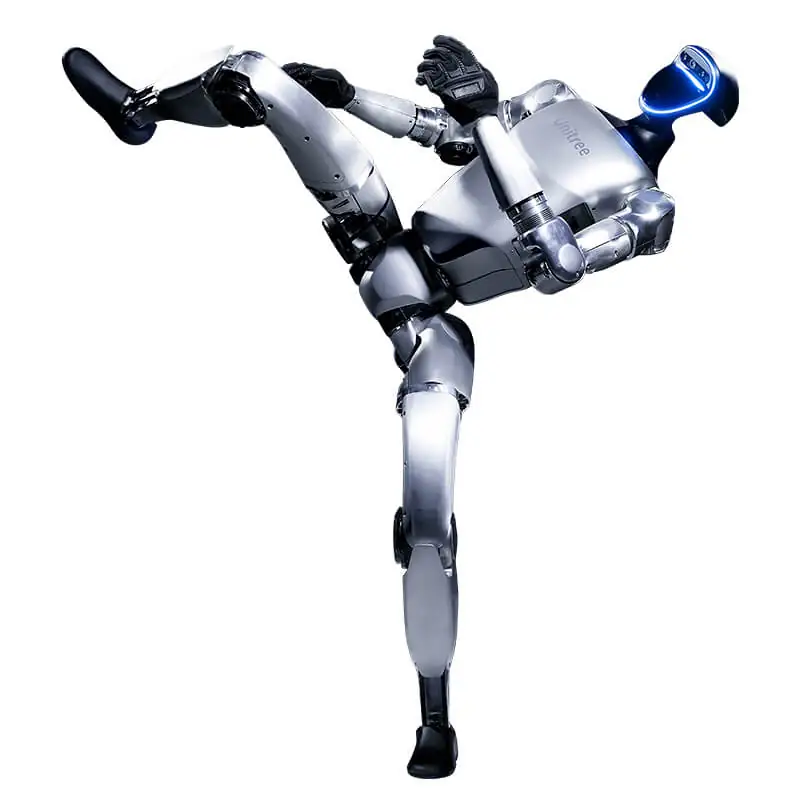
Unitree's most affordable humanoid robot, listed publicly on AliExpress — available to anyone with a browser and a credit card.
Let that number sit for a moment. $4,370. For a humanoid robot. Listed on AliExpress — the same platform where you buy electronics, tools, and household goods. No form to fill out. No sales representative to call. No "partnership enquiry" to submit. You open the page, you see the price, you decide.
This is not primarily a technical announcement. The technical capabilities of this robot are appropriate for its price point — it is an entry-level humanoid, not a warehouse-ready industrial system. What is remarkable is the commercial posture. By listing on AliExpress, Unitree is doing something no humanoid robot company has done before at this price: normalising the product.
AliExpress is not where you buy exotic, niche technology that only specialists can access. It's where you buy things. Listing a humanoid robot there — publicly, with a price, available to anyone — sends a signal that this is a product, not a project. It belongs in a shopping cart, not a request-for-proposal process.
Unitree's Consistent Bet on Transparency
This isn't new behaviour for Unitree. The company has consistently published prices for its entire line-up, from the Go2 quadruped to the G1 humanoid — and each time, those prices have reset expectations for the industry. When Unitree announced the G1 at around $16,000, it forced every other humanoid manufacturer to answer an uncomfortable question that hadn't previously needed answering: compared to what?
Price anchors create reference points. Once a humanoid robot has a public price, the conversation shifts. Buyers at companies evaluating more expensive alternatives now have a baseline. Journalists covering the industry have something to quote. Investors have something to benchmark against. The entire ecosystem benefits from the information that a single published number provides.
Unitree understands this. The company has built its market position partly on the simple insight that transparency is a competitive advantage in a world where everyone else is hiding their prices. If you're the only company willing to say what your product costs, you don't just get credit for being open — you set the frame for how the entire category is evaluated.
What Consolidation Requires
The humanoid robot industry is young. This is the most common defence offered for its current opacity, and it's not wrong. These companies are navigating genuinely difficult commercial terrain: costs are still falling rapidly, production volumes are tiny, and the potential applications are so varied that any given robot might be worth very different amounts to different buyers. Pricing under these conditions is genuinely hard.
But hard is not the same as impossible. And young industries that want to grow into mature, trusted markets need to start building the infrastructure of trust early. Pricing transparency is one of the most fundamental components of that infrastructure.
The automobile industry didn't become a mass market by keeping prices secret. It published prices, created comparison guides, established MSRPs, and built the commercial framework that allowed buyers to evaluate products, form preferences, and make decisions. The dealership might still negotiate, but the starting point was always public.
Humanoid robotics needs to get there. Not immediately — the technology is still maturing, and some of the reasons for current opacity are legitimate. But the direction of travel matters. Companies that are already publishing prices are already building the habits of transparency that will define the mature industry. Those still hiding behind contact forms are accumulating a trust deficit they will eventually need to pay off.
Unitree's AliExpress listing is not just a price announcement. It's an argument about what the humanoid robot industry should become: open, comparable, and accessible enough that a motivated buyer can find out, in thirty seconds, whether this product is something they can afford to take seriously.
That's a low bar. And it's remarkable how few companies in this space have cleared it.