
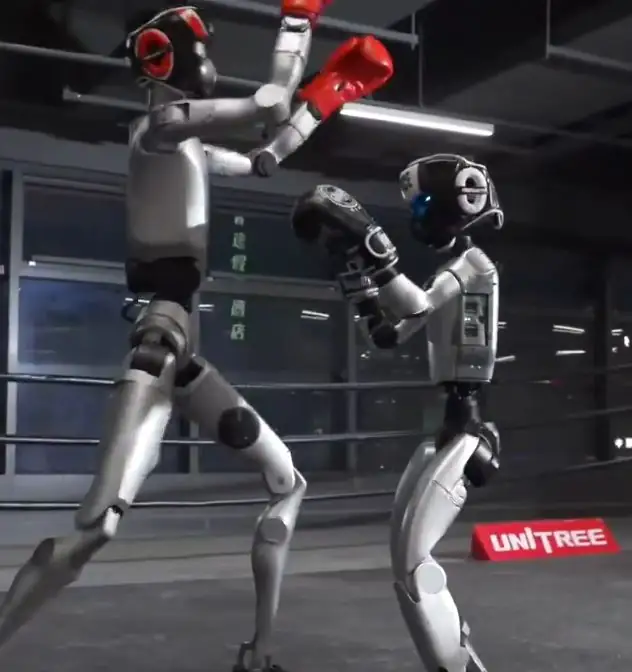
Every time a robot dances in a video, someone in the comments writes the same thing: "Cool trick, but when is it going to fold my laundry?" I understand the impatience. I feel it too. But I've come to think that comment misses something fundamental about how you actually build a robot that can one day do everything — and why the dance, the race, the half marathon are not distractions from that goal. They are the goal.
I run RobotTesters because I genuinely believe we are living through the most important decade in the history of robotics. And one of the things I've learned from watching hundreds of hours of robot footage is that the hardest problems in this field are not the ones that look hard. They're the ones that look easy. Walking across a room looks easy. Keeping your balance when someone nudges you looks easy. Recovering from a stumble on uneven ground looks easy. None of this is easy. And the best way to prove you've actually solved it — not in a lab, not in a controlled demo, but for real — is to put the robot somewhere where failure is public and immediate.
"You don't know if a robot can really move until you watch it do something that was never in its training manual."
Dancing Is the Hardest Locomotion Problem There Is
People underestimate dancing. Watch a human dance well — I mean really well, not shuffling at a wedding — and you're watching the product of a nervous system that spent decades learning to coordinate hundreds of muscles with millisecond precision, adapting constantly to rhythm, space, and the movement of other bodies. We do it so naturally that we forget it's extraordinary.
For a robot, dancing is a nightmare. It requires dynamic balance — not the static kind, where you plant your feet and stand still, but the continuous, flowing kind where your centre of mass is constantly shifting and your joints are catching up a hundred times per second. It requires timing to an external signal, which means the robot has to perceive, process, and act fast enough to stay on beat. And it requires fluid transitions between movement states — no jerky resets, no pauses while the system recalculates.
Every one of those requirements maps directly to something you need a working humanoid robot to be able to do in the real world. The factory floor doesn't care if your robot moves elegantly, but it does care if the robot can reach, pivot, and recover without toppling into a machine or a colleague. The capabilities that make a robot a decent dancer are the same capabilities that make it safe and useful in an unstructured environment.
This is from my TikTok — and what I find remarkable is not that the robot is moving to music. It's the weight shifts. Watch the hips. Watch how it distributes load before transferring it. That's not choreography. That's a locomotion controller doing something genuinely difficult.
Obstacle Courses Test the One Thing Labs Can't Simulate
I have a theory about robotics demos: the more controlled the environment, the less the demo tells you. Flat floor, good lighting, no surprises — you're not watching a robot navigate the world. You're watching a robot navigate a set. And sets are easy.
An obstacle course is the opposite of a set. It's unpredictable by design. The jumps are at different heights. The gaps are irregular. The surfaces change. You can't memorise the terrain, because the terrain is different every time. To complete it, a robot needs something that lab demos almost never require: real-time adaptation.
This is where the gap between "impressive demo" and "actually works" becomes visible. A robot that navigates an obstacle course is proving that its perception pipeline can process novel geometry on the fly, that its motion planner can generate new solutions without a pre-built map, and that its balance system can handle surfaces its engineers never specifically trained it on. That's not a party trick. That's the entire unsolved problem of general-purpose robotics, played out in public in about ninety seconds.
I've posted several of these to my TikTok, and the question I always get is: "but can it do this outdoors, with mud?" Fair question. The honest answer is: not yet, not reliably, not all of them. But the trajectory is clear — and the obstacle course is how we track it.
A Half Marathon Is a Statement About Endurance — and Engineering
In October 2023, a Unitree H1 completed a half marathon in Beijing. Twenty-one kilometres. In about two and a half hours. On a public road. That was a first in the history of humanoid robotics, and I don't think it got nearly enough attention outside the specialist press.
Here's why it matters. A half marathon is not just a long walk. It's a sustained dynamic load test. Every joint, every actuator, every thermal management system in that robot is being asked to perform at or near its limit for a hundred and fifty minutes. If anything is wrong — a slightly misaligned joint, a motor running hot, a battery cell with lower capacity than rated — the half marathon will find it. Not in a bench test. Not in a controlled trial. In the field, in real time, where there's no stopping and resetting.
From an engineering perspective, an endurance event is the most honest test a robot can sit. It's the equivalent of a car manufacturer doing a twenty-four hour race before claiming their production vehicle is reliable. The spec sheet might say the battery lasts eight hours. The half marathon tells you if it actually does. The spec sheet might say the ankle actuator can handle continuous dynamic load. The half marathon tells you at what kilometre it starts to degrade.
And here's the thing no spec sheet will ever tell you: whether the software stack is robust enough to keep a robot upright and moving forward for two hours on a road it has never seen, dealing with camber, cracks, and the occasional runner who doesn't quite get out of the way in time.
These Are Benchmarks. Treat Them Like Benchmarks.
Sports exist, in part, because humans needed a structured way to measure capability. You can argue about who the better fighter is, or you can hold a bout. You can argue about who is faster, or you can run a race. The competition strips away the argument and replaces it with evidence.
Humanoid robotics is at the stage where it desperately needs that kind of evidence. The marketing from every lab and every company is extraordinary. The claims are vast. The renderings are beautiful. The keynote demos are carefully choreographed. And it is genuinely very hard, if you are not an expert, to tell the difference between a robot that is six months from commercial deployment and one that is six years away.
Dance competitions, obstacle courses, and endurance races cut through that noise. They are public, replicable, and hard to fake. A robot either completes the half marathon or it doesn't. It either keeps its balance through the obstacle course or it falls. It either stays on beat for three minutes of dancing or it drifts. The result is binary and visible to anyone watching.
I've been following this space long enough to know that the companies investing in these challenges — the ones willing to put their robots in front of a crowd and let them succeed or fail publicly — are almost always the ones making the most genuine technical progress. The ones who only demo on a clean stage, with rehearsed sequences, without an audience who might ask them to try something unscripted, are the ones I watch with the most skepticism.
What This Means for the Next Five Years
We are entering a period in humanoid robotics where the marketing will outpace the hardware by a significant margin. That's not a criticism — it's what happens in every industry at this stage of development. The cars of the 1900s were sold on possibility as much as performance. The smartphones of 2006 were sold on a vision that took three more years to fully materialise.
The way we stay honest — as an industry, as enthusiasts, as people who genuinely care whether this technology delivers on its promise — is by insisting on challenges that can't be faked. Dancing in front of an audience. Running 21 kilometres without stopping. Jumping over obstacles that weren't there last week.
Those aren't spectacles. They're proof of work. And the robots that pass them are the ones worth betting on.