
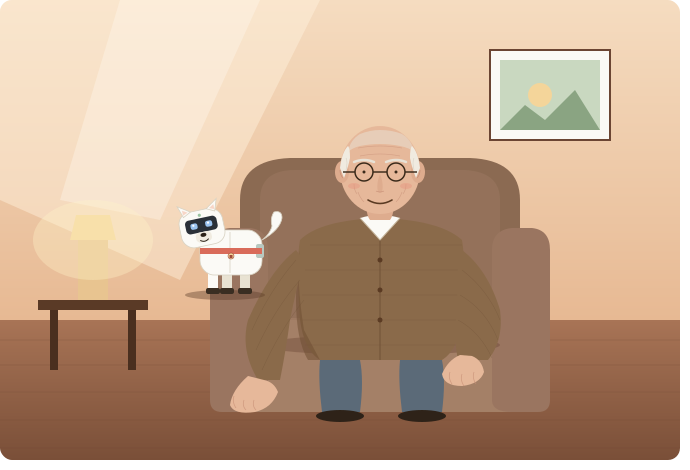
There is more clinical evidence behind robot pets for dementia care than behind most consumer electronics you will ever buy. PARO, the robotic therapeutic seal developed at Japan's National Institute of Advanced Industrial Science and Technology, has been tested in controlled studies across multiple countries. The results are consistent: reduced agitation, lower anxiety scores, measurable decreases in loneliness, and in some studies, a reduction in the need for sedative medication.
This is not a soft technology story. It is a healthcare outcome story — and the outcomes are real. The harder question, and the one that most guides in this space don't answer clearly, is which robot actually makes sense to buy. Because PARO costs around $6,000. Joy for All costs $120. Tombot launched at $149. Sony's Aibo sits at $2,900. The price range spans more than 50 to 1. And the right choice depends entirely on context — the person, the setting, the stage of cognitive decline, and who is managing the care.
This guide works through each option honestly, with the research and without the marketing.
Why Robot Pets Work for Dementia: The Short Version
Dementia progressively impairs memory and language, but emotional and sensory processing often remains substantially intact for much longer. A person who cannot remember their caregiver's name may still respond vividly to the sensation of holding a soft, warm, breathing object that makes sounds and responds to touch.
This is not a metaphor. It is neuroscience. The amygdala — the brain structure responsible for emotional responses — is typically damaged later in Alzheimer's disease than the hippocampus, which handles memory formation. Robot pets exploit this asymmetry deliberately: they offer emotional engagement through sensory channels that remain functional even when declarative memory has deteriorated significantly.
The mechanism matters for product choice. A person in early-stage dementia may notice and care that a robotic pet is not real — and may prefer a product that feels more credibly lifelike and interactive. A person in mid-to-late stage may respond equally well to a much simpler device that offers warmth, texture, and gentle sound. Getting this wrong in either direction is a waste of money and, more importantly, a missed opportunity.
The Four Main Options in 2026
| Robot | Type | Price | Clinical Evidence | Best Setting |
|---|---|---|---|---|
| PARO | Therapeutic seal | ~$6,000 | Extensive (20+ years of trials) | Memory care facilities, hospitals |
| Joy for All | Cat or dog | ~$120–130 | Growing (purpose-built for seniors) | Home care, assisted living, gifting |
| Tombot | Puppy | ~$149 | Emerging (dementia-focused trials ongoing) | Home care, memory care |
| Sony Aibo | Dog | ~$2,900 | Limited (consumer product, not clinical) | Early-stage, tech-comfortable users |
Robot pets are a complement to human caregiving, not a substitute. The research consistently shows benefits when robot pets are introduced as part of a broader care plan — not when they are used as a replacement for human interaction. Any guide that positions these products differently is doing the reader a disservice.
PARO — The Clinical Gold Standard
PARO is a baby harp seal. It weighs about 2.7 kg, feels warm to the touch, and responds to being held, petted, and spoken to. It blinks. It makes soft vocalisations similar to those of a real seal pup. Its fur is an antimicrobial white plush that can be wiped clean. And it has been the subject of more rigorous clinical investigation than any other robot in this category by a significant margin.
Developed by Dr. Takanori Shibata at Japan's National Institute of Advanced Industrial Science and Technology, PARO was specifically designed to look like an animal that most people have no strong prior associations with. A dog or cat robot risks triggering comparisons to a real pet the person once owned — comparisons the robot will lose. A baby seal carries no such baggage. It is novel, soft, and safe. That design choice, which looks almost accidental, turns out to be deeply intentional.
The evidence base is substantial. Randomised controlled trials conducted in Japan, Denmark, Australia, and the United States have consistently shown PARO reduces agitation and anxiety in nursing home residents with dementia. Studies have measured decreases in cortisol levels (a physiological marker of stress), reductions in behavioural symptoms that typically require pharmacological management, and improved mood as rated by both residents and staff. Denmark's national health service has purchased PARO units for deployment in care homes. Several US Medicare Advantage plans now cover it.
The price is the conversation stopper for most families. At roughly $6,000 for the current generation unit, PARO is priced as a medical device for institutional buyers, not as a consumer product for home use. For memory care facilities managing dozens of residents, the per-patient cost can be justified against reduced medication costs and staff time. For a family buying for one person, it is a significant investment — and the honest answer is that Joy for All or Tombot will deliver meaningful benefit at a fraction of the cost for most home care situations.
- Deepest clinical evidence base of any robot pet
- FDA Class II medical device designation
- Novel animal design avoids "uncanny" comparisons to real pets
- Antimicrobial fur, institution-grade durability
- Covered by some insurance plans and national health systems
- ~$6,000 price makes individual purchase hard to justify
- Requires charging and ongoing maintenance
- Designed for institutional rather than home settings
- No app connectivity or software updates
- Seal form may seem unfamiliar to some users initially
PARO was not designed to be a consumer product. It was designed to be a clinical tool. That distinction explains both why the evidence is so strong and why the price is so high.
Joy for All — The Accessible, Practical Choice
Joy for All started its life as a Hasbro project and became a dedicated company — Ageless Innovation — when Hasbro recognised it had created something with real utility beyond the toy market. The product is straightforward: a soft, realistic-feeling robotic cat or dog that responds to petting, holding, and speaking with purring, heartbeat simulation, movement, and gentle sounds.
No internet connection. No subscription. No app required. You charge it, you turn it on, and it works. This simplicity is intentional and, in the context of dementia care, genuinely important. A product that requires setup, connectivity, or technical oversight is a product that creates caregiver burden. Joy for All creates none.
The research on Joy for All specifically is less extensive than on PARO, but it is growing. A number of studies in assisted living settings have shown measurable improvements in mood and reductions in agitation comparable in magnitude to more expensive alternatives. The current clinical picture suggests that, for home care contexts, Joy for All delivers most of the benefit of PARO at roughly 2% of the cost.
The honest limitation is that Joy for All is less sophisticated than its price might lead you to underestimate. The interactions are more limited than PARO's — there is no learning behaviour, no genuine responsiveness, and the movement repertoire is narrower. For a person in mid-to-late stage dementia, this may not matter at all. For someone in earlier stages who is still cognitively sharp enough to notice the robot's limitations, it might.
If you are buying this for a parent or grandparent and you are uncertain which product to start with, Joy for All is the right starting point. If it works — and there is good reason to think it will — you have spent $120 and solved the problem. If it doesn't work well for this particular person, you have learned something useful without a $6,000 lesson.
- Exceptionally low price for the category
- No setup, no connectivity, no caregiver overhead
- Realistic cat and dog options — familiar forms for most people
- Purpose-built for seniors, not repurposed from toy market
- Growing evidence base in real-world care settings
- More limited interaction repertoire than premium options
- No learning or adaptive behaviour over time
- May not satisfy users in earlier stages of dementia
- Less durable than institutional-grade products
Tombot — The Dementia-First Newcomer
Tombot was founded by Tom Stevens after his mother was diagnosed with Alzheimer's — a founding story that is reflected directly in the product's design priorities. The robot puppy was built from the ground up for people with dementia, not adapted from a general consumer product or a toy. That distinction shows in the details.
The Tombot puppy is designed to feel significantly more realistic than Joy for All. It is larger, heavier, and its movements are more elaborate — ears that move, a tail that wags, eyes that blink, and vocalisations that respond contextually to how the user is interacting with it. The body is soft and washable, which matters considerably in a dementia care context where hygiene is a practical concern.
The clinical work behind Tombot is earlier than PARO's but more deliberate than Joy for All's. The company has run trials specifically in Alzheimer's and dementia populations, rather than general elderly populations, and the product has been iterated based on those findings. The emotional responses documented in Tombot's research — laughter, affection, reduced agitation — are consistent with the broader therapeutic robot pet literature.
At $149, Tombot sits in an interesting middle position. It is more expensive than Joy for All but more realistic and purpose-built for dementia. It is far cheaper than PARO while sharing more of PARO's design philosophy — choosing the right form factor, prioritising tactile engagement, building for the specific cognitive profile of the people using it. For home care settings, Tombot may offer the best balance of affordability and efficacy currently available.
- Designed specifically for Alzheimer's and dementia from the start
- More realistic movement and response than Joy for All
- Washable, practical for caregiving environments
- Clinical trials conducted in dementia-specific populations
- Strong value proposition at $149
- Evidence base less mature than PARO's two decades of research
- Puppy form may not suit users who dislike dogs
- Less widely available than Joy for All (fewer retail channels)
- Long-term durability data still limited
Sony Aibo — The Premium Option for Early-Stage Users
Aibo occupies a different category than the other robots in this guide. It was not designed for dementia care. It is a consumer AI companion product — a robotic dog that learns its owner's preferences, responds to voice commands, navigates its environment, and develops what Sony describes as its own personality over time through machine learning.
For a person in early-stage dementia who is cognitively present enough to engage with a sophisticated interactive product, Aibo can be genuinely compelling. The learning behaviour — Aibo becomes more attuned to its owner with each interaction — creates a sense of real relationship over time that simpler products cannot match. It is, by a significant margin, the most capable interactive robot pet available at a consumer price point.
The critical limitation is that Aibo's strengths become irrelevant as dementia progresses. A person who cannot reliably remember previous interactions will not experience Aibo's learned personality as cumulative relationship-building — it will simply be a dog-shaped robot that does things. At that point, Joy for All or Tombot serve the need just as well for a fraction of the price. Aibo also requires a WiFi connection and a subscription plan, which adds ongoing cost and caregiver setup burden.
There is also a harder question to raise here: Aibo is, clinically speaking, the least well-evidenced option for dementia care specifically. It works in contexts where its complexity is a feature, not a liability. For moderate to severe dementia, that complexity becomes noise.
- Most sophisticated AI and interaction repertoire in this category
- Genuinely learns and adapts to its owner over time
- Best option for early-stage users who remain cognitively engaged
- Extremely realistic dog movement and behaviour
- Significant emotional engagement for capable users
- Requires WiFi and Sony subscription plan to unlock full features
- Complexity becomes irrelevant as dementia progresses
- No specific clinical evidence base for dementia care
- $2,900 + ongoing subscription is a significant investment
- Not washable — hygiene management is more difficult
How to Actually Choose
The right choice depends almost entirely on three factors: where the person is in their dementia progression, where they live, and who is managing their care day-to-day. Here is a direct decision framework.
What the Research Doesn't Tell You
The clinical literature on therapeutic robot pets is more honest about its limitations than most healthcare technology research. A few things worth knowing before you make a decision:
Individual response varies enormously. Studies report averages, and averages hide the fact that some individuals respond strongly to robot pets while others show little or no engagement. A family member who knows the specific person will often predict response better than any research finding. If someone has always disliked animals, a robotic animal is unlikely to become their comfort object.
The novelty effect is real. Most trials are conducted over relatively short periods. There is limited longitudinal data on whether therapeutic benefits are maintained over months and years, or whether they diminish as the robot becomes familiar. Caregivers who use robot pets long-term often report the need to vary the interaction — different rooms, different times, occasional "breaks" — to maintain engagement.
Staff or family involvement matters. In most successful deployments, caregivers are involved in the interaction rather than leaving the robot as a standalone intervention. Robot pets appear to work best as a social catalyst — something that enables conversation, shared attention, and physical contact — not as a substitute for human presence.
Some clinicians and ethicists raise the question of whether it is honest to allow a person with dementia to form attachment to a robot presented as if it were alive. It is a real concern and deserves acknowledgment. The consensus view in the therapeutic robotics literature is that for people in moderate-to-severe dementia, the subjective experience of comfort and connection is what matters — and that experience is genuine even if the relationship is not. But for people in early-stage dementia who may be aware of the robot's nature, involving them in the choice is worth doing whenever possible.
The Bottom Line
The evidence that robot pets benefit people with dementia is among the strongest in the consumer robotics space. This is not a technology trend with promised future applications — it is a documented clinical intervention with twenty years of research behind it.
What the market has lacked, until recently, is affordable options that bring this benefit to home care settings. PARO's price made it effectively a hospital and nursing home product. Joy for All and Tombot change that equation. For most families managing dementia care at home, the right robot pet is now available for under $150.
The harder work — understanding the specific person, introducing the robot thoughtfully, and integrating it into a broader caregiving approach — is human work that no robot can do. But the robot, once chosen well, can make that human work a little less exhausting. That is not a small thing.