
Every generation gets exactly one technology trend that, in hindsight, looks blindingly obvious — and that almost everyone alive at the time failed to see coming. In the 1840s it was the railroad. In the early twentieth century it was the automobile. In the late 1990s it was the dot-com, the moment a clumsy academic network quietly became the nervous system of the planet. And in the 2020s it has been artificial intelligence — the fastest-adopted general-purpose technology in human history.
I want to make a claim that sounds bold today and will sound mundane in ten years: the next one is already here, and it is robots. Not robots as a science-fiction fantasy. Robots as the next great global trend — the kind that reorganises the economy, mints the most valuable companies on Earth, and ends up being counted, like cars and phones before them, per human being. Most people have no idea this is happening. That is exactly what the early innings of a megatrend always feel like.
Why the World Keeps Missing the Big One
The strange thing about transformative trends is not that they are hidden. It is that they are visible and dismissed at the same time. In 1995, plenty of smart people had used the internet and concluded it was a toy for academics and hobbyists. In 1900, the automobile was a rich man's noisy novelty that frightened horses. The railroad was, for years, derided as a dangerous and uneconomic way to move what canals moved just fine. Each of these was laughed at right up until the moment it became the single most important infrastructure of its age.
Robots are in that exact phase right now. People watch a clip of a humanoid stumbling in a lab and conclude the whole field is a gimmick. They are making the 1995 mistake. They are judging a general-purpose technology by its most awkward early demo instead of by the slope of its improvement curve — and the slope, this time, is almost vertical.
"The people who got rich on the internet were not the ones who waited until it obviously worked. They were the ones who saw the curve and acted while everyone else was still laughing at the modem noise."
AI Was the Brain. Robots Are the Body.
Here is the connection almost everyone misses: robots are not the trend after AI. They are the trend AI makes inevitable. For fifty years, robotics had a dirty secret — the hardware was never really the bottleneck. We could build astonishing actuators, hands, legs and sensors decades ago. What we could not build was a brain capable of dealing with the chaotic, unstructured, unpredictable physical world. A robot that could weld the same seam a million times was easy. A robot that could walk into your kitchen, find a dirty glass it had never seen before, and put it in a dishwasher it had never seen before — that was science fiction.
That is the wall AI just knocked down. The same leap in machine intelligence that gave us language models and self-driving stacks is the missing ingredient robotics waited half a century for. Suddenly the body has a brain worthy of it. This is why the field went from "interesting research" to "the most heavily funded hardware race on the planet" in the span of about three years. We covered the engineering side of this shift in how modern AI systems actually run a humanoid robot, and the pattern is the same everywhere: the moment intelligence stopped being the constraint, the body became the product.
The Productivity Multiplier Nobody Is Pricing In
Strip away the hype and a robot is one thing above all else: a unit of physical labour that can be manufactured. That is a genuinely new thing under the sun. For all of human history, the supply of physical work was capped by the number of humans willing and able to do it. Robots break that cap. They turn labour from something you have to be born into and trained for into something you can build on a production line and improve every year, like a phone.
The industrial revolution multiplied human muscle with steam and steel, and it took global GDP from essentially flat for millennia to the hockey-stick we have lived on ever since. But those machines were single-purpose: a loom wove, a press stamped. A general-purpose humanoid is different. The same body, with a software update, can stock shelves on Monday, assemble parts on Tuesday and care for an elderly person on Wednesday. When you can manufacture flexible labour, the productivity of the entire species stops being limited by headcount. That is not an incremental improvement. That is a new curve.
Soon We Will Count Robots Per Human
Here is a useful way to feel where this goes. We have a long habit of measuring adoption per person. There are roughly 1.5 cars for every household in much of the developed world. There are now more active mobile phones on Earth than there are people — well over one device per human. Television, radio, the personal computer: each crossed the threshold from "a thing some people own" to "a thing measured per capita."
Robots are going to follow the same arc, and the per-human number is going to be surprisingly large — because robots are not a single device you carry. They are a category that shows up everywhere at once. One folding laundry at home. Several on the factory floor that built your car. A fleet in the warehouse that shipped your order. One restocking the supermarket overnight, one in the hospital ward, one in the field harvesting crops. Add up every robot working on your behalf across the economy and the honest forecast is not a fraction of a robot per person. It is several robots per human — and over a long enough horizon, very possibly more robots than people. We already track the production targets manufacturers are racing toward in 2026 and 2027, and the trajectory only points one way: up and to the right.
The Math Is Simple — and It Builds a New Nvidia
This is the part that should make any investor sit up, because the arithmetic does not require any imagination at all. AI minted Nvidia: a company that, by selling the indispensable hardware of one trend, became one of the most valuable enterprises in history. Robotics is structurally set up to mint its own equivalent — and the napkin math is almost embarrassingly straightforward.
Take a single manufacturer that sells one million robots at an average price of $10,000. That is $10 billion in revenue — from one year, from one product line, from a market that has barely started. For context, a million units is a number Tesla alone has openly targeted for its humanoid programme. Now remember the per-human framing above: we are not heading toward millions of robots. We are heading toward billions. Run the same multiplication at that scale and you are no longer talking about a successful company. You are talking about the largest hardware market the world has ever seen.
And hardware is only the visible half. Every one of those robots needs software, skills, updates, spare parts, repairs and a marketplace of behaviours to do anything useful — a recurring layer stacked on top of every single unit sold. We have already seen the first versions of this with Unitree's developer marketplace for robot skills. The company that ends up owning the best robots — and the platform they run on — will not merely be profitable. It will be the defining corporation of its decade, the way Standard Oil defined one era and Apple and Nvidia define ours.
"One million robots at ten thousand dollars each is ten billion dollars. You do not need a spreadsheet to see where this goes. You need to remember that the market is measured in billions of units, not millions."
Why the Car Companies Saw It First
If robots are the next megatrend, the obvious question is who builds them at scale — and the answer is hiding in plain sight. Look at who is pushing hardest into humanoid robotics and you find a striking pattern: a remarkable share of the leaders are car companies. Tesla. Xpeng. BYD. Hyundai, which owns Boston Dynamics. This is not a coincidence, and it is not a fad. It is the single biggest tell about where this trend is going. We dug into the full roster in why every major carmaker is building a humanoid, and the logic comes down to two things they already own.
First, a modern car is already a robot. It is a fleet of sensors, cameras, radar and lidar feeding a perception stack; a set of electric actuators and precision motors; a large battery and power-management system; and increasingly an autonomy brain that makes real-time decisions in an unpredictable world. The Venn diagram between "the engineering required to build a self-driving electric car" and "the engineering required to build a humanoid robot" is very nearly a circle. A company that has already solved batteries, electric actuation, sensor fusion and on-board autonomy has solved most of a robot without realising it.
Second, their factories are already vast robotic organisms. The thing carmakers are genuinely world-class at is not really the car — it is the manufacturing of the car: the kilometre-long robotic production lines, the supply chains, the cost engineering that turns an exotic prototype into something affordable at a scale of millions. That manufacturing DNA is precisely the capability robotics needs and that pure software companies lack. Knowing how to build a humanoid is one problem. Knowing how to build ten million of them at a price normal people can pay is a completely different one — and it is the one the auto industry has spent a century mastering. It is no accident that the most credible robot price targets come from carmakers; we walked through one in Xpeng's bet that building cars and building robots are the same problem and Tesla's case for Optimus as its most important product ever.
Which leads to a genuinely vertiginous conclusion. The global automotive industry is one of the largest on the planet, worth trillions. And yet, if the per-human robot forecast is even roughly right, the auto sector will one day look like a rounding error next to robotics — a single, narrow product category that happened to be the training ground where the winners learned to mass-produce intelligent machines. The carmakers racing into humanoids are not diversifying. They are following the money to the much, much bigger market that their own expertise unlocks.
The Counter-Arguments, and Why They Mostly Echo 1995
"The demos are clunky." So was the first iPhone keyboard, the first car, the first website. You do not bet against a technology because of its worst current version. You bet on the slope of the curve, and the slope here is steepening every quarter.
"It will take decades." Maybe the full vision does. But the railroad did not need to span a continent to start reshaping the economies it touched — it just needed the first profitable line. Robotics already has profitable lines: warehouses, factories, logistics. The trend does not wait for the humanoid in your kitchen to be perfect. It is already compounding in the places where the economics work today.
"What about the jobs?" The most serious objection, and a real one — but it is an argument about how we distribute the gains, not about whether the trend is real. Every prior productivity revolution provoked exactly this fear, and every one of them ultimately expanded the economy rather than shrinking it. The transition is the hard part, and it deserves real policy attention. The direction does not.
The Verdict: This Is a 1995 Moment
I have spent a year on this site testing robots, pulling apart their specs and pricing them out, and the longer I do it the more convinced I become that we are living through a 1995 moment for an entirely new category. The pieces are all on the table: the enabling breakthrough has arrived (AI), the manufacturing base exists (the car industry), the unit economics are devastatingly simple ($10,000 a unit, billions of units), and the adoption curve is going to be measured, eventually, in robots per human.
The only thing missing is broad recognition — and that is always the last thing to arrive. The railroad, the automobile, the dot-com and AI each spent years being underestimated by almost everyone before becoming impossible to ignore by everyone. Robots are in that window right now. A decade from now, "robots are the next big trend" will read like a truism so obvious it is barely worth saying. The interesting question is not whether that happens. It is who is paying attention while it is still early — and who is still laughing at the clumsy demo.
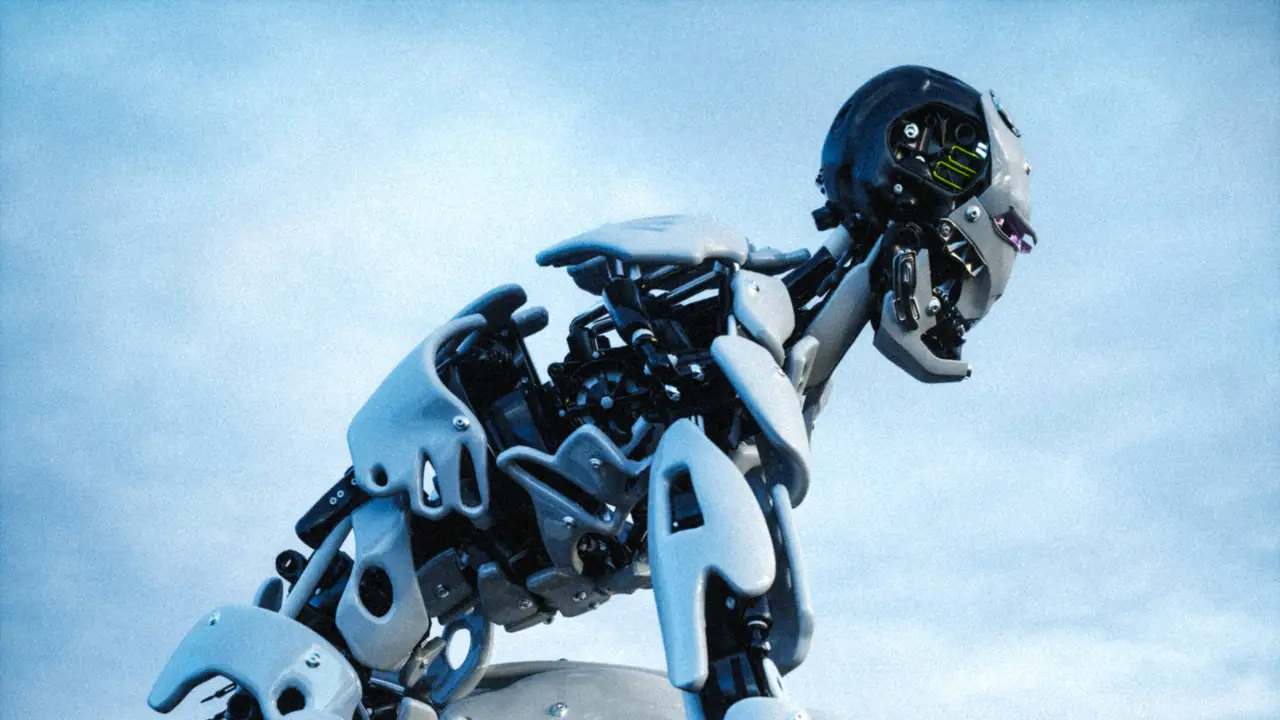
The brain arrived. The body is being mass-produced. The next great global trend is not coming. It is already crouched on the rocks, getting to its feet.