
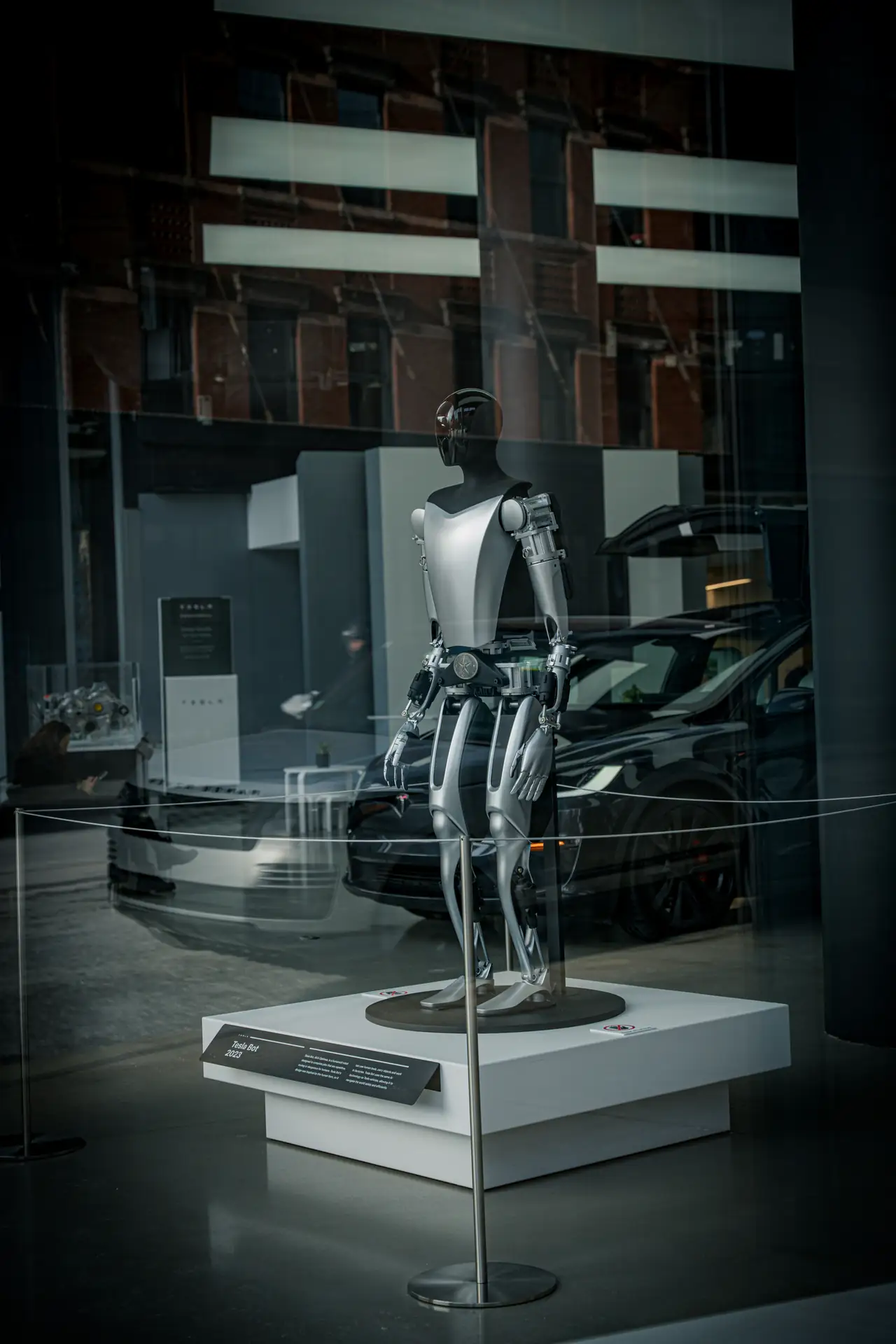
Look at the list and it starts to feel almost absurd. Tesla, BMW, Mercedes-Benz, Hyundai, Toyota, BYD, Xpeng — within the span of a few years, virtually every major car manufacturer on the planet has announced a humanoid robot project. That's not a trend. That's a structural shift. And when that many serious industrial companies move in the same direction at the same time, it's worth asking why.
The answer isn't one thing. It's at least four things converging simultaneously — and once you see the pattern, it makes complete sense.
Who's Building What: The Field Right Now
Let's start with the actual players, because the differences in maturity between them are significant. The same word — "project" — covers everything from robots actively operating on factory floors to divisions that have barely published a press release.
| Manufacturer | Robot | Partner / Approach | Status |
|---|---|---|---|
| Tesla | Optimus | In-house | Factory deployed |
| BMW | Figure 03 | Figure AI | Active pilot |
| Mercedes-Benz | Apollo | Apptronik | Active pilot |
| Hyundai | Atlas | Boston Dynamics (owned) | Advanced dev |
| Xpeng | Iron | In-house (XNGP stack) | Shipping enterprise |
| Toyota | T1X | Toyota Research Institute | Long-term R&D |
| BYD | Unnamed | Internal division | Announced / dev |
Tesla — Optimus is the furthest along in commercial terms. Units have been doing real tasks in Tesla's own factories — sorting parts, moving components — since 2024, and Musk has committed to broader commercial production in 2026. The ambition is to manufacture at automotive scale: eventually millions of units per year, not thousands.
BMW — Figure 03 is the clearest example of a traditional automaker making a genuine operational bet rather than a PR move. The Figure AI partnership has produced live pilots at BMW's Spartanburg plant in South Carolina, with robots doing multi-step assembly tasks alongside human workers.
Mercedes-Benz — Apollo follows a similar model: a partnership with Apptronik, one of the most credible engineering teams in the humanoid space (NASA heritage, strong manipulation stack). The pilot has been running long enough to generate real operational data, which is the only kind that matters.
Hyundai — Atlas has perhaps the strongest institutional position of all, because Hyundai owns Boston Dynamics outright. They didn't partner — they bought the company that had already built the most capable bipedal robot on the planet. The electric Atlas is a significant engineering step forward from the hydraulic original, and Hyundai's manufacturing network gives them a deployment environment that pure robotics companies can only dream of.
Xpeng — Iron is the one that surprised most Western observers. At a price point around $27,000 and specs — 60+ degrees of freedom, 15 DoF per hand — that undercut competitors at that price by a significant margin, Iron is positioning itself as the first humanoid robot that might actually hit volume. The EV transfer thesis (more on that below) gives their approach a structural credibility that most robotics startups can't claim.
Toyota — T1X is the methodical one. Toyota has been doing humanoid robotics research longer than almost anyone — prototype robots were walking around their labs two decades ago. Their current work through the Toyota Research Institute is less media-friendly but more rigorous. They're building toward long-term deployment rather than chasing a headline, and their AI investment is serious.
BYD is the most honest case to describe: they've announced a humanoid robot initiative and created a dedicated division, but as of now they're in development rather than deployment. Given BYD's manufacturing scale and the Chinese government's strategic support for the sector, dismissing them would be a mistake. But they're not yet in the same conversation as Tesla or BMW in terms of operational maturity.
When BMW, Mercedes, Hyundai, Tesla, Toyota, Xpeng and BYD all move in the same direction within five years of each other, that's not a coincidence. That's an industry reading the same signal.
The Real Driver: The EV Transition Is Forcing a Factory Reset
The timing of all this is not random. It's being driven by the electric vehicle transition — and that's the part that doesn't get said clearly enough.
Building an EV is fundamentally different from building an ICE vehicle. The engine is gone. The transmission is simplified or eliminated. The battery pack requires different handling, different assembly sequences, different safety protocols. Factories optimized over decades for combustion engines don't just get upgraded — they get rebuilt from scratch.
And that's the window. When you're redesigning a factory entirely, you can make choices that a factory mid-production cycle never could. You can plan for humanoid robots from the start, rather than retrofitting automation into a workflow designed around humans.
Every major automaker is either mid-transition or planning it. That means every major automaker has a window right now to redesign their production around a fundamentally different kind of workforce. The ones who move first lock in advantages — in deployment experience, in cost structure, in the data that trains their robots faster — that late movers will struggle to close.
The Economics Are Actually Quite Straightforward
Let's be direct about what a humanoid robot offers that a human worker doesn't, because the business case is real even if it's uncomfortable to say out loud.
A humanoid robot works 24 hours a day, seven days a week. It doesn't get sick. It doesn't go on strike. It doesn't demand a wage increase or accumulate pension obligations. It doesn't get tired in hour seven and start making more errors. When you need more capacity, you don't hire and train — you buy more units and deploy them.
The cost structure is categorically different from labour. Labour is a recurring cost that compounds: wages rise, benefits expand, turnover creates constant retraining expense. A robot is a capital expenditure — one large payment, then maintenance. Once the price per unit drops below a certain threshold (and it is dropping fast — Xpeng's Iron at $27,000 is a data point that would have seemed impossible three years ago), the math flips decisively in favour of automation for anything repetitive, physically demanding, or running across three shifts.
There's also a measurement advantage that tends to get overlooked. When a robot performs a task, that task is logged, timed, and fully analysable. You know exactly how long each assembly step takes, where bottlenecks appear, what the error rate is. That operational data is genuinely valuable for continuous improvement — and it's data that's very hard to gather consistently from a human workforce at scale.
The Symbiosis: Factory R&D Funds the Consumer Market
There's a second part of this story that's strategically more interesting, and it has nothing to do with assembly lines.
Every hour a humanoid robot spends doing real tasks in a real factory is data — training data for the AI that controls the robot, operational data about failure modes, feedback about what tasks are within reach and what still needs another year of engineering. You cannot simulate your way to the level of generalisation a robot needs to operate reliably in uncontrolled environments. You need real-world miles.
Carmakers deploying humanoid robots in their own factories are essentially running a funded R&D programme at scale. The robots improve faster because they're working, not sitting in a lab. And the R&D cost is partially offset by the operational benefit of having the robot on the floor.
The long-term destination is obvious: the consumer market. A humanoid robot that costs $15,000–20,000 and can reliably perform a range of domestic tasks — cleaning, carrying, handling logistics — is a product that an enormous number of households would eventually want. The carmakers who spent years developing and deploying factory robots will have engineering depth, manufacturing scale, and safety data that pure-play robotics startups simply cannot replicate quickly.
The investment structure makes this a genuine win-win: the factory use case funds the R&D that eventually builds the consumer product, and the consumer product creates a revenue stream that doesn't depend on automotive cycles. That diversification is significant for an industry that has historically lived and died by macroeconomic conditions and fuel prices.
What This Means for Shareholders — and for Everyone Else
From a shareholder perspective, the humanoid robot bet does several things simultaneously. It provides a credible growth narrative beyond automotive. It signals capability in AI and advanced manufacturing, which influences how the company is valued and the talent it can attract. And it opens the possibility of a revenue stream — robot sales, robot software, robot-as-a-service contracts — that scales very differently from vehicles.
Tesla has been explicit: Musk has said Optimus could eventually be worth more than the car business. Whether that's true or not in fifteen years, the claim has already changed how investors think about Tesla's robotics potential. The other carmakers are aware that being seen as purely automotive in a world where AI defines market cap is a competitive disadvantage in the capital markets, not just in the factory.
The factories come first. The consumer market follows. The R&D is shared between both. The carmakers who moved early — Tesla, Hyundai, BMW, Mercedes — are accumulating advantages in deployment experience, cost, and training data that later entrants will struggle to close.
The industry that gave us the assembly line is about to automate its own assembly line. The irony is almost too neat. But the logic is sound, the timing makes sense, and the money is real. This is not science fiction — it's industrial strategy playing out in plain sight, and the list of participants keeps growing.