
Let me tell you something about the Asimov books. I was around fourteen when I found I, Robot on a shelf at home in Spain, a battered paperback my father had never read. I devoured it in two days. Then I read everything else — the Robot series, the Foundation crossovers, the short stories in the back of obscure magazines. I spent the rest of my adolescence absolutely convinced that humanoid robots were coming, and the rest of my adult life slowly accepting, reluctantly, that they probably weren't.
Not in my lifetime. Not in a way that actually mattered. Not in the kitchen, or the factory, or walking down the street. The hardware was always too expensive, the AI always too brittle, the business case always too shaky. And then Tesla announced Optimus, and I had that feeling again — the one from being fourteen, reading about R. Daneel Olivaw for the first time.
"I believe Optimus will be the most transformative product in history." — Elon Musk, Tesla AI Day
He would say that, of course. But this time, I'm not sure he's wrong.
What Tesla Optimus Actually Is
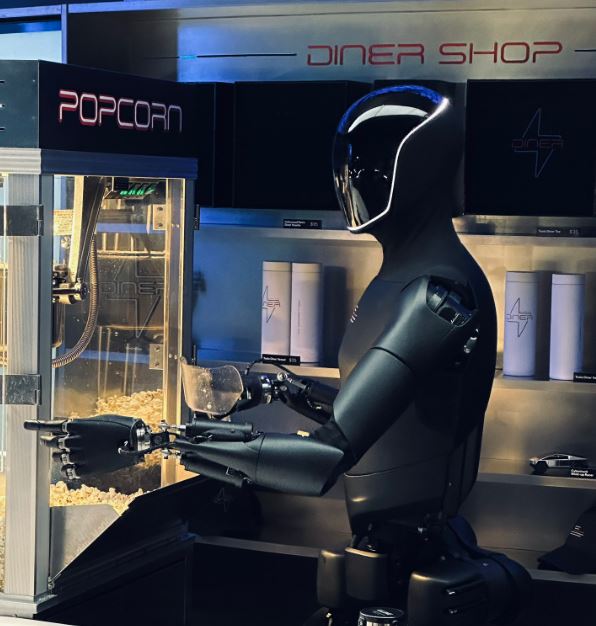
Tesla Optimus — officially called Optimus Gen 2 in its current iteration — is a 5'8" (172 cm) humanoid robot weighing approximately 57 kg. It's designed to perform repetitive, physically demanding tasks in structured environments: factory floors first, domestic settings later. Tesla has been running Optimus units inside its own Fremont and Gigafactory facilities, handling parts sorting, bin management and basic assembly tasks.
What makes Optimus different from most humanoid robots is the stack underneath. Tesla isn't building a robot company — they're extending an AI and manufacturing company into a new physical form factor. The same FSD (Full Self-Driving) neural network that guides Tesla vehicles feeds into Optimus' vision system. The same Dojo supercomputer used to train driving models is being retooled for manipulation and locomotion.
| Specification | Tesla Optimus Gen 2 |
|---|---|
| Height | 172 cm (5'8") |
| Weight | ~57 kg |
| Degrees of Freedom | 28 DoF (hands: 11 DoF each) |
| Walking Speed | ~0.5 m/s (current), targeting 1.4 m/s |
| Payload | ~20 kg |
| Battery Life | ~8 hours (claimed) |
| Actuators | Tesla-designed linear + rotary actuators |
| Vision | Cameras + proprioception (FSD-derived) |
| Target price | $20,000–$30,000 (mass production) |
The Number That Changes Everything
One million units. That's Tesla's stated production target for Optimus by the end of 2025 — a number that sounds absurd until you remember that Tesla went from 0 to 500,000 cars per year in under a decade, and that they design and manufacture virtually everything in-house, including the chips, the motors, the battery packs, and now the actuators.
No robot company has ever shipped humanoid robots at scale. The closest is Boston Dynamics with Spot — a quadruped, not a biped — and their production runs in the thousands, not hundreds of thousands. If Tesla hits even 10% of their stated target, it would represent a generational leap in humanoid robot deployment.
The target price matters as much as the volume. At $20,000–$30,000 per unit for early customers, Optimus is expensive but comprehensible. At the $10,000 Musk has dangled as a long-term goal — cheaper than a used car in Spain, cheaper than a year of minimum wage in most EU countries — it stops being a factory tool and starts being something else entirely. Something closer to what Asimov was actually writing about.
What I Think They've Actually Figured Out
I spent years as a lawyer reviewing technology contracts, and then years building software products. Both jobs teach you the same lesson: the hardest part is never the part the press covers. For Optimus, the impressive demos — folding shirts, sorting objects, walking without falling — are table stakes. The hard part is what you don't see:
The hands. Optimus Gen 2's hands have 11 degrees of freedom each, with tactile sensing in the fingertips. Getting a robot to grip objects without crushing them, to adjust grip force in real time, to pick up an egg and also a metal bolt, is an unsolved problem most companies have quietly given up on. Tesla hasn't. Their hand development videos show genuine dexterity — not perfection, but progress that looks fundamentally different from what I was watching a decade ago.
The training pipeline. Tesla's cars improved because they could train on real-world data from millions of vehicles. Optimus running inside Tesla's own factories gives them the same advantage in robotics: real-world manipulation data at scale, without having to send robots into the wild. By the time Optimus reaches commercial customers, it will have been trained on thousands of hours of actual factory work. That's not nothing. That's a massive moat.
What Still Worries Me
I want this to work. Let me be transparent about that, because it should colour how you read my optimism. I've waited 25 years to write something like this article. But wanting something to be true is the first step toward fooling yourself, and I've been fooled before.
Tesla's timelines are notoriously aggressive. The "million units by end of 2025" prediction has already slipped. Current deployments are in the hundreds, not thousands. Walking speed remains well below the target. And the gap between "working in a controlled Tesla factory" and "working reliably in an arbitrary environment" is the gap that has killed every previous wave of robotics optimism.
The other concern is more philosophical, and it's one Asimov would have appreciated: what does it mean for labour markets when even one million of these exist? I don't have a clean answer. Nobody does. The economic disruption scenarios range from "marginal productivity bump" to "civilisational restructuring", and the honest answer is that we don't have good models for something this novel.
My Verdict: Cautious Believer
Here's where I've landed after spending the last six months watching every piece of Optimus footage I can find, reading every technical breakdown, and thinking about this with the skepticism of someone who has been disappointed before and the excitement of someone who cannot quite make themselves not care.
Tesla Optimus is the most credible attempt at a mass-market humanoid robot the world has ever seen. Not because the demos are perfect — they're not — but because Tesla is the only company attempting this that has a realistic path to manufacturing at scale, a proprietary AI stack with a proven real-world track record, and an economic model that doesn't depend on venture capital believing in a ten-year horizon.
Will they hit a million units? No. Not by end of 2026. But will they ship meaningful numbers of functional humanoid robots into real industrial environments within the next two years? I think yes. And if they do, even at small scale, it changes the conversation permanently.
Fourteen-year-old me, dog-earing pages of I, Robot at his parents' kitchen table in Spain, would have considered this an acceptable outcome.
While Tesla Optimus has no commercial release date yet, several of the robots mentioned in this article are already available — or approaching it.
- Boston Dynamics Atlas — the benchmark for locomotion and dexterity
- Agility Robotics Digit — the only humanoid already deployed in Amazon fulfillment centers
- Figure 03 — TIME Best Invention 2025, designed for everyday home use
- Unitree G1 — the most affordable advanced humanoid at $16,000