
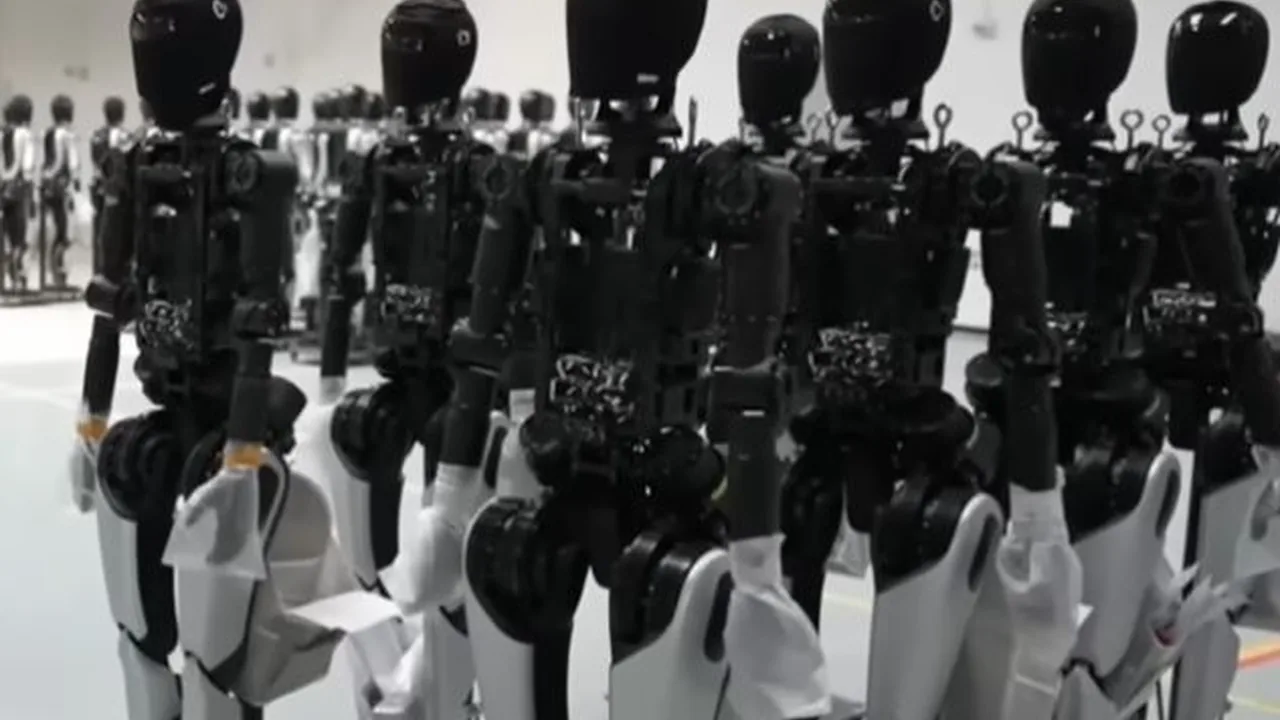
Unit counts and production targets tell you what a manufacturer plans to build. Manufacturing speed tells you whether they can. The two are not the same thing — and right now, the gap between them is one of the most revealing metrics in the entire humanoid robot industry.
Takt time — the rate at which a factory must complete one unit to meet demand — has historically been irrelevant in humanoid robotics because demand itself was irrelevant. You don't optimize a production line for twelve units a year. But in 2026, for the first time, several manufacturers are operating at a pace where takt time actually matters. Some are accelerating hard. Some are holding back deliberately. And a few are discovering that the gap between a factory announcement and a factory that runs is larger than they publicly admitted.
This is a look at the manufacturing velocity behind the volume numbers — which companies have genuinely increased their production pace in recent months, which have stalled, and what each factory strategy tells us about their actual readiness to scale. For a side-by-side view of the raw production targets themselves, see our full humanoid production forecast for 2026 and 2027.
Manufacturing Velocity at a Glance
| Manufacturer | Robot | Factory | 2026 Pace | Trend |
|---|---|---|---|---|
| Tesla | Optimus | Fremont + Giga Texas | 5,000–12,000 / yr | Accelerating |
| Unitree | G1 / H1 / R1 | Hangzhou (in-house) | 8,000–15,000 / yr | Accelerating |
| Figure AI | Figure 03 | BotQ — San Jose | 8,000–12,000 / yr | Accelerating |
| Xpeng | Iron | Guangzhou (EV transfer) | 2,000–5,000 / yr | Ramping up |
| Agility Robotics | Digit | RoboFab — Salem, OR | 1,500–3,000 / yr | Steady |
| Apptronik | Apollo | Jabil (contract) | 1,000–2,000 / yr | Ramping up |
| 1X Technologies | Neo | Undisclosed | 1,000–3,000 / yr | Steady |
| UBTech | Walker X / S2 | Shenzhen (gov. backed) | 1,000–2,500 / yr | Ramping up |
| Fourier Intelligence | GR-3 | Shanghai | 500–1,500 / yr | Steady |
| Boston Dynamics | Atlas (electric) | Hyundai (internal) | 200–500 / yr | Deliberately slow |
Trends reflect publicly reported factory activity and stated ramp plans as of Q2 2026. "Accelerating" means the manufacturer has demonstrably increased output pace or added capacity in the last six months. "Deliberately slow" reflects an explicit strategic choice, not a capability gap.
Why Manufacturing Speed Matters More Than the Number
A production target is a goal. A factory's demonstrated ramp rate is evidence. The history of the humanoid robot industry is littered with targets that were announced with conviction and revised quietly — Tesla's original plan to ship one million Optimus units a year being the most quoted example. What matters for anyone trying to understand where this industry actually is in 2026 is not the number a company claims but the pace at which they have demonstrably increased output in practice.
Manufacturing speed also matters structurally. A factory that can double throughput without capital expenditure has a fundamentally different competitive position than one that has to break ground on a new building. The difference between these two situations is not visible in a volume forecast — it only appears when you look at the factory itself.
The robots that will define 2027 are being assembled today. The speed at which a factory can learn and iterate right now is the most honest signal of where each manufacturer will be in twelve months.
Tesla — The Loudest Acceleration
Tesla's Optimus production narrative has always moved faster than the actual units. But starting in late 2025, the gap between the two began to close in a visible way. Fremont and Giga Texas have been confirmed as active Optimus assembly points, and the V3 design — which eliminated several complex sub-assemblies that slowed V2 production — is credited with a meaningful improvement in takt time. Internal Tesla figures cited in Q1 2026 suggested a 3–4× improvement in units per week compared to the same period in 2025.
The 5,000–12,000 range for 2026 is still a range, not a hard delivery commitment, and Tesla has not published audited production figures. But the directional signal — accelerating — is the clearest in the field. The company is openly treating manufacturing velocity as a competitive moat, and the V3 design was explicitly engineered to enable that. If they hit the upper end of the range, they will have achieved something no other manufacturer has: a humanoid robot at genuine automotive production cadence.
Unitree — The Quiet Volume Leader
Unitree does not announce production milestones the way Western manufacturers do. They ship. The G1 and H1 have been delivered to research labs, universities and developers globally at a scale that makes Unitree the only manufacturer currently moving multi-thousand-unit volumes that are not just internal deployments. Their Hangzhou facility operates within an existing electronics and mechatronics supply chain that took decades to build — which means they can absorb a 3–4× increase in output without the capital planning that a greenfield factory requires.
The incoming R1 pushes the price floor below $6,000 and introduces a new SKU that shares significant component overlap with the G1, further compressing manufacturing cost per unit. Unitree's acceleration is not newsworthy in the conventional sense — there are no ribbon-cutting ceremonies — but the production pace improvement from 2025 to 2026 is among the most significant in the industry.
Figure AI — A Factory Designed for Speed From Day One
BotQ, Figure's dedicated manufacturing facility in San Jose, was not designed as a first-generation prototype factory. It was designed with a stated throughput target of 12,000 units per year, and the Figure 03 was co-designed with that constraint in mind — meaning assembly complexity was a first-class engineering requirement, not an afterthought.
The four-year, 100,000-unit framework agreement with BMW gives Figure something most of its competitors lack: demand certainty. When you know what you need to build and when, optimizing a production line becomes a solvable engineering problem rather than a speculative one. The 8,000–12,000 estimate for 2026 essentially saturates first-year BotQ capacity. Acceleration in 2027 requires a second production line — which Figure has confirmed is in planning. The trajectory is credible precisely because the factory was built for it.
Agility Robotics — The First Dedicated Humanoid Factory in the World
RoboFab in Salem, Oregon deserves a specific mention not because of its current pace — 1,500–3,000 units in 2026 is moderate by the standards of this comparison — but because of what it represents structurally. It was the first factory ever purpose-built for humanoid robot production. Full build-out capacity is rated at 10,000 units per year, meaning the current pace reflects a deliberate early ramp rather than a ceiling.
Digit's logistics-first strategy — deployed at GXO Logistics and Amazon facilities — limits SKU complexity in a way that directly benefits manufacturing. A factory building one robot model for one class of application can optimize its line in ways that a multi-SKU operation cannot. The pace is steady rather than accelerating, but the structural advantage of a purpose-built facility is compounding quietly.
Apptronik — Manufacturing Speed Without a Factory
The most counterintuitive production story in 2026 belongs to Apollo. Apptronik does not own its own manufacturing facility — instead, it has partnered with Jabil, the contract manufacturer responsible for production lines at Apple, Johnson & Johnson and others. This arrangement lets Apptronik access industrial-scale manufacturing expertise and capacity without the 2–3 year lead time of building a greenfield factory.
The trade-off is control: Jabil's line is not exclusively Apptronik's, and throughput is subject to the contract's terms and Jabil's other commitments. But the speed of ramp — going from small-batch Mercedes-Benz pilots in 2025 to 1,000–2,000 commercial units in 2026 — is only possible because of that partnership. For manufacturers without the capital to build their own facility, the Jabil model is the fastest path from engineering validation to production volume.
Xpeng Iron — The EV Supply Chain Shortcut
Xpeng's approach to manufacturing speed is the most structurally novel of the field. Rather than building a robotics factory from scratch or contracting with an electronics manufacturer, Xpeng is transferring its humanoid production into the supply chain it already operates for EVs. The Guangzhou facility that will produce Iron in late 2026 already handles high-precision electromechanical assembly at automotive scale — the same skills required for humanoid manufacturing.
The 2,000–5,000 figure for 2026 is a soft launch; the 20,000–30,000 target for 2027 is where the supply chain thesis gets tested. If Xpeng can actually transfer EV production efficiency to humanoid assembly, they become the first manufacturer to reach five-figure volumes without either Tesla's in-house scale or Figure's dedicated facility. That would be a significant structural proof point for the entire industry.
UBTech — The Government Tailwind
No manufacturer in this comparison has a tailwind quite like UBTech's. China's explicit policy support for domestic humanoid adoption — including government-funded pilot deployments at NIO, BYD and Geely — functions as a demand guarantee that private-market manufacturers in other geographies cannot access. The Walker X and the Walker S2 have been running multi-shift assembly testing at Chinese automotive OEMs for over a year, generating operational data under conditions that most Western pilots are still designing for.
The production pace for 2026 is modest in absolute terms, but the ramp potential is supported by something most of the field does not have: a customer base that is politically as well as commercially motivated to absorb units. If those enterprise contracts convert to volume orders in 2027, UBTech's pace will look conservative in retrospect.
Fourier Intelligence — Precision Over Pace
Fourier's manufacturing profile is a deliberate choice, not a limitation. The GR-3 comes from a rehabilitation-robotics background where precision and reliability per unit matter more than throughput. Shanghai production is optimized for quality control at small batch sizes — which makes sense for research labs and medical applications, where a defective unit creates real harm, but limits the pace at which Fourier can grow volume.
The 500–1,500 range for 2026 is honest about that position. Fourier is not competing for the warehouse deployment or automotive assembly markets where volume is the primary metric. In the niche they serve, pace is less important than provenance.
Boston Dynamics — The Most Deliberate Slow Lane
Atlas is the most recognizable name in the field and the slowest production ramp by a significant margin. The 200–500 unit estimate for 2026 is not the result of factory constraints — it reflects a conscious strategic choice by Boston Dynamics, backed by parent company Hyundai, to prioritize engineering depth over commercial deployment speed.
The electric Atlas only entered limited Hyundai plant pilots in late 2025. Boston Dynamics has been explicit that they are not racing to match competitor volumes in the near term. The bet is that by the time the rest of the field has scaled to tens of thousands of units, Atlas will be capable of tasks that none of them can reliably perform — and that industrial customers will pay a meaningful premium for that capability delta.
Whether that bet pays off is genuinely uncertain. But Boston Dynamics is the only manufacturer in this comparison for whom a low production number is a feature rather than a problem. The slow lane is intentional — and it is funded by one of the largest automotive manufacturers in the world.
1X Technologies — A Different Speed Calculus
Neo sits in a category of its own because its target market is the home rather than the factory. Consumer electronics manufacturing operates at a completely different pace and complexity level than humanoid robotics — but also at a completely different volume. If the consumer launch generates the waitlist demand that 1X's OpenAI-backed marketing suggests, the production ramp required for 10,000–20,000 units in 2027 would need to be the fastest in the company's history.
That gap between 1,000–3,000 units in 2026 and 10,000–20,000 in 2027 is the largest relative acceleration in this comparison. Whether the factory infrastructure exists to support it is the central question for 1X in the second half of 2026. The consumer thesis may be right — but production speed will determine whether it becomes reality.
The Pattern Behind the Speed
Looking across the ten manufacturers in this comparison, three distinct manufacturing models are visible — and each creates a different speed profile.
In-house, vertically integrated factories (Tesla, Figure AI, Agility) have the highest ceiling but the longest ramp. Building your own facility means full control of quality, process and iteration — but also full ownership of the capital expenditure and the learning curve.
Supply chain transfer (Xpeng, Unitree, UBTech) relies on existing manufacturing infrastructure — EV lines, electronics factories, mechatronics supply chains — to absorb humanoid production without starting from zero. This approach gets to volume faster but inherits the constraints and culture of the original supply chain.
Contract manufacturing (Apptronik/Jabil) is the fastest path to industrial-scale production for companies without the capital or time to build their own facility. The speed advantage is real; the dependency on a third party is a structural risk that has no equivalent in the in-house models.
None of these models is obviously superior. The right one depends on what a manufacturer is building, for whom, and how much capital they have to absorb the friction of learning. What the 2026 production landscape makes clear, for the first time, is that the choice of model is no longer theoretical. Every major manufacturer has committed. The factories are running. The speed they achieve this year will set the baseline for 2027 — and the distance between the leaders and the rest is already measurable.