
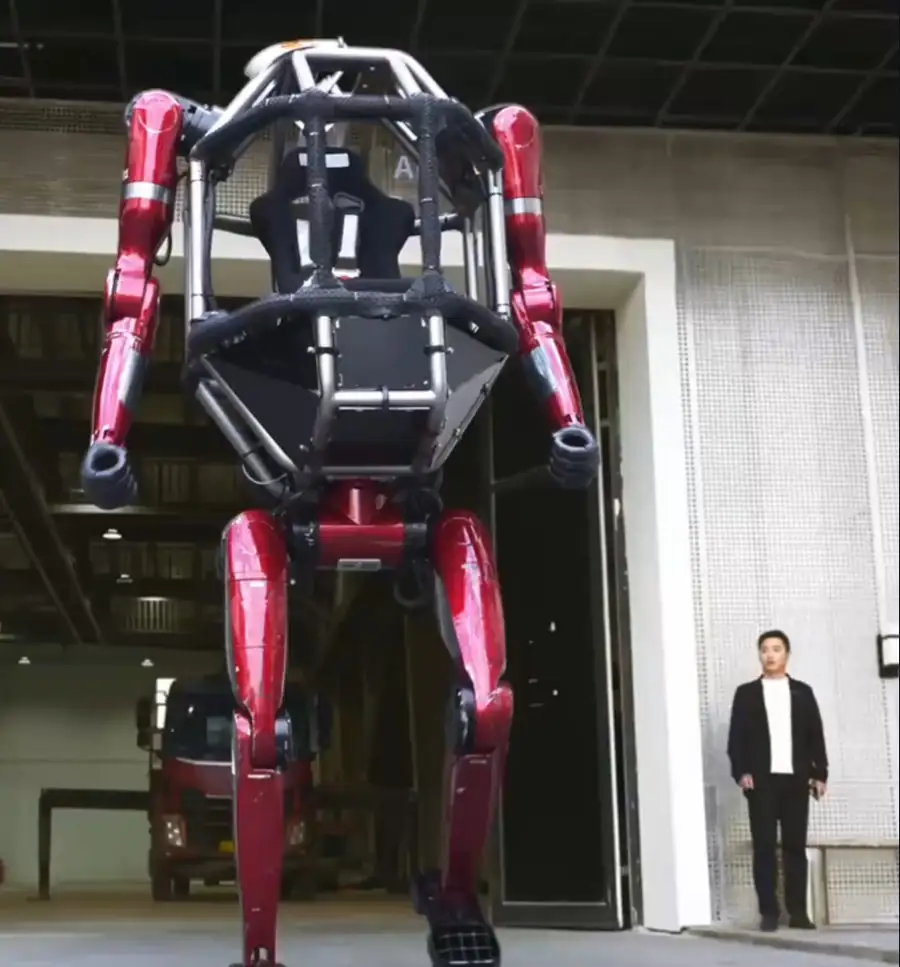
On May 12, 2026, Unitree uploaded a one-minute video to Weibo and X. In it, a 2.7-metre, red-and-black machine walks across a workshop, throws a single punch through a brick wall, and then — without dramatic music, without a narrator, without any of the usual robot-launch theatre — folds down into a four-legged crawl. The piece is called the GD01, and Unitree describes it as the world's first mass-produced, human-carrying transformable mecha. Pricing starts at 3.9 million yuan, which works out to roughly $650,000 at today's exchange rate.
The first thing I felt watching it was the same thing I suspect a lot of people felt: I have seen this before, and it was in a James Cameron film. The GD01 is not subtle about its lineage. The torso-mounted cockpit, the exposed exoskeletal frame, the heavy hydraulics-style limbs — it is the AMP suit from Avatar, made real, made Chinese, and made available for pre-order. That comparison is not a criticism. It is a statement of what just happened this week, which is that an engineering team in Hangzhou has shipped a category of machine that until now lived only on a soundstage in Wellington.
"The GD01 is the world's first mass-produced transformable manned mecha. Pilots receive a complete, ready-to-operate system." — Unitree Robotics, launch statement, May 12, 2026
Watch the Walk-Through (Our TikTok)
Before we go further into specs, this is the moment to actually see the GD01 move. We posted our quick reaction on the RobotTesters TikTok the same evening Unitree dropped the announcement — including the moment the mecha shifts gait mid-stride. The Avatar parallel becomes much harder to argue with once you watch it move.
What the Unitree GD01 Actually Is
Strip away the science-fiction framing for a second. The GD01 is a 2.7-metre transformable robotic platform with a pilot cockpit integrated into its torso. The pilot does not wear it like a suit; the pilot climbs inside it. The machine moves on two legs when manoeuvring through doorways or up stairs, and reconfigures into a four-legged stance — wider footprint, lower centre of gravity — for stability when lifting, pushing, or operating across rough terrain.
What Unitree has not disclosed is, frankly, almost everything beyond that. There is no public battery-life figure. No payload number that we can independently verify. No degrees-of-freedom breakdown for the limbs. No mention of the actuator architecture, the cooling system, or the safety harness inside the cockpit. The numbers below are what the company itself has stated or what we have triangulated from the launch footage and the Chinese tech press.
| Specification | Unitree GD01 |
|---|---|
| Height | ~2.7 m (≈ 8'10") |
| Total weight (with pilot) | ~500 kg |
| Configuration | Bipedal ↔ quadrupedal, on-demand transformation |
| Operation mode | Manned (pilot inside torso cockpit) |
| Demonstrated capability | Walking, gait transition, brick-wall demolition |
| Battery life | Not disclosed |
| Payload | Not disclosed |
| Price | From 3.9 M RMB (~ $650,000 USD) |
| Availability | Production-ready; pre-order via Unitree |
| Announced | May 12, 2026 |
Why I Am Not Buying One — and Neither Should You
Let me be direct. The GD01 is one of the most genuinely impressive things any robotics company has shipped this decade. It is also, in its current form, almost completely irrelevant to anything happening in the human world over the next three to five years. That is not a contradiction. Both things are true at once, and the gap between them is what makes this launch interesting to write about.
Three concrete reasons the GD01 does not fit our world right now:
1. The weight
Five hundred kilograms — half a metric tonne — does not navigate human infrastructure. It does not take an elevator without exceeding its rated load. It does not cross a residential wooden floor. It does not park in a normal garage, climb a fire escape, or pass over a standard pedestrian bridge without an engineer first checking the load tables. The machine is heavier than a fully grown horse, and we did not exactly build cities around horses either. Humanoids like the Tesla Optimus or the Unitree G1 are deliberately designed in the 35–80 kg range for precisely this reason: they need to live inside the same physical envelope as a person.
2. The price
$650,000 is not a consumer price. It is not a small-business price. It is not even, for the tasks the GD01 demonstrated, a sensible industrial price. Construction firms can rent a mid-sized hydraulic excavator with an experienced operator for a fraction of that figure per year. The military procurement cycle, where the GD01 might eventually find natural buyers, runs on multi-year evaluation programmes that no Chinese-built platform is likely to clear in the West any time soon. The current price tag is, plainly, a statement price — it signals what the technology is worth in the abstract, not what the market will pay for the machine in practice.
3. The dimensions
Almost three metres tall. That is taller than the doorway of every residential building I have ever lived in. It is taller than every commercial ceiling under standard code. It is taller than the average tunnel of a metro station, the average parking-garage entrance, and the average ground-floor of a hotel. The GD01 was not designed to walk through the built environment we already have. It was designed to walk through a different built environment that does not yet exist.
So What Is It Actually For?
Reasonable question. The answer is that the GD01 is not a product in the same sense the Unitree G1 humanoid is a product. It is a platform — a deliberately maximal demonstration of what a Chinese mid-cap robotics company can ship to a fixed deadline, aimed at a small set of customers who do not need it to fit through their front door. There are three of those customer types, and they are all long-horizon.
Demolition, debris clearance, structural lifting on open sites. The brick-wall demo was not random — it was a pitch deck for jobs where a 500 kg piloted machine genuinely outperforms two humans and a hand tool.
Underground operations, hostile-temperature environments, sites where a pilot needs strength multipliers more than agility. This is where the Avatar comparison stops being a joke and starts being a use case.
Battlefield casualty extraction, field engineering, fortified-position breaching. Every major military procurement office in Asia will have evaluated this machine within six months. The GD01 will not be sold to them as-is — but its successor might be.
Collapsed buildings, contaminated zones, environments where humans should not be sent and where pure quadruped robots cannot reach. Bipedal-to-quadrupedal transformation is, on paper, exactly what urban search-and-rescue has been waiting for.
The Long-Term Bet Is Real — Just Not For 2026
Here is where I have to be careful not to swing too far the other way. If you read the paragraphs above and concluded that the GD01 is vapourware, that is also not what I am saying. It is, almost certainly, a real machine. Unitree has the manufacturing depth to ship the demonstrated unit and (probably) a small first batch. The Chinese supply chain for high-torque actuators, lithium-ion power packs and structural composites is mature enough that "production-ready" is not a stretch claim.
What I am saying is that the GD01 is a product whose moment is not now. It needs three things to converge before it stops being a curiosity:
A price collapse. The actuator and battery cost curve in humanoid robotics is on the same trajectory the EV battery pack followed between 2014 and 2022. A 60-70% reduction in piloted-mecha unit cost over the next five to seven years is plausible. At $200,000 the GD01 becomes a serious comparison against a $150,000 hydraulic excavator with a permanent operator salary attached. At $80,000 the comparison stops being close.
An infrastructure shift. The next generation of large industrial sites — lunar-surface analogue programmes, deep-sea construction, modular fab-shop assembly — are being designed with non-human form factors in mind. The GD01 does not need to fit through your door. It needs to exist when the door is, deliberately, three metres tall.
A regulatory pathway. A 500 kg piloted machine that can punch through brick is, in most jurisdictions, somewhere between a fork-lift and a battlefield vehicle. The legal category for it does not yet exist in the EU, the US, or even most of China. Whoever writes that framework first will determine who gets to sell these machines, and at what scale.
The Avatar Comparison Cuts Both Ways
I keep coming back to the AMP suit because the comparison is so visually obvious that pretending otherwise is silly — but the comparison also tells us something useful about where this category goes. In Avatar, the AMP was a niche tool deployed by a mining-and-security operation, on a planet whose environment human bodies could not safely occupy. That is not a coincidence. Piloted exoskeletal machines make economic sense exactly when the environment is hostile and the cargo is high-value — almost never when the job is something a human in normal clothing can already do.
The GD01 is real. Its successor — lighter, cheaper, with a defined regulatory home and a clearly addressable industrial market — is the one I will be watching. Unitree just told the rest of the industry that the door is open. The first walk-through has happened. Now the actual product cycle begins, and it will not be measured in months.
Our Verdict: A Spectacular Demo, a Patient Investment Case
If you came to this article asking whether the Unitree GD01 should be on your purchase shortlist for the next twelve to thirty-six months, the honest answer is no — unless you are buying it as a piece of corporate marketing, a research platform, or a museum exhibit. The weight, the price, and the dimensions all point in the same direction: this is not yet a machine for the human world.
If, on the other hand, you came here asking whether piloted mecha represent a real product category that will matter in the second half of the 2020s — yes, they do, and Unitree just put the first credible stake in the ground. The next five years will be about turning a $650,000 statement piece into a sub-$200,000 industrial workhorse aimed at the four use cases listed above. That is a hard engineering problem, but it is the kind of hard problem that the humanoid sector has already solved once.
For now, file the GD01 alongside the first DJI camera drone, the first Tesla Roadster, and the first Boston Dynamics BigDog. None of them changed the world on launch. All of them announced that something was coming. And the people who took those launches seriously are the people writing the next decade of robotics.