
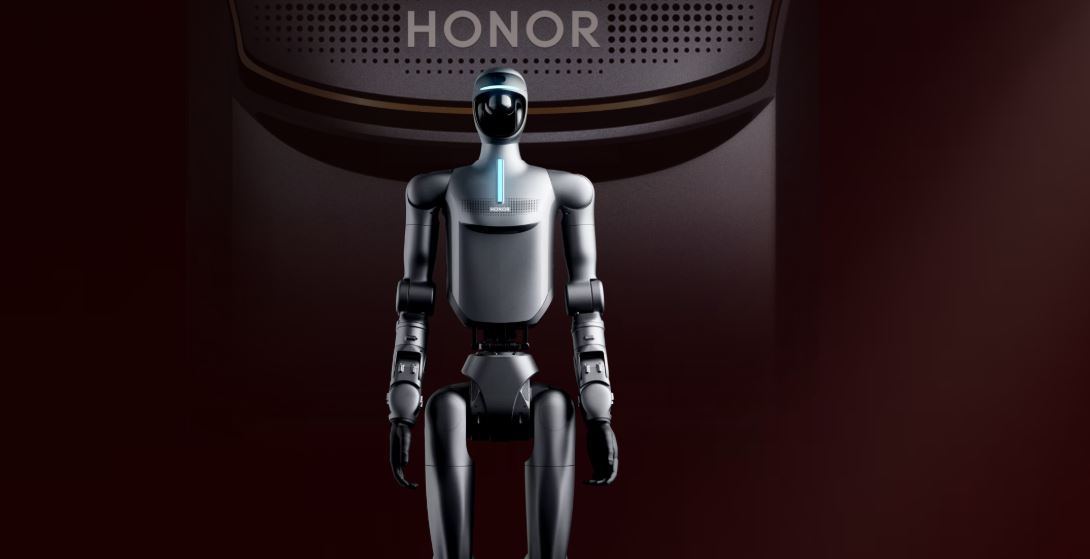
There is a moment from MWC 2026 that keeps coming back to me. Not the backflip — you expect that from a launch stage. Not the moonwalk either, though watching a 136-centimetre silver robot slide across a Barcelona stage without a hint of hesitation does tend to rewire something in your brain. The moment I keep returning to is simpler: the pause. The A1 stops centre-stage, faces the audience, and just — stands there. Upright, still, perfectly balanced, looking entirely at ease in the middle of a crowd of strangers. A machine comfortable in human space.
Its official name is the Honor Robotics A1. Its unofficial nickname, chosen by the team that built it, translates roughly from Chinese as Yuanqi Zai — "Energetic Kid". It is the smaller, more approachable sibling of the D1 (the racing robot that broke the human half-marathon world record in April). While the D1 was designed around one question — how fast can a humanoid run? — the A1 was designed around a very different one: how do you make a robot that people actually want to be around?
Watch It Dance
This is the video that started the conversation. We posted our reaction the same week of the MWC presentation — the A1 moving through choreography that most humans would struggle to replicate cleanly, built on a platform barely taller than a twelve-year-old.
A1 vs. D1: Two Very Different Robots, One Brand
Honor Robotics launched two humanoids in the space of a few months, and the confusion between them is understandable. Both are silver. Both are bipedal. Both share the same MagicOS + YOYO AI stack. Beyond that, they diverge sharply.
| Feature | A1 (Yuanqi Zai) | D1 (Lightning) |
|---|---|---|
| Height | 136.9 cm | 169 cm |
| Focus | Companion / retail / demos | Locomotion / speed records |
| DOF | 20 (incl. 5-finger hands) | Not fully disclosed |
| Max speed | Not disclosed | 4 m/s (14.4 km/h) |
| Peak torque | Not disclosed | 400 N·m |
| Half-marathon | Competed — Best Gait Award | Won (50:26, world record) |
| Design intent | Approachable, expressive | Athletic, aerodynamic |
| Target buyer | Consumer / service sector | Research / industry |
The D1 is an engineering showcase. The A1 is a product vision. And product visions, in the long run, tend to matter more — because they define what the market will actually pay for.
The Specifications: What Honor Has Shared
Honor has been selective about publishing numbers for the A1, especially on the performance side. What follows is what has been officially confirmed, plus context from the launch demonstrations and third-party reports from Chinese tech media.
| Specification | Honor Robotics A1 |
|---|---|
| Height | 136.9 cm |
| Nickname | Yuanqi Zai (元气仔) — "Energetic Kid" |
| Degrees of Freedom | 20 (including 5-finger hands) |
| Hands | Five-fingered, human-like |
| Max Speed | Not disclosed |
| Sensors | Forehead camera, multimodal perception |
| AI Stack | MagicOS on-device + YOYO intelligent agent |
| Voice / Dialogue | Intelligent voice dialogue, multi-modal awareness |
| Locomotion | High-dynamic motion — demonstrated backflip, moonwalk, choreography |
| Awards | Best Gait Award, 2026 Beijing Yizhuang half-marathon |
| Price | Not announced |
| Availability | Not for sale (prototype/pre-production) |
| Announced | March 1, 2026 (MWC Barcelona) |
Twenty degrees of freedom is a modest figure by 2026 standards — Unitree's G1 runs at up to 43, Ubtech's Walker X at 41. But DOF is a means to an end, not an end in itself. The A1's five-fingered hands and fluid choreography demonstrate that whatever the count, the motion system is tuned for expressiveness rather than raw manipulation. That is a deliberate choice, and the right one for the use cases Honor has targeted.
The Half-Marathon: Not the Winner, But the Best Posture in the Room
In April 2026, at the Beijing Yizhuang Humanoid Robot Half-Marathon, the A1 took to the starting line alongside the D1 and robots from Unitree, Booster, and several other brands. The D1 crossed the finish line first in record time. The A1 did something subtler: it won the Best Gait Award — given to the robot whose biomechanics most closely resembled natural, efficient human movement.
That is not a consolation prize. In a field where most humanoids still move with a characteristic stiffness that gives away their non-biological origin, a robot that wins "best running posture" against a field of purpose-built racing platforms is doing something genuinely impressive. The A1 was not optimised for speed. It was optimised for looking like it belongs, and in that race, it won the award that mattered most for its intended market.
"The A1 is not trying to be the fastest. It is trying to be the most human." — Honor Robotics team, Beijing Yizhuang event, April 2026
What It Is Actually Built For
The YOYO agent — Honor's onboard AI — is the throughline across everything the A1 does. It provides the voice interaction, the object and person recognition, and the contextual awareness that turns a moving robot into a communicating one. Crucially, it can pull from the user's existing MagicOS profile on their Honor phone, meaning the robot can theoretically recognise you, know your preferences, and adapt its behaviour before you have spent a single day with it.
In-store guidance, product queries, greeting. Honor's own retail network — hundreds of stores across Asia and Europe — becomes the A1's first live deployment environment. The company is its own best first customer.
At 136.9 cm, the A1 operates comfortably at adult eye level when seated and child eye level when standing. The scale is not accidental — it is approachable without being imposing, which matters enormously for domestic and care contexts.
The dance capabilities demonstrated at MWC make the A1 immediately deployable as a live event asset — the kind of role that generates the brand awareness and public familiarity that precedes mass adoption. Performance robots build consumer comfort with robots in general.
Reception, wayfinding, light task assistance. The A1's compact footprint — smaller than a tall human colleague — means it fits through standard doors, rides standard lifts, and operates in spaces designed for humans without modification.
What We Still Do Not Know
The information gap on the A1 is significant. Honor has been generous with demonstration footage and minimal with technical data, which is the standard playbook for pre-production hardware but still leaves important questions open.
Battery life. Nothing has been published. For a retail deployment robot running eight-hour shifts, this is the single most important operational parameter, and Honor has not addressed it.
Manipulation beyond demonstration. Five-fingered hands capable of expressive movement are not the same as five-fingered hands capable of reliable task execution. We have seen the A1 gesture and wave. We have not seen it reliably open a door, pour a drink, or carry a tray — the things a retail companion actually needs to do.
Price and timeline. Analyst estimates range from $15,000 to $35,000 for a consumer unit. Honor has confirmed nothing. For any business planning a deployment around A1, the absence of a price and a ship date makes planning impossible.
Developer ecosystem. Honor has not announced an SDK, a developer programme, or third-party app support for the YOYO platform. Without that, the A1 can only do what Honor builds for it — which caps its addressable market at whatever Honor's own software team prioritises.
Our Verdict: The Right Robot for the Right Moment
The robotics industry in 2026 is full of robots that can do impressive things and no one who wants to buy them. The gap between "technically capable" and "commercially deployable" is wider than most press releases acknowledge. The Honor Robotics A1 is interesting precisely because it is designed to close that gap from the human side rather than the engineering side.
The dance at MWC was not a gimmick. It was a proof of concept for something that rarely gets measured on a spec sheet: whether people are comfortable being in the same room as a robot. The A1 passes that test in a way that very few humanoids currently do. Its compact height, its fluid movement, its approachable silver design — these are not accidents. They are the result of a design brief that asked "how do we make this less threatening?" before it asked "how do we make this faster?"
The D1 holds the record. The A1 has the personality. In consumer markets, personality tends to win.
We will be watching closely as Honor Robotics moves from prototype to product. The A1 has earned a place on our comparator — and a place on the shortlist of humanoids that could actually matter when the first real consumer wave arrives. The half-marathon showed it can keep up. Barcelona showed it knows how to dance. The next twelve months will show whether it knows how to work.