
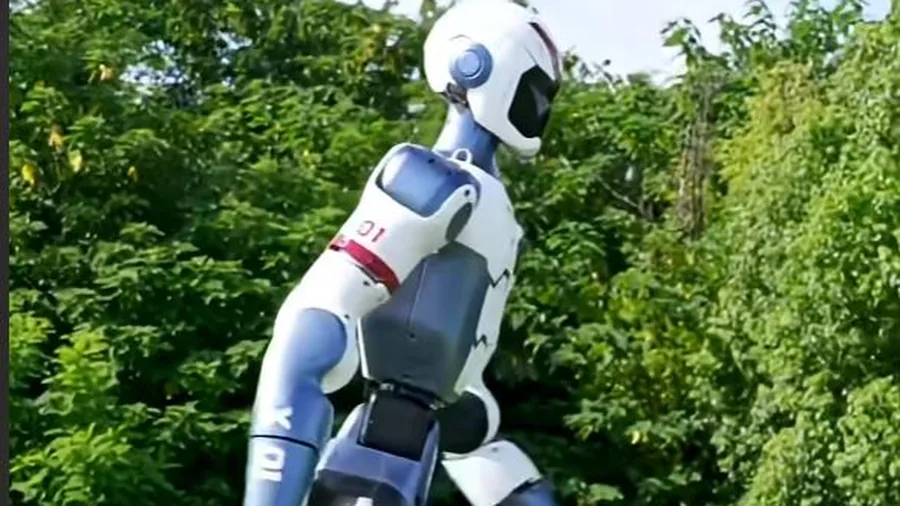
Unitree keeps showing up first. When everyone else was announcing roadmaps, Unitree was shipping the G1. When the conversation was still about whether sub-$20,000 humanoids were possible, Unitree was already there. And now, with the R1 at $4,900, they have answered the question that the entire industry has been avoiding: what does a humanoid robot cost when the goal is actual volume?
That number — $4,900 — is the story. Not the robot's capability, not its elegance, not the demo reel. The story is that the price floor for bipedal, AI-equipped, humanoid-form robots just dropped below $5,000 for the first time. That is a threshold the industry did not expect to cross this decade.
Watch: Our Take on the R1 Launch
We covered the R1 launch on our YouTube channel the day it dropped. Worth watching before digging into the analysis:
Specs: What You Are Actually Getting
The R1 is compact. At 1.23 m and 27–29 kg it is significantly smaller than a full-size humanoid — closer to a pre-teen in stature than to an adult peer. That is not a flaw; it is a deliberate design choice that makes it lighter, cheaper to produce, and far less intimidating in domestic and educational environments. The onboard AI is UnifoLM, Unitree's own multimodal model, running locally — no cloud dependency for basic interaction.
| Specification | Unitree R1 |
|---|---|
| Height | 1.23 m (≈ 4'0") |
| Weight | 27–29 kg |
| Locomotion | Bipedal — walking, running, handstands, cartwheels |
| Onboard AI | UnifoLM multimodal LLM (voice + vision) |
| Battery | Hot-swappable |
| Starting price | $4,900 |
| Availability | shop.unitree.com — AliExpress listing pending |
| Notable | TIME Magazine Best Invention 2025 |
Full specs, scores & community data
Unitree R1 spec sheet, ecosystem score, and what the robotics community is building with it — all on the robot's dedicated page.
View Unitree R1 ficha →Humanoid or Companion? The Wrong Question
A predictable debate is already forming online: is the R1 really a humanoid, or is it a companion robot wearing a humanoid costume? It has two legs, two arms, and a head. It runs bipedal locomotion. By every convention the industry uses, it qualifies as humanoid. The fact that it is 1.23 m tall rather than 1.7 m does not change the mechanical category.
The semantic argument is also irrelevant to what makes the R1 interesting. Call it what you want — the question that actually matters is whether it is cheap enough to generate volume, and whether that volume will drive the feedback loop that makes the next generation meaningfully better. On both counts, the R1 passes.
The price floor just moved. The first humanoid below $5,000 is not the best humanoid — it is the one that starts the countdown on every price tag above it.
In terms of genuine near-term use cases, the R1 sits comfortably in companion and light-assistance territory: homes, schools, care settings, developer workbenches. It is not going to carry warehouse pallets — that is the G1's job. The R1's job is to exist at a price where enough units ship to matter.
The Flywheel That Actually Matters
The history of consumer hardware is full of devices that were mediocre on launch and essential three years later. The iPhone had no App Store. The first Tesla Roadster was barely reliable. The reason they improved fast was not magic — it was the feedback loop that scale creates.
More R1 units in the field means more real-world data. Floors that the training set did not include. Voices the model had not heard. Lighting conditions that break the vision stack. Every R1 deployed in a home or classroom is an edge-case generator for the software team. That friction — the messiness of real deployment — is exactly what the next generation needs to improve.
The hardware cost will also fall as production scales. Fixed tooling amortizes across more units. Supply chains for actuators, sensors, and the compute boards deepen as order volumes grow. The first major wave of R1 sales is, in effect, subsidising the cost reduction of R2, R3, and whatever Unitree ships after that.
Unitree's Track Record: Take the Pioneer Seriously
We have written about Unitree a lot on this site — and we will keep doing so for as long as they keep being first. We asked recently whether Unitree is the next Nokia or the next iPhone. The R1 does not answer that question definitively. But it does reinforce the pattern: when the industry is debating whether something is possible, Unitree is already shipping it.
Whether Unitree ultimately wins this market is genuinely uncertain. Tesla, Xpeng, Figure, and Agility Robotics all have serious programmes with serious capital. Boston Dynamics still has the brand recognition that defines the category in the public imagination. But being first to prove a price point is worth more than it looks. Unitree has now set the expectation that humanoid robots can cost less than $5,000. Every competitor will be judged against that bar.
On AliExpress: Not Yet — But Soon
The R1 is not on AliExpress at the time of writing. It is available directly through shop.unitree.com. Given that the Go2 and the G1 both found their way onto AliExpress in relatively short order, we expect the R1 to follow the same route. When that happens, it will be the first humanoid robot you can order alongside a phone case and a pair of wireless earbuds. That normalisation — not the product itself — is the signal to watch.
Our Read: A Rough First Step That Will Matter in Ten Years
The R1 is, by any reasonable standard, an imperfect product. Its capabilities are limited. Its software will need years of iteration. Its form factor sits in an ambiguous space between companion and utility robot. It will frustrate buyers who come expecting the demo reel.
None of that diminishes what it represents. The important question for humanoid robotics has never been "will someone eventually build a great one?" — everyone agrees on that. The real question has been "how do we get from here to there without waiting another decade for enterprise data?" The answer is to make the hardware cheap enough that the consumer market starts generating data instead.
In ten years, when capable humanoid robots are a normal feature of the world, someone will write a retrospective about where it all started. The Unitree R1 deserves a line in that piece — not because it was the best robot, but because it was the first one priced like a mass-market product. That is a harder thing to achieve than it sounds.