
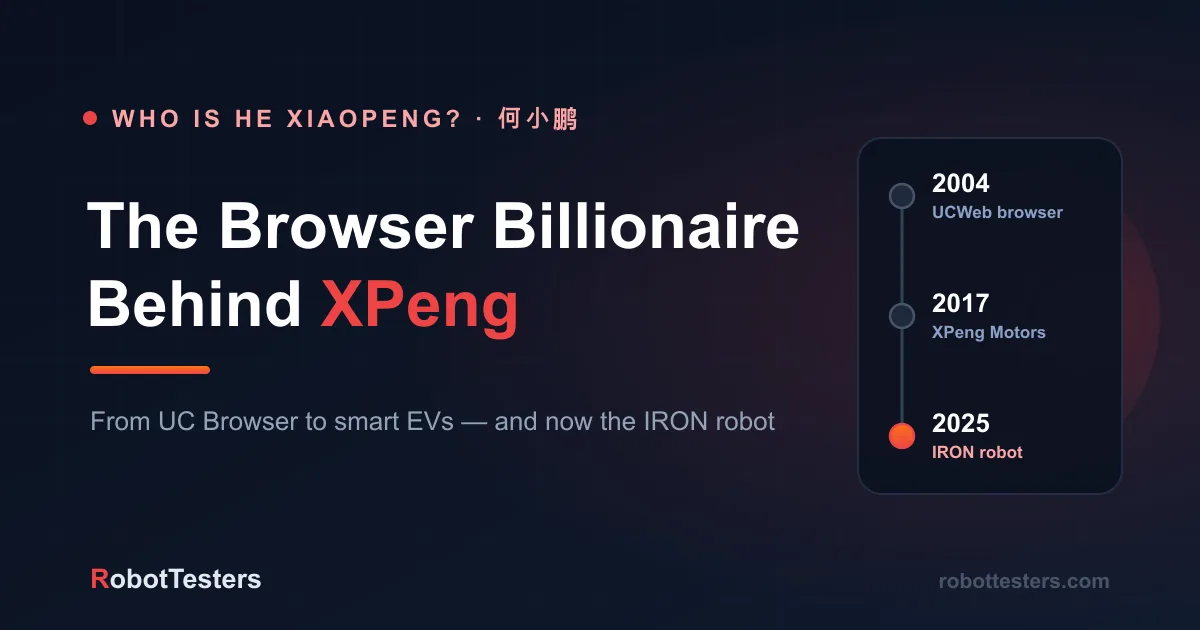
XPeng is one of China's most closely watched smart-EV makers — and, increasingly, one of the loudest voices in humanoid robots, with its IRON humanoid aiming for mass production by the end of 2026. The person who willed all of that into being isn't a car engineer or a roboticist. He's a software guy who first got rich building a mobile web browser. Meet He Xiaopeng (何小鹏) — the founder, chairman and CEO whose given name the company literally carries.
His career reads as a clean three-act story: browsers, then cars, then robots — each one a bigger, more capital-intensive bet than the last, and each built on the same stubborn conviction about owning the entire technology stack. Here's who he is, how he made his money, and how a browser billionaire ended up personally running a humanoid-robot program.
- Who: He Xiaopeng (何小鹏) — co-founder, chairman and CEO of XPeng.
- Born: November 3, 1977, Huangshi, Hubei, China.
- Studied: Computer science, South China University of Technology.
- Made his name: co-founded UCWeb (UC Browser); sold to Alibaba in 2014 for a reported ~$4.3 billion.
- Founded XPeng: backed it at its 2014 founding, took over as chairman & CEO in 2017 — the company is named after him.
- Now: personally leads XPeng's robotics unit and its IRON humanoid (since June 2026).
- Net worth: reported at around $3.6 billion (Forbes, 2026).
Who is the CEO of XPeng?
XPeng's chairman and CEO is He Xiaopeng. The important thing to grasp up front is what he is not: he's not an engineer-founder who built the core technology himself like Unitree's Wang Xingxing, and he's not a lab veteran like Boston Dynamics' Robert Playter. He's a serial internet entrepreneur who made his fortune in software and then walked into two of the hardest hardware businesses on Earth — cars, and now robots. We placed him among his rivals in who runs the humanoid robot companies.
From AsiaInfo to a browser empire
He Xiaopeng was born in 1977 in Huangshi, in China's Hubei province, and studied computer science at the South China University of Technology. He started his career as an engineer at the software firm AsiaInfo. Then, in 2004, he co-founded UCWeb with Liang Jie and led the product that made his name: UC Browser.
UC Browser is easy to overlook in the West, but at its peak it was one of the most-used mobile browsers on the planet — a default gateway to the internet for hundreds of millions of people across China, India and the emerging markets, precisely during the messy leap from feature phones to smartphones. Building it taught He Xiaopeng how to ship consumer software at enormous scale, on constrained hardware, under fierce competition — the exact skill set a modern car or robot company runs on.
The $4.3 billion exit and the Alibaba years
In June 2014, Alibaba acquired UCWeb in a deal reported at around $4.3 billion — at the time one of the largest mergers in Chinese internet history — and He Xiaopeng became a billionaire. He didn't cash out and disappear; he stayed on inside Alibaba as a senior executive, running its mobile business group, chairing Alibaba Games and heading the video platform Tudou.
By any normal measure he had already won: a landmark exit, a powerful perch inside China's biggest tech company, and nothing left to prove. In August 2017 he walked away from all of it.
He Xiaopeng's pattern is a founder's restlessness: reach the top of one industry, get bored of having won, and jump into a harder one. Software was act one. Cars were act two. Robots are act three.
Betting on cars: founding XPeng
Back in 2014, He Xiaopeng had already backed a small electric-vehicle startup founded by Xia Heng and He Tao. It carried his name — Xiaopeng Motors, known internationally as XPeng. When he left Alibaba in 2017, he took over as chairman and CEO and threw himself into it full time.
Under him, XPeng became one of China's "new force" EV makers with a very deliberate identity: a full-stack company that develops its own smart-driving software and core technology in house rather than buying it off the shelf. XPeng listed on the NYSE in 2020 and added a Hong Kong primary listing in 2021, becoming the first Chinese smart-EV maker with dual primary listings. It has since pushed into flying cars (through its AeroHT affiliate) and Robotaxi — always chasing the same idea, that the future of mobility is one integrated software-and-hardware problem. That thesis — that building cars and building robots are the same problem — is exactly why the robot exists.
The name everyone told him to change
Here's a detail that says a lot about him: XPeng is literally his own name. "Xiaopeng" (小鹏) is He Xiaopeng's given name — and in China, badging a company with your own name is not the flex it is in the West. It is often read as egotistical or provincial, the mark of a small family-run shop rather than a serious national brand. He has said that for seven or eight years, friends kept urging him to rename the company, insisting sales would jump if he did. (The founding team had first wanted to call it "Orange," but that trademark was already taken.)
He never changed it — and at the July 2026 Munich launch he answered the critics on their own turf. Standing in the country whose carmakers famously carry their founders' names — Porsche, Benz, Ford, Honda — he reframed the whole thing: putting your own name on a product, he argued, is a mark of "confidence and responsibility," not ego. Staking your family name on what you build is a public promise that you will stand behind it.
In China they mocked him for naming the company after himself. In Germany — the home of Porsche and Mercedes-Benz — the same choice reads as the opposite: a founder putting his name, and his reputation, on the line.
From robot ponies to IRON
XPeng's robots did not start as humanoids. Back in 2016 the company set up a robotics arm, Pengxing Intelligence (鹏行智能, also branded XPeng Robotics) in Shenzhen — one of the earliest Chinese teams to work seriously on legged robots. Its first attention-grabbing product was not a worker but a toy: a rideable robot pony for children, nicknamed "Little White Dragon," which helped the unit raise a $100 million Series A led by IDG Capital in 2022.
From that quadruped lineage, XPeng pivoted to a bipedal humanoid: IRON. A first-generation IRON appeared at XPeng's 2024 AI Day, and a dramatically more human-like next generation debuted at its November 2025 AI Day. It stands about 178 cm, weighs roughly 70 kg, and packs a biomimetic spine, a flexible outer skin, a 3D curved-display head, hands with 22 degrees of freedom, three of XPeng's own Turing AI chips (2,250 TOPS) and its second-generation VLA model. XPeng is targeting mass production from the end of 2026, more than 1,000 units a month, and a 2027 rollout — a plan it brought to Europe at its Munich launch.
IRON also produced one of the strangest moments in robotics of the year. Its 2025 catwalk was so fluid and lifelike that some viewers were convinced a human in a costume was inside. To kill the rumor, XPeng literally cut one of the robots open on stage to show the joints and wiring underneath. It was equal parts confidence and damage control — and very on-brand for a founder who likes a spectacle.
Taking personal command of the robots
In June 2026, He Xiaopeng did something telling: after the robotics unit's product chief resigned, he took direct personal charge of the division, effectively naming himself its "CEO," and committed the company to spending around RMB 7 billion (about $1 billion) on physical-AI research in 2026. Around the same time he rejoined the Alibaba orbit by taking a seat on the board of Ant Group. We covered what that reshuffle really means in He Xiaopeng takes command of XPeng's robots.
When a billionaire founder puts his own name on a division and a billion dollars behind it, the deadlines stop being marketing and start being personal. It is the clearest signal yet that XPeng's robot program is not a side project.
His strongest card, and his biggest exposure
Strip away the headlines and the case for He Xiaopeng — and the worry about him — both come into focus:
- Manufacturing muscle. Unlike a startup founder, he already runs factories that build a complex, safety-critical product at scale. If humanoids really are "cars with legs," few people are better positioned to mass-produce them.
- Vertical integration. Owning the chips, the software and the hardware is the same playbook he ran at XPeng and the same one Tesla runs — a deliberate bet that the winners will control the whole stack.
- Patience and capital. He has funded robotics since 2016 and can pour a billion dollars a year into it. This is a marathon, and he has the balance sheet to keep running.
- The risk: the pattern of overpromising. XPeng's robotics arm once suggested household robots were only "two years" away — back in 2022. The gap between a viral catwalk and a robot that can actually hold down a job is the whole game, and it's the same gap we keep flagging in how you actually test a humanoid robot. His paper fortune has also swung violently with XPeng's share price through China's EV price war — a reminder that the money funding all this is not guaranteed.
Whether XPeng becomes a defining humanoid company or an overstretched one, the through-line is one man's conviction, executed across three industries and funded by a browser. In a field full of engineer-founders and lab veterans, He Xiaopeng is something rarer: a consumer-software billionaire who treats "build a humanoid" as simply the next, hardest company to build. That's worth understanding.
He Xiaopeng's career, summarised
| Full name | He Xiaopeng (何小鹏) |
| Role | Co-founder, chairman and CEO of XPeng |
| Born | November 3, 1977, Huangshi, Hubei, China |
| Education | Computer science, South China University of Technology |
| First company | UCWeb / UC Browser (co-founded 2004; sold to Alibaba 2014, reported ~$4.3B) |
| Founded XPeng | Backed 2014; chairman & CEO from 2017 (NYSE 2020, HKEX 2021) |
| Robotics | Leads XPeng's robotics unit and the IRON humanoid (personally, since June 2026) |
| Net worth | ~$3.6 billion (Forbes, 2026) |