
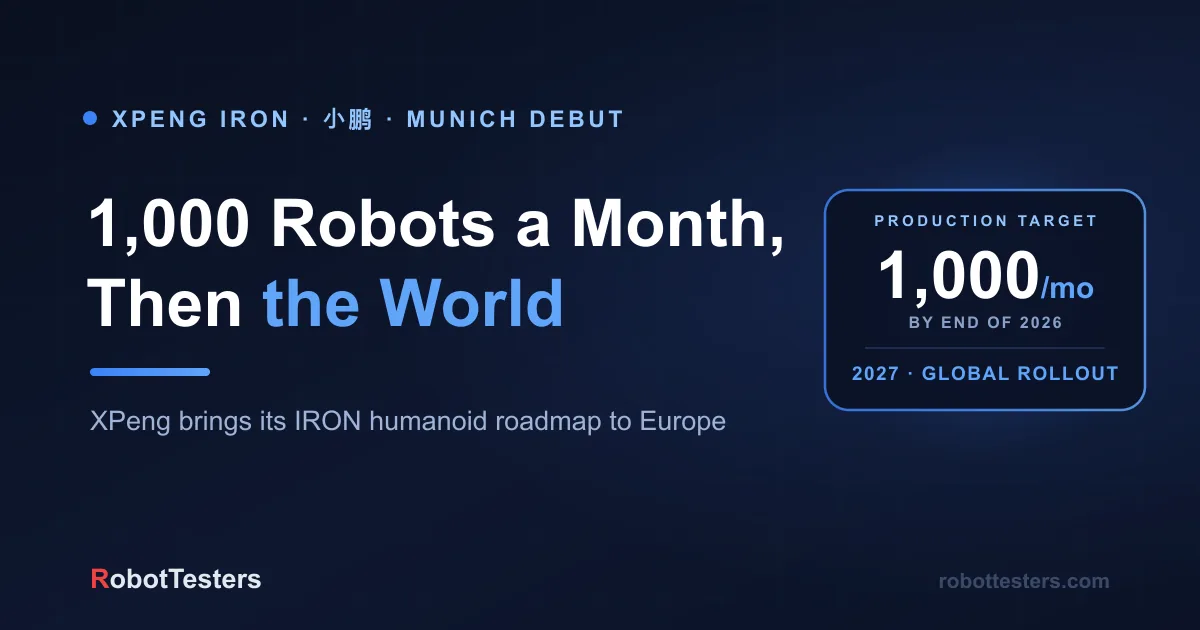
XPeng used its European coming-out party to make a robot promise. At the mid-July 2026 world premiere of its MONA L03 electric car in Munich — the first time the Chinese automaker has staged a global EV launch outside China — XPeng put fresh numbers on IRON, its humanoid robot: a manufacturing capacity of more than 1,000 units a month by the end of 2026, mass production beginning at year-end, and a global rollout in 2027.
And IRON's first job won't be a factory or a living room. XPeng plans to put the robot to work inside its own business — standing in its showrooms and offices, greeting visitors and answering customers' questions about its cars. It is a deliberately modest debut for a machine wrapped in a very immodest ambition, and it tells you exactly how XPeng thinks the humanoid era actually starts.
The event: XPeng launched its MONA L03 EV in Munich in mid-July 2026 — its first world premiere outside China — and used the stage to bring its IRON humanoid roadmap to Europe.
The numbers: a target of 1,000+ IRON units a month by the end of 2026, mass production starting at year-end, a 2027 global rollout, and a stated ambition of ~1 million units a year by 2030.
The first job: from Q1 2027, IRON is slated to work as a showroom sales assistant in China — answering vehicle questions — before overseas stores and office reception roles later that year.
The caveat: these are XPeng's own targets. A scripted greeter in a controlled showroom is a long way from an autonomous, general-purpose humanoid — and RobotTesters has not tested a unit.
What XPeng Announced in Munich
The headline in Munich was a car, not a robot. XPeng chose Germany — in He Xiaopeng's framing, the "cradle of the automotive industry" — to hold the first world premiere of an XPeng EV outside China, unveiling the MONA L03 to a European audience and pairing it with a new Munich R&D center, the company's first in Europe. It was a statement of intent from a Chinese brand that wants to be taken seriously on Western roads.
But XPeng is no longer only a car company, and it used the European stage to carry its robot story west. IRON itself was fully revealed back at XPeng's AI Day in November 2025; what the mid-July 2026 push added was a firmer set of production and deployment numbers, delivered to a Western audience for the first time. For a company arguing that building cars and building robots are the same problem, launching both on the same stage is the whole point.
The Production Math: 1,000 a Month by the End of 2026
Here is the number that matters. XPeng is targeting a manufacturing capacity of more than 1,000 IRON units per month by the end of 2026, with mass production beginning around year-end and a broader global rollout in 2027. Longer term, the company has floated an ambition of roughly one million units a year by 2030. The robots are to be built at a new Guangzhou facility spanning about 110,000 square meters, on which construction began in the first quarter of 2026.
It is worth being precise about the timeline, because it is easy to garble. The "1,000 a month" figure is a capacity milestone for the end of 2026, not the start of the assembly line — and 2027 is the deployment year, when those robots actually start showing up in the real world. In other words, 2026 is when XPeng wants to be able to build them at rate; 2027 is when it wants them working.
If XPeng hits it, 1,000 humanoids a month is not a demo cadence — it is a car-industry cadence. That is exactly the comparison XPeng wants you to draw.
A thousand units a month would put XPeng among the most aggressive humanoid manufacturers in the world — in the same conversation as Tesla, UBTech and AgiBot. Whether any of these targets survive contact with reality is a separate question; we pulled the industry's stated numbers apart in our humanoid production forecast for 2026 and 2027, and the consistent pattern is that announced capacity and shipped units are very different things.
IRON's First Job: Answering Questions on the Showroom Floor
The most revealing part of XPeng's plan is not the factory — it is the first assignment. From the first quarter of 2027, XPeng intends to deploy IRON as a sales assistant in its own China showrooms: greeting visitors, walking them through the cars, running interactive presentations and answering questions about vehicle specifications. Overseas stores are slated to follow later in 2027, and the company has also described reception, visitor check-in and front-desk roles for IRON inside its offices and corporate campuses, where the robot's 3D curved-display face is meant to make it more expressive in a professional setting.
This is a smart, honest choice, and it is worth understanding why. A car showroom is a near-perfect first habitat for a humanoid: it is a controlled, mapped, well-lit space; the questions are predictable and can be scripted; the robot doubles as the most eye-catching piece of marketing on the floor; and every interaction generates data XPeng can use to improve the product. It is the same instinct behind the early-adopter window we've argued is now open — start where the environment is forgiving, then expand outward as the software catches up.
It is also a long way from the fantasy. A robot that answers "what's the range on this trim?" in a showroom is a customer-service kiosk with legs — genuinely useful, but categorically different from a machine that folds your laundry or works a warehouse shift. XPeng knows this; its own sequencing puts showroom greeting first, industrial work later, and the household — with a price He Xiaopeng has only vaguely described as eventually "similar to car prices" — later still.
What IRON Actually Is
The next-generation IRON that anchors all of this is a genuinely ambitious piece of hardware — at least on paper. XPeng designed it to be as human-like as possible: it stands about 178 cm and weighs roughly 70 kg, moves on a biomimetic spine and muscle system under a fully flexible outer skin, and wears a 3D curved display for a face. Its brain is three of XPeng's own Turing AI chips delivering a combined 2,250 TOPS, running the company's second-generation VLA (vision-language-action) model.
| Height | ~178 cm |
| Weight | ~70 kg |
| Hands | 22 degrees of freedom |
| Compute | 3× XPeng Turing AI chips (2,250 TOPS total) |
| AI model | XPeng second-generation VLA (vision-language-action) |
| Power | All-solid-state batteries |
| Body | Biomimetic spine + muscle system, fully flexible skin, 3D curved-display head |
| Mass production | From end of 2026 (target >1,000 units/month) |
| First deployment | China showrooms, Q1 2027; overseas stores later 2027 |
| Price | Not announced (He Xiaopeng: eventually "similar to car prices") |
Two caveats travel with every line of that table. First, these are manufacturer figures — RobotTesters has not tested a unit, and a TOPS count or a degrees-of-freedom spec tells you what a robot could do, not what it reliably does on a real task. Second, "all-solid-state batteries" at scale is itself an aggressive claim; the whole car industry is still fighting to mass-produce them.
The "Apple of Robotics" Bet
Underneath the numbers is a strategy. XPeng is openly reaching for the "Apple of robotics" comparison: it wants to own the entire stack — the chips, the joints, the hands, the operating system and the physical hardware — rather than bolt together parts from suppliers. It is the same vertical-integration thesis that XPeng, like Tesla, already applies to cars, and it is betting that a decade of squeezing cost and complexity out of EV manufacturing transfers directly to humanoids.
The company is backing that with money and with its own CEO's time. XPeng expects to spend around RMB 7 billion (about $1.03 billion) on physical-AI R&D in 2026, and in June 2026 He Xiaopeng took personal charge of the robotics unit after its product chief resigned — a move we covered in He Xiaopeng takes command of XPeng's robots. When a founder-CEO puts his own name on a division and a billion dollars behind it, the deadlines stop being marketing and start being personal.
The Honest Caveats
Now the cold water. IRON's public track record is not spotless. At one appearance the robot face-planted on stage; at another, its walk looked so uncannily smooth that viewers accused XPeng of hiding a person in a costume — a rumor the company only killed by literally cutting a unit open on camera to show the machinery inside. Those are the growing pains of a machine being pushed hard in public, but they are also a reminder that the gap between a polished stage moment and dependable autonomy is wide.
The deeper caveat is the one that applies to the whole field: the hard part of a humanoid is not the body, it is whether it can do a real job without a human quietly driving it. At ICRA 2026, plenty of the show-floor humanoids turned out to be running on a joystick, and the only way to separate a genuine deployment from a demo is to measure autonomy, endurance and success rate over time — the framework we laid out in how you actually test a humanoid robot. A scripted showroom Q&A is a sensible place to start precisely because it minimizes those unknowns; it does not resolve them.
And every figure in this article is XPeng's own. "More than 1,000 a month by the end of 2026" is a target announced by a company launching a car, not an audited production number — and the humanoid industry's recent history is a graveyard of confident capacity forecasts. Treat the roadmap as a statement of ambition, and judge XPeng on the first thousand robots that actually show up on a showroom floor.
XPeng's plan is the most credible-sounding humanoid roadmap of the summer — because it starts small on purpose. Building at a car-industry cadence and then deploying the first robots as showroom greeters is exactly the kind of unglamorous, controlled first step that a company with real manufacturing discipline would take. It is a world away from promising a robot butler in your kitchen next year.
The risk is that the two halves of the pitch don't match. The manufacturing ambition (1,000 a month, a million a year, an "Apple of robotics" stack) is enormous; the first use case (answering car questions in a store) is tiny. The whole bet is that XPeng can ride that modest, data-rich beginning up the curve fast enough to justify the factory it is building.
The honest summary: XPeng didn't come to Munich to sell you a robot — it came to prove it can build them like cars. If it ships even a few hundred IRONs into its own stores in 2027, doing a genuinely useful, genuinely autonomous job, that will be a bigger milestone than any stage demo. Until then, this is a very well-funded promise.