
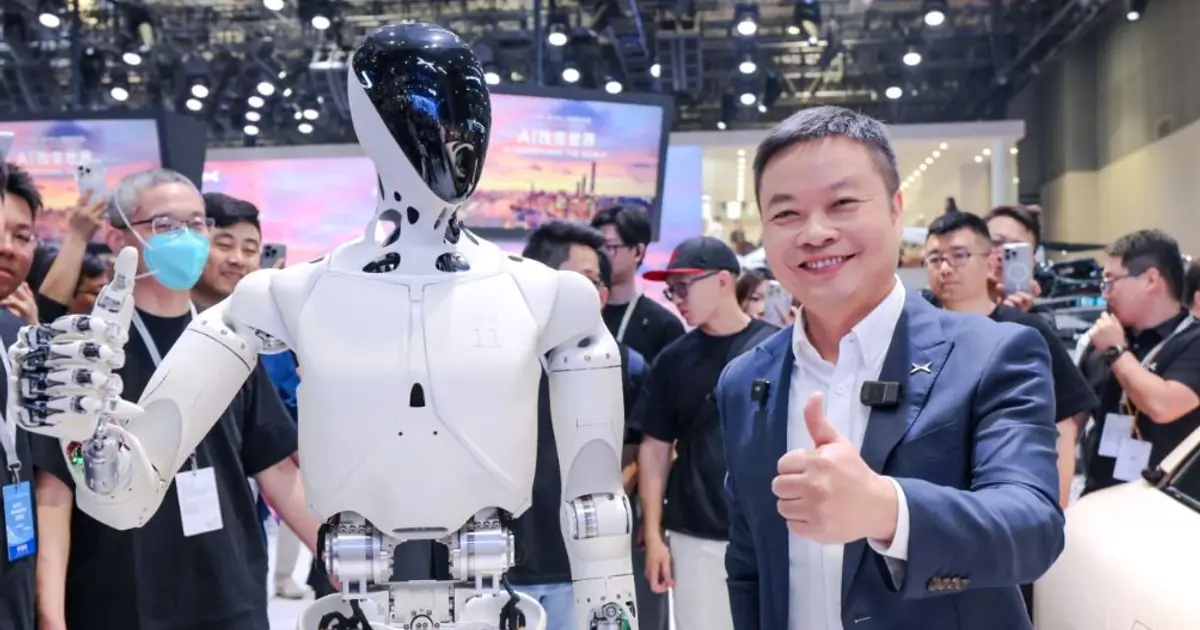
In early June 2026, XPeng's robotics business lost the person who had built it. Shi Xiaoxin, the core product chief of the company's humanoid effort, resigned after 1,675 days — nearly four and a half years — spent designing IRON's product from the ground up. Days later, on June 10, co-founder and chairman He Xiaopeng told staff in an internal letter that he would take the unit over himself, signing off as the robotics business's "CEO" — the quotation marks his own, because the division has not been spun out as a separate company.
On paper it's a personnel change. In practice it lands at the worst possible moment — with mass production promised for the end of this year and a robot that has, very publicly, fallen on its face. That combination has set off a wave of speculation about what really happened, and what comes next for one of the most-watched humanoid programs in the world.
- Who left: Shi Xiaoxin, core product chief of XPeng Robotics, after ~4.6 years. No official reason given.
- Who's in charge now: He Xiaopeng, running robotics directly as its "CEO" — the unit is not separated from XPeng Group.
- Why it matters: XPeng has promised IRON mass production by the end of 2026, with deliveries in 2027.
- The backdrop: IRON face-planted at a public demo in Shenzhen in January 2026.
What actually happened
Shi Xiaoxin wasn't a mid-level manager passing through. By the accounts circulating in Chinese tech media, he was a benchmark veteran who had been there since the early days, carrying XPeng's humanoid effort through its messy integration into the main group and building its product system from scratch. 1,675 days is the kind of tenure you only get by being there from the start — and it's exactly why his exit raised eyebrows rather than shrugs. XPeng offered no official reason, and reports describe the move as sudden; he is said to have turned down approaches from rival robotics firms and new carmakers, planning instead to simply rest.
He Xiaopeng's response was not to hire a replacement but to take the wheel himself. We flagged the move the moment it happened in our profile of the people running the humanoid companies: when a founder personally runs a unit, that unit gets his calendar, his political capital and first claim on resources. It is, simultaneously, the strongest possible vote of confidence and an admission that the project is too important to leave to anyone else right now.
Why the timing has people nervous
Strip away the drama and the anxiety is really about a calendar. XPeng has staked a lot on a brutal timeline:
| When | Milestone |
|---|---|
| Nov 2025 | New-generation IRON unveiled, with in-house chips and a solid-state battery |
| Jan 2026 | First prototype built to automotive manufacturing standards |
| Q1 2026 | Construction begins on a 110,000 m² robot production base in Guangzhou |
| Early Jun 2026 | Product chief Shi Xiaoxin resigns |
| Jun 10, 2026 | He Xiaopeng takes direct control of the robotics unit |
| End 2026 | Target: large-scale mass production of IRON |
| 2027 | Target: first customer deliveries |
Losing the person who owns the product roadmap with barely two quarters left on the clock is the sort of thing that rattles a team — and the market. The bull case for XPeng has always been that it can apply a car maker's manufacturing discipline to humanoids; we made that argument ourselves in XPeng Iron: building cars and building robots are the same problem and again in our humanoid production forecast. But manufacturing discipline assumes the product is locked. A late-stage leadership change invites the question of whether it is.
There's a human layer to it too, and it's the part that fuels the most speculation. Here is someone who spent four and a half years building this thing — and who is now stepping away just before it's born. Nobody pours that much of themselves into a project and casually skips the finish line. So people are left guessing: did he simply burn out, or did something about the plan change under him? XPeng isn't saying, and into that silence the theories rush.
The robot is still learning to walk — literally
The nerves aren't only about org charts. They're about what people have actually seen IRON do. At a public debut at MixC Shenzhen Bay on January 31, 2026, IRON walked out in front of a crowd, twisted its torso in an unnervingly unnatural way, and face-planted onto the floor with an audible thud. It took three people to carry the 70-kilogram machine off, and the next day's demo had the robot strapped to a support frame. He Xiaopeng addressed the fall on Weibo with a line that, in hindsight, reads like foreshadowing:
"It reminds me of how all toddlers learn to walk. After a fall, they will stand firm; the next step is to begin running, and to keep running."
It's worth being fair here: XPeng's bigger problem at earlier shows was the opposite one. IRON's gait was so smooth that viewers accused the company of putting a human in a costume — to the point that XPeng cut open the robot's back on camera to prove there were actuators, not a person, inside. A company that has to prove its robot isn't too good, and then watch it topple over weeks later, is a company still living on the knife-edge between demo and product. That's the real backdrop to the leadership change, and it's the same gap between stage and reality we keep coming back to across the whole humanoid field.
Why a founder takes the wheel himself
Step back and the move looks less like panic and more like pattern. Founders who have already done one hard, capital-intensive, manufacturing-heavy thing tend to reach for the same playbook the second time — and He Xiaopeng has done exactly that with cars. Taking direct control concentrates decision-making, kills internal politics, and signals to suppliers and staff that robots are now a company-defining bet, not a side project. He has rebranded XPeng as a "global embodied-intelligence company"; you don't say that and then delegate the embodied intelligence.
It also rhymes with the other car maker chasing this exact prize. Elon Musk treats Optimus as a personal mission and frames cars and robots as one and the same autonomy-plus-manufacturing problem — a thesis we unpacked in the car makers' humanoid race. He Xiaopeng grabbing the wheel of XPeng robotics is the same instinct, and it quietly turns Tesla-vs-XPeng into a humanoid rivalry as much as an EV one.
Our read
Let's be honest about the risk, because pretending it isn't there would be the marketing-speak this site exists to avoid. A founder-veteran walking out months before launch is a genuine loss of institutional knowledge, it can dent morale, and the on-stage stumbles prove IRON is not a finished product. Anyone telling you this is purely good news is selling something.
And yet — the more I sit with it, the more bullish the underlying signal looks. A CEO doesn't take personal, hands-on command of a unit he intends to wind down. He does it for the thing he most wants his name on. Everything about how He Xiaopeng talks about robots — the toddler metaphor, the "embodied intelligence" rebrand, the refusal to spin the division off and lose control of it — reads like a founder chasing the project he's most excited about in years. My personal bet is that this is his real passion, and that humanoids are going to be one of the markets that dominates the conversation over the next two years. If anyone can drag a half-finished "baby" across a punishing finish line, it's a founder who has already turned a startup into a globally listed car company once before.
So the honest summary is this: higher risk and higher conviction at the same time. The team lost the person who built IRON, but it gained the one person at XPeng with the authority to move heaven and earth to ship it. Q4 2026 just became the most interesting quarter in humanoid robotics — and we'll be watching it closely.