
Something quietly changed in robotics this year, and most people missed it. For the first time, you can walk up, pay, and take home a general-purpose humanoid robot — if you are the kind of person who accepts that version-one hardware is rough, buggy and unfinished. The industry has opened its doors to early adopters. It has not yet opened them to everyone else, and the gap between those two moments is the most important thing to understand about robots in 2026.
Here is the honest state of play in one breath. The bodies are extraordinary: today's humanoids run, climb stairs, catch their balance on gravel and work a factory line. The brains are not there yet: reliably picking up an unfamiliar object, holding a real conversation, and doing a chore exactly as you asked — without a human quietly driving it — remain unsolved. Robots have crossed the line from "lab curiosity" to "buyable pioneer tool." They have not crossed the line to "trust it with your home." My estimate is that second crossing is two to five years away, and the machines most likely to make it happen are Tesla Optimus and XPeng IRON.
Key takeaways
- The window is open: you can buy a humanoid today (Unitree R1 at $4,900, G1, Booster T1, LimX Oli), but as a developer-grade pioneer tool — not a finished appliance.
- Bodies lead, brains lag: locomotion is largely solved; manipulation, conversation and following freeform instructions are the real bottlenecks.
- Optimus and IRON are the chasm-crossers: both come from mass-manufacturers targeting consumer prices, and are the machines most likely to become the first robots people truly trust — though both are still unproven.
- The pioneer window is ~2–5 years: after that, the "wait for it to be perfect" majority arrives and the easy positioning is gone.
- Our call for professionals: if you want to build a business on robots, move now. The platforms, standards, data and service networks are being set today — the cheapest entry ticket you'll ever get.
What "open for early adopters" actually means
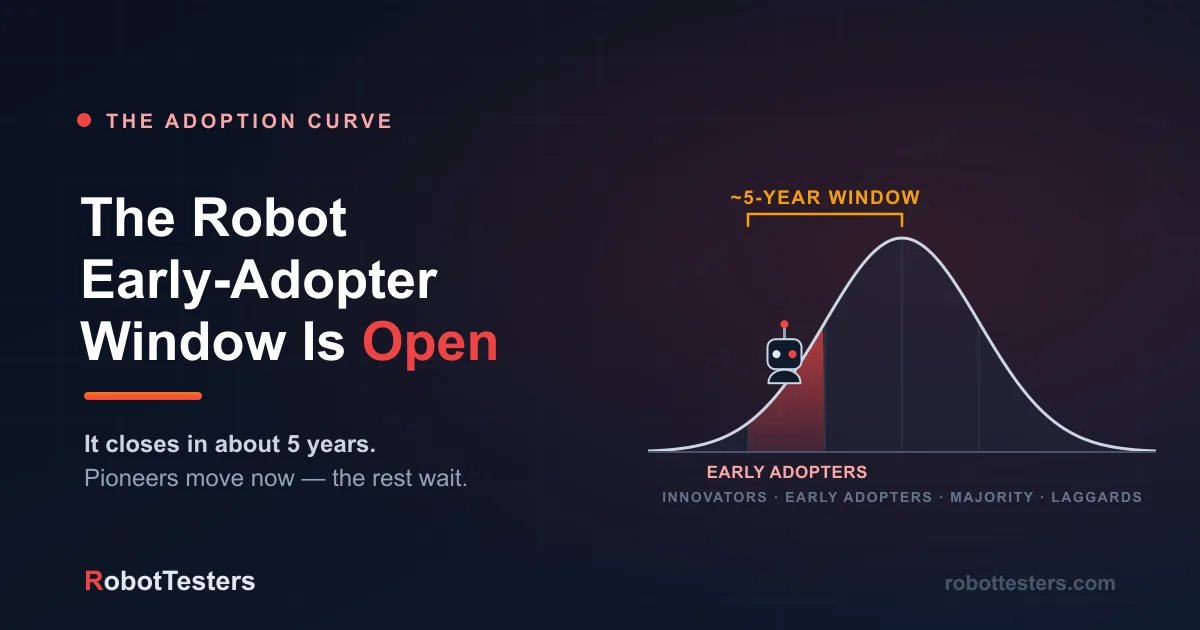
Every world-changing technology moves along the same curve. Sociologist Everett Rogers mapped it decades ago and Geoffrey Moore made it famous in business: first come the innovators, then the early adopters, then — across a stubborn gap Moore called "the chasm" — the early majority, the late majority, and finally the laggards. The personal computer, the web, the smartphone and the electric car each walked this exact path. Robots are now taking their first real steps along it.
In 2026, humanoid robots sit right at the early-adopter band. You are no longer limited to watching demos on a screen — you can own the machine. The humanoids you can actually buy right now include Unitree's $4,900 R1 and G1, Booster Robotics' $33,949 T1 and LimX Dynamics' Oli from about US$21,800. But read what those products are: they are sold to developers, researchers, universities and enthusiasts. They are programmable platforms you help mature, not appliances that already fold your laundry. That distinction is the whole story.
"An early-adopter product isn't a finished thing you consume. It's an unfinished thing you help finish — in exchange for a head start nobody can sell you later."
This is exactly the phase the iPhone was in around 2008, or the web around 1996. The thing worked, barely, for people willing to tolerate the rough edges — and those people learned a landscape before it filled up. That is what "open for early adopters" means for robots today: the door is open, the room is nearly empty, and the price of admission is patience.
The bodies are ready. The chores, the talk and the trust are not.
If you only watched the highlight reels, you would think robots had already arrived. They dance, they do backflips, they run half-marathons, they carry boxes across a warehouse. And it's real — locomotion is the part that's largely solved. Making a machine walk, balance and move like a person is no longer the hard problem. That's why the demos are so seductive.
The trouble is that a home doesn't need a robot that can backflip. It needs a robot that can pick up your specific mug from your cluttered counter, understand "can you tidy this up before my parents arrive," and get it right without supervision. That is three separate unsolved problems stacked on top of each other:
Grasping and handling arbitrary objects in a messy, unpredictable space. Walking is solved; reliable hands in the real world are not — and this is the single biggest gap.
Being told a task in plain language and actually parsing what you meant, including the parts you left unsaid. Chatbots talk well; robots that talk and then correctly act are rare.
Doing a task it wasn't explicitly trained for, in a home it has never seen, without a human quietly steering it through the hard bits.
At ICRA 2026, many humanoids on the show floor were still teleoperated by a human with a controller — the honest signal of where autonomy really is.
This is why our whole testing methodology ignores the backflip and asks harder questions: how autonomous is it really, how long does it last on a charge, what's its success rate on the tenth try, does it generalize, and does it recover when things go wrong? A polished demo answers none of those. A robot you can trust in your home has to answer all of them. In 2026, none can — and that's not a criticism, it's a timestamp.
Optimus and IRON: the machines built to cross the chasm
So which robots turn "buyable for pioneers" into "trustworthy for everyone"? The two carrying the highest expectations both come from companies that already mass-produce complex machines for consumers: Tesla and XPeng. That's not a coincidence. Crossing the chasm isn't only an AI problem — it's a manufacturing, cost and distribution problem, and carmakers are unusually good at exactly those.
Tesla Optimus is the most-watched robot on Earth for a reason: it inherits Tesla's manufacturing flywheel, its self-driving data and compute stack, and a stated ambition to build at car scale for a target price of $20,000–$30,000. If any company can drive a capable humanoid down to a mass-market price, it's this one. The honest caveat is that the brain lags the body: Optimus Gen 3's custom AI5 chip only taped out in April 2026 and won't reach volume until 2027, so the machine meant to be trustworthy is still waiting for the compute that would make it so.
XPeng IRON is built on a blunt thesis: building cars and building robots are the same problem — mass-market autonomy, at scale, at a price. XPeng is targeting mass production of IRON by the end of 2026. But it, too, is unproven in the most literal way: the robot face-planted on stage recently, its robotics product chief resigned after 1,675 days building IRON from scratch, and CEO He Xiaopeng then took personal control of the unit. That is what a company looks like when it's sprinting through the hardest part of the curve.
Neither is a sure thing. But this is the point: they are the first humanoids where the goal isn't a viral clip, it's a product you could hand to your parents. When either one ships a robot that does real household tasks reliably, at a price a normal family will pay, the early-adopter window starts to close — because the early majority finally has a reason to walk through the door.
The 2–5 year window: pioneers vs. the wait-for-perfect crowd
Here's how the next few years split. On one side are the pioneers — the people and businesses who buy version one, live with the bugs, and learn the terrain while it's still empty. On the other are the wait-and-see majority — the sensible, patient people who will buy a robot the way most people bought their first smartphone: once it was obvious, polished and safe. Both are rational. They just pay for their choice in different currencies — one in patience and risk, the other in lost position.
| Dimension | Pioneer (buys now) | Wait-and-see (buys later) |
|---|---|---|
| The product they get | Rough, buggy, frequently updated, quickly outdated | Polished, reliable, cheaper, mature |
| What they pay | More money, more patience, real risk | Less money, less risk — but years later |
| What they learn | The platform, the tooling, the ecosystem, first-hand | A finished product everyone already understands |
| Market position | Front of the line | Back of the line |
| Best fit for | Developers, founders, integrators, tinkerers | Most consumers and risk-averse businesses |
For an ordinary household, waiting is completely defensible — I'd tell my own family to wait. But "wait" is the wrong answer for one specific group, and that's who the rest of this article is for.
Why professionals should move now, not later
Here is RobotTesters' actual position, stated plainly: if you are a professional who wants to build a business on robots, you should start now — not when the robots are perfect. Wait for perfection and you won't be early to a mature market; you'll be late to a crowded one. The reason is that the parts of this industry that get locked in — the platforms, the app stores, the standards, the service networks, the training data — are being decided during exactly this messy, pre-perfect phase. They are cheapest to influence before they harden, and impossible to influence after.
The best part: you don't have to build a robot to get in. The same thing happened with the smartphone. The people who got rich from the iPhone mostly didn't make phones — they made apps, accessories, services and businesses on top of a platform someone else shipped. The developers who moved in 2008–2010 captured positions latecomers never recovered. Robotics is at that moment now, and here are the on-ramps that don't require a hardware lab:
The app-store layer for robots is forming now (Unitree's store is an early example). A useful "skill" — a task a robot can download and perform — is a product you can build today on hardware that already ships.
Someone has to install, integrate, maintain and repair these machines. Fleet operations, robot-as-a-service and on-site support are boring, real businesses that scale with every unit sold.
Real-world manipulation data is the scarce fuel of this whole field. Collecting it — often by teleoperating robots — is a genuine business precisely because autonomy isn't solved yet.
Packaging a robot for one industry — hospitality, security, elder care, retail — is where the near-term money is. So is the training, media and expertise that helps everyone else catch up.
This isn't a lone-optimist take. It's the same conclusion we reached from the numbers: robots are the next global trend after AI, and 2026 looks like the entry point. The forecasts are loud — Morgan Stanley keeps raising its 2026 estimate (now 50,000 humanoids for China alone), and long-range scenarios run to a trillion-dollar-plus market and tens of millions of machines in use by 2035. Forecasts are not guarantees. But you don't wait for a boom to be confirmed before you enter it — by then the entering is over.
"The window to be early doesn't close when robots get good. It closes when everyone else realizes robots are about to get good."
The honest risks (go in with your eyes open)
Moving early is not the same as moving blind. If you're going to be a pioneer — as a buyer or a builder — you should price in the risks that come with the territory, because they're real:
| Risk | What it means for a pioneer | Severity now |
|---|---|---|
| Reliability | Version-one machines break, stall and need supervision; don't rely on one for anything critical | High |
| Obsolescence | What you buy this year is superseded fast; treat it as a learning platform, not a decade-long asset | High |
| Cost | You pay a premium for being first, in money and in time spent tinkering | Medium |
| Safety & liability | Rules for capable home robots are still forming; the responsibility for a mishap isn't fully settled | Medium |
| Regional lag | Adoption is uneven — momentum is real in China and the US, slower in Europe | Medium |
That last one deserves a flag for our European readers. Having spent 45 days with a first robot of my own, my honest read is that the robot future feels imminent almost everywhere except Europe, where regulation and slower commercial rollout mean the hardware arrives late. If you're building here, that's a headwind to plan around — and, arguably, an opening, because less competition is also less crowded.
There's a governance dimension too. China is already moving to give every humanoid a 29-character digital ID, a lifecycle passport from factory to scrapyard. Whoever writes the rulebook — identity, safety, liability — shapes the market, and right now that's being drafted in real time. Being early means being in the room while it's written.
How to read this window if you're deciding right now
Strip away the hype and the decision is simple, and it depends entirely on who you are:
If you're a household weighing whether to buy a humanoid for chores: wait. The trustworthy, plug-and-play home robot is a 2-to-5-year story, and the sensible money buys the third version, not the first. Enjoy the companion robots and robot pets that already work today, and let the humanoids mature.
If you're a professional — a developer, a founder, an integrator, an investor of time or money — the calculus flips. The market is unformed, the platforms are up for grabs, the data is scarce and valuable, and the incumbents haven't been chosen yet. That is the definition of an opening, and it does not stay open. Start small, start now, and treat the rough edges as the price of a front- row seat.
The robots on sale in 2026 will look primitive in five years, the way a 2008 smartphone looks now. That's not a reason to dismiss them. It's the reason to pay attention. The early-adopter window is the only time you can be early — and for the people whose job is to build the future, being early is the whole game.