
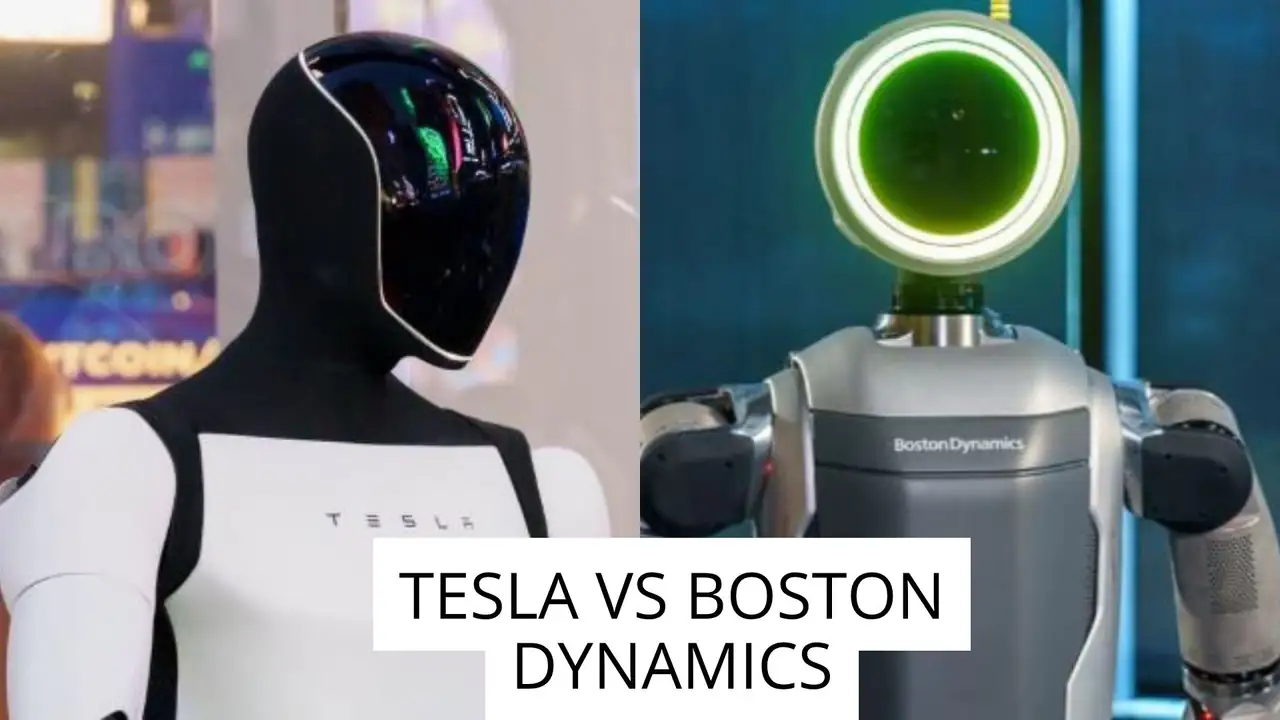
Twenty-five years ago, if you had told me that in 2026 I would be sitting down to write a head-to-head comparison between the world's most technically capable humanoid robot and a challenger aiming to undercut it by a factor of five, I would have assumed you were summarising an Asimov novella. But here we are.
On one side: Boston Dynamics Atlas, the fully electric humanoid that arrived at CES 2026 representing more than a quarter-century of robotics research, the most capable machine of its kind ever built. On the other: Tesla Optimus Gen 2, a robot that still doesn't have a confirmed commercial price, a public delivery timeline, or an open SDK — and that might still turn out to be the most important robot in history.
This is not a normal product comparison. These two machines represent entirely different philosophies about what a humanoid robot is for, who should build it, and how you get from prototype to world-changing scale. Let me try to do both of them justice.
What Atlas Actually Is
Boston Dynamics has been building robots for longer than most of its current competitors have existed as companies. Atlas, in its current fully electric form, is the culmination of that history. At 1.5 metres tall and 89 kg, it is not designed to pass for human — it is designed to outperform one. The numbers are remarkable: 56 degrees of freedom, a 50 kg arm payload, a 2.3-metre reach, and a top speed of around 1.8 m/s. The custom Hyundai Mobis electric actuators replaced the old hydraulic system entirely, making Atlas cleaner, quieter, and more precise than any previous iteration.
The single most interesting engineering decision in Atlas is the self-swapping battery. Atlas can replace its own battery pack autonomously, which means — in theory — it never needs to stop working between shifts. For warehouse and manufacturing deployments, the economics of zero downtime are transformative. It is the kind of detail that looks like a footnote in a press release and turns out to be a competitive moat.
Atlas went into production immediately after CES 2026, backed by Hyundai's manufacturing infrastructure. A 30,000-unit-per-year factory is planned for 2028. This is not a startup with a demo robot — this is one of the world's largest automakers putting its manufacturing weight behind a humanoid robot product.
What Tesla Optimus Actually Is
Tesla Optimus Gen 2 is a different kind of machine making a different kind of bet. At 172 cm and ~57 kg, it is lighter than Atlas, taller, and considerably less powerful on paper. Its 28 degrees of freedom are less than half Atlas's 56. Its top speed is currently around 0.5 m/s — a slow walk. Its arm payload of ~20 kg is less than half of Atlas's 50 kg lift.
But Tesla isn't building a robot company. They are extending an AI and manufacturing company into a new physical form factor. The same FSD neural network that guides Tesla vehicles — trained on real-world data from millions of cars — feeds directly into Optimus's vision system. The same Dojo supercomputer used to train driving models is being retooled for manipulation and locomotion. And Optimus has been running inside Tesla's own factories for months, generating real-world training data that no competitor can easily replicate.
Where Atlas has the better hardware, Optimus has the better pipeline. Tesla's reported Gen 3 design pushes each hand to 22 degrees of freedom with a tendon-driven architecture that moves the actuators up into the forearm — a claimed step-change in dexterity over the 11-DOF hands of Gen 2. The ability to grip an egg and a metal bolt with appropriate force, adjusting in real time, is a problem that has quietly defeated most robotics programmes. Tesla hasn't shipped this in volume, and every Gen 3 figure below is reported or Musk-claimed rather than independently confirmed — but the hand development direction shows a different quality of progress than what existed five years ago.
The other headline Gen 3 claim is the brain. Tesla intends to run Optimus on its own custom AI5 inference chip, with xAI's Grok as the language and reasoning layer. That is a genuinely different architecture from the vehicle-derived FSD hardware in earlier prototypes — and, crucially, it does not exist as a shipping product yet. We break the silicon down in our Tesla AI5 chip deep-dive, and the full robot in our Tesla Optimus Gen 3 breakdown.
The Specs, Side by Side
| Specification | Boston Dynamics Atlas | Tesla Optimus Gen 2 |
|---|---|---|
| Height | 1.5 m | 1.72 m |
| Weight | 89 kg | ~57 kg |
| Degrees of Freedom | 56 (demonstrated) | Gen 3 hands: 22 each, tendon-driven (reported) |
| Max Speed | ~1.8 m/s | ~0.5 m/s (target: 1.4) |
| Arm Payload | 50 kg | ~20 kg |
| Reach | 2.3 m | — |
| Battery | Self-swapping (zero downtime) | ~8 hours |
| Sensors | Stereo vision, LiDAR, force sensing, IMU | Cameras + proprioception (FSD) |
| Actuators | Hyundai Mobis electric | Tesla-designed linear + rotary |
| AI Stack | Proprietary Boston Dynamics | FSD neural network today; Gen 3 intends xAI Grok (reported) |
| Compute / Brain | Conventional (Nvidia-class), shipping now | Custom Tesla AI5 — taped out Apr 2026, volume 2027 (claimed) |
| Price | Not publicly confirmed | Not publicly confirmed |
| Commercial availability | Industrial partners only | Not commercially released |
The Compute Gap: A Shipping Robot vs a 2027 Promise
The most important line in that table is the one about the brain, and it is easy to skim past. Atlas is a working, demonstrated robot today, and it runs on conventional, Nvidia-class compute that you can buy right now. Its capability is not a slide — it is footage of a machine doing the thing.
Tesla's Gen 3 pitch rests on a chip that does not yet exist in customers' hands. By Tesla's own account, the custom AI5 inference silicon only taped out in April 2026 and will not reach volume until mid-to-late 2027. Musk has claimed AI5 delivers roughly 8× the compute, 9× the memory and 5× the bandwidth of the previous AI4, and that a single AI5 rivals an Nvidia H100 on Tesla's own workloads — with dual-sourced fabrication at TSMC and Samsung to de-risk supply. Those are impressive numbers. They are also, every one of them, Musk-claimed and unverified.
So the honest framing of this comparison is not spec-for-spec parity. It is a shipping robot versus a 2027 promise. Atlas's articulation, payload and locomotion are things it has been filmed doing; the Gen 3 hand count, the Grok brain and the AI5 that powers it are things Tesla says it will build. Treat the two columns accordingly.
Where Atlas Wins
On mechanical capability, there is no contest. Not even close. The 56-DOF gap between these two robots is not just a number — it represents a fundamentally different range of motion that lets Atlas perform tasks Optimus hasn't demonstrated and may not be able to replicate for years.
- 56 DOF vs 28 — nearly double the mechanical articulation
- 50 kg arm payload vs ~20 kg — real heavy industry capability
- 2.3 m reach — accesses spaces Optimus can't
- Self-swapping battery — zero operational downtime
- 1.8 m/s top speed — already above human walking pace
- LiDAR + force sensing — richer environmental understanding
- 25+ years of locomotion R&D, now fully electric
- Hyundai manufacturing backing — 30,000 units/year by 2028
- Gen 3 hands — 22 DOF tendon-driven, reported (Gen 2 shipped 11)
- FSD AI stack — trained on millions of real-world vehicle miles
- Factory training data — months of real manipulation inside Tesla
- 57 kg weight — lighter, easier to deploy in human-scale spaces
- Mass-market price trajectory (target, not confirmed price)
- Ambition to scale to hundreds of thousands of units
- AI + manufacturing flywheel unique in the industry
The self-swapping battery deserves more attention than it usually gets. If you are running a warehouse with humanoid robots working in shifts, the difference between an 8-hour robot that then needs two hours of charging and a robot that autonomously swaps its battery and keeps going is not a minor feature — it is the difference between buying two robots per shift and buying one. The economics ripple through every deployment calculation.
Boston Dynamics also brings something harder to quantify: decades of real-world knowledge about what fails in robotics, what the press glosses over, and what actually matters when you put a physical machine in an imperfect environment. Every backflip video and every door-opening demo has contributed to an institutional understanding of failure modes that no startup can buy its way into quickly.
Where Optimus Wins — and Why It Matters More Than the Specs Suggest
Tesla's advantages are not in the hardware. They are in the stack underneath it, and in the direction of travel.
The FSD neural network is, at this point, the most thoroughly road-tested autonomous AI system in the world. It has processed billions of miles of real-world driving data. The ability to transfer that learning infrastructure — the training pipelines, the simulation environments, the data labelling at scale — into robotics is an advantage that has no direct equivalent anywhere in the industry. When Optimus runs inside Tesla's Fremont factory, it is not just doing tasks. It is generating training data that feeds back into a system with more compute and more data infrastructure than any dedicated robotics company can currently match.
And then there is manufacturing. Tesla went from 0 to 500,000 cars per year in under a decade, in-house, including the chips, the motors, the battery packs, and now the actuators. No robot company has ever shipped at anything approaching that scale. If Tesla applies even a fraction of its manufacturing expertise to Optimus production, the cost curves will look different from anything the industry has seen before. That matters enormously — not because Optimus is good value today, but because of where the price line points over the next five years.
On Price: What Nobody Will Actually Tell You
Here is the thing almost no coverage of this comparison addresses honestly: neither of these robots has a confirmed commercial price.
Atlas's figure of around $150,000 per unit is what analysts and industry contacts report for enterprise discussions. Boston Dynamics has not published a price sheet for Atlas. You cannot visit their website, add one to a cart, and receive an invoice for that amount. What you can do is contact their enterprise team, enter a partnership conversation, and eventually receive a proposal. The number that circulates in every article — including ours — is an informed estimate, probably accurate, but not a formal retail price that any individual or company has been quoted publicly.
Tesla Optimus's $20,000–$30,000 figure comes from statements Elon Musk made during AI Days and earnings calls as a target for mass production. Tesla has not opened commercial pre-orders. There is no product page with a price, no confirmed delivery timeline for external customers, no published spec sheet with a number on it. The $10,000 "long-term goal" he has mentioned is even further from a price than the $20,000–$30,000 range.
If you are trying to buy either robot today, you cannot. And even if you could, neither price is set.
This is not a criticism of either company — it reflects the genuine state of a market that is still forming. Commercial humanoid robotics is months old in any meaningful sense. Pricing models, support contracts, deployment frameworks: all of it is being negotiated in real time between these companies and their first enterprise partners. The numbers will firm up. They have not yet.
Who Each Robot Is Actually For
Right now, in mid-2026, Atlas is for a specific kind of buyer: a large manufacturer, a logistics operator, a defence contractor or research institution with an existing relationship with Boston Dynamics. Someone who has the budget, the engineering team, the facility safety infrastructure, and the operational complexity to integrate a cutting-edge industrial robot into a real environment. The barrier to entry is not just money — it is organisational readiness. Atlas demands partners, not just customers.
Optimus's near-term customers are similar: Tesla's own factories, and eventually a small number of select enterprise partners willing to work closely with Tesla's team. But the long-term roadmap points somewhere fundamentally different. Tesla has explicitly described a path toward a price point — however unconfirmed — that puts Optimus in range of the kind of buyer who currently pays $16,000 for a Unitree G1, or $30,000 for premium industrial equipment. Eventually, if the price trajectory holds and the technology matures, the vision is a robot that competes on the same shelf as a car — a major but comprehensible capital purchase, not an enterprise contract.
Atlas is not trying to be that. It is not designed to get dramatically cheaper. It is designed to be the best humanoid robot available to the organisations that can afford and operate it, for as long as those organisations exist and need exactly that.
The Question Everyone Is Avoiding
There is a broader question underneath this comparison that the robotics press tends to sidestep: what does it mean for the industry if Tesla succeeds?
If Optimus reaches meaningful production volumes at a price that undercuts traditional humanoid robots by a factor of five or more, it does not just compete with Atlas — it potentially redefines what all humanoid robots need to cost to remain viable. Boston Dynamics has survived and thrived in a world where robotics was expensive and exclusive. A Tesla-driven commoditisation would change that world fundamentally, and the companies that cannot adapt their cost structures would find themselves squeezed from both ends.
This is speculative, and there are a hundred things that could prevent it from happening. Tesla's timelines have slipped before — the "million units by end of 2025" prediction did not survive contact with reality. Current Optimus deployments number in the hundreds, not thousands. And the gap between "working reliably in a controlled Tesla factory" and "working reliably in an arbitrary environment" is the same gap that has ended every previous wave of robotics optimism.
But the direction of travel is real. And it matters even if Tesla only gets halfway there.
If you need the best humanoid robot available today, Boston Dynamics Atlas is the answer. There is nothing on the market that matches its mechanical capability, its proven locomotion, or its industrial-grade engineering. For any organisation with the budget and operational readiness to deploy it, it is the benchmark — deservedly so.
If you are planning for the next five years, Tesla Optimus is the more consequential story. Not because it is better right now — it is not — but because of where the price, the scale, and the AI infrastructure point. A robot that reaches meaningful production volumes at a fraction of Atlas's cost changes the market permanently, even if it never matches Atlas's raw capability.
The honest summary: Atlas has won the hardware race so far. Tesla is betting that the hardware race is the wrong race to win. In five years, we will know which philosophy was right. Right now, both of them are correct in their own way — and that is what makes this the most interesting head-to-head in robotics history.
Fourteen-year-old me, reading Asimov at a kitchen table in Spain, was not imagining this exact conversation. He was imagining something simpler: a robot, in a home, doing something useful. By that measure, we are still a few years away. But we are closer than we have ever been, and for the first time in 25 years of watching this industry, the two machines making the most credible case for that future are both real, both operational, and both getting better every month.
That, more than any single spec or price estimate, is the story worth telling.