
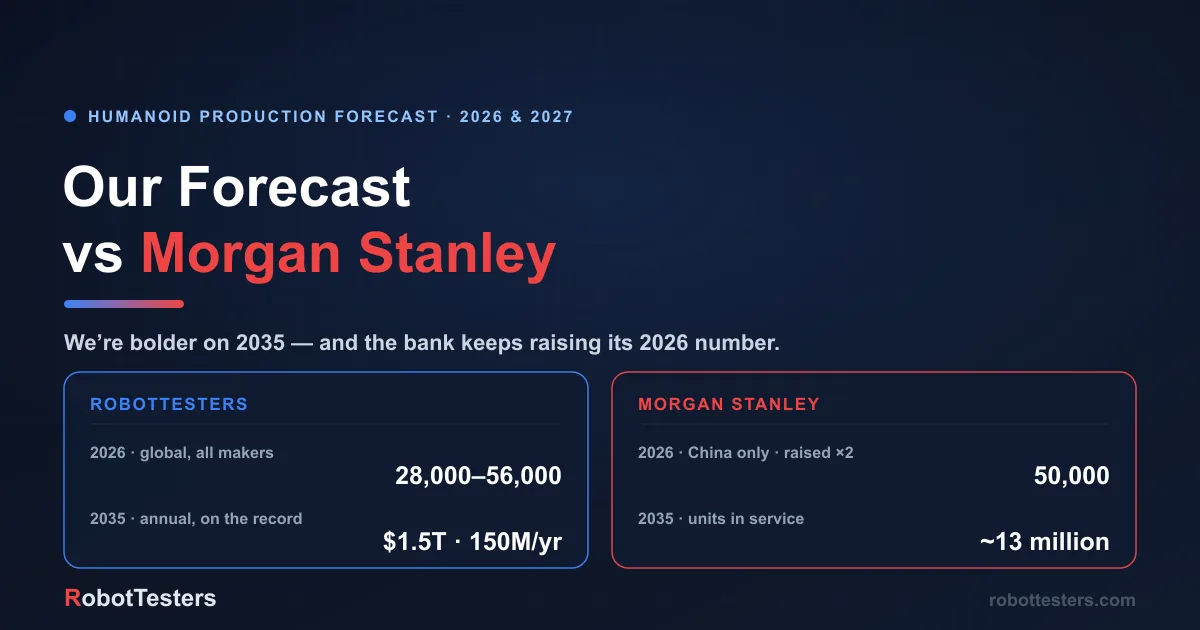
Six weeks ago we put a number on humanoid production. On May 7 we forecast the industry would build 28,000–56,000 humanoids worldwide in 2026, climbing to 150,000–280,000 in 2027 — our full production comparison is here. On June 24, Morgan Stanley raised its own 2026 number — to 50,000 units — for the second time this year. The headlines made it sound as if the bank had just caught up to us. The truth is more interesting, and it cuts both ways: Morgan Stanley is more bullish than we are on near-term China, we are far more bullish than the bank on 2035, and the real signal isn't any single number — it's that the sell-side's forecast has only ever moved in one direction.
- What we said (May 7): global humanoid production of 28,000–56,000 units in 2026 and 150,000–280,000 in 2027 — a ten-fold expansion over 2025, summed across ten manufacturers.
- What Morgan Stanley says now: 50,000 humanoids in 2026 — but that figure is China only, and it's the bank's second upward revision of the year (roughly 14,000 → 28,000 → 50,000).
- Same metric? No. Ours is global and all-vendor; theirs is a single country. Comparing the two head-to-head is the mistake most of the coverage made.
- Who's more optimistic? Morgan Stanley, on near-term China. Us, by a wide margin, on 2035 — our ~$1.5 trillion / ~150-million-units call dwarfs the bank's "about 13 million in service."
- The tell: every Morgan Stanley humanoid revision this year has been upward. A model that only ever corrects one way started too low.
What each of us actually forecast
Before anyone declares a winner, the numbers have to be put on the same footing — and that's exactly where most of the reporting slipped. Here is the honest side-by-side, with the scope of each figure spelled out.
| Horizon | RobotTesters | Morgan Stanley | The catch |
|---|---|---|---|
| 2026 · annual units | 28,000–56,000 | 50,000 | Ours = global, 10 makers. Theirs = China only. |
| 2027 · annual units | 150,000–280,000 | No unit figure | MS gives a mix share, not a count. |
| 2030 · annual units | — (we stop at 2027) | 446,000 | China only; raised from 262,000. |
| 2035 | ~$1.5T · ~150M/yr | ~13M in service | Annual flow vs cumulative fleet. |
| 2050 | — | ~$5T · 1B+ units | The bank's ceiling, 15 years further out. |
Our figures are global annual production from our May 7, 2026 forecast. Morgan Stanley's near-term numbers are China-only shipments (SCMP / CNBC, June 24, 2026); its long-range numbers are global. Annual production, cumulative installed fleet and dollar market size are three different things — the column above labels which is which. Morgan Stanley publishes no separate global 2026 unit number and no 2027 unit number at all.
The scope catch almost everyone missed
Morgan Stanley's 50,000 is not a world number. It is China-only shipments, and the bank says so plainly. That single qualifier rewires the whole comparison. China shipped more than 80% of the world's humanoids in 2025, so if you gross the bank's China figure up to a global one you land around 55,000–62,000 for 2026 — essentially the top of our 28,000–56,000 global range. At the high end, the bank and we basically agree.
Where we don't agree is the part nobody is quoting. Our own China-only subset — Xpeng Iron, Unitree, UBTech and Fourier — adds up to roughly 11,500–24,000 units for 2026, well below the bank's 50,000. On a true like-for-like, China-to-China basis, Morgan Stanley is two-to-four times more bullish than we are. We'll own that: we think China's first real production year runs a little slower than the bank does. Anyone telling you we "matched" Morgan Stanley is comparing a global number to a national one.
The coincidence worth a second look
Here is the part that made the comparison irresistible in the first place. When we published on May 7, Morgan Stanley's then-current China-2026 figure was 28,000 — the exact floor of the global range we'd just printed. By late June the bank had pushed China alone to 50,000, which lands near the top of that same band. We drew the range once and haven't touched it; Morgan Stanley revised twice to climb into it.
We're not going to claim we "predicted Morgan Stanley's number" — the scopes are different, and we've said so. But it's fair to say the sell-side has spent 2026 migrating toward figures the field already had on the board.
Morgan Stanley has raised its 2026 number twice in six months
Forget the level for a moment; the trajectory is the story. Morgan Stanley's 2026 China shipment forecast has moved three times this year, and every move has been up:
| When | 2026 China forecast | Move |
|---|---|---|
| January 2026 | ~14,000 units | Initial 2026 figure |
| Early 2026 | 28,000 units | Doubled |
| June 24, 2026 | 50,000 units | Second raise — "nearly double" the prior 28,000 |
And it isn't only 2026. In the same June note the bank lifted its 2030 China shipment forecast to 446,000 units from 262,000; in its long-range model it had already raised the projected 2050 US humanoid fleet to 77.7 million from 63 million. The June bump was reportedly nudged along by a single ~6.8-billion-yuan (~$1 billion) State Grid order — i.e., one contract was enough to move a national forecast.
None of this means the analysts are wrong; Morgan Stanley does serious work, and its "Humanoid 100" map of the value chain is genuinely useful. But a forecast that only ever gets revised in one direction is, by definition, a forecast that started too low. The model is reactive — it keeps correcting upward to catch a curve that's bending faster than it assumed. That is the difference between tracking a trend and leading it.
Where we're genuinely more optimistic — and where we're not
Now the honest reckoning, in both directions. On 2035 we're far ahead of the bank. Our on-the-record call is roughly $1.5 trillion and about 150 million units a year — a number we ourselves described as "far more aggressive than the sell-side." Morgan Stanley's nearest long-range figure is about 13 million humanoids in service by 2035. That looks like a ~10× gap, but read it carefully: ours is annual production, theirs is cumulative installed base, so it isn't a clean apples-to-apples multiple. The direction, though, is unambiguous — we think the curve arrives sooner.
Two caveats so this doesn't read as a victory lap:
1. Near-term China. As noted, the bank is more bullish than we are for 2026. If China really ships 50,000 humanoids this year, our Chinese-maker estimates were too cautious, and we'll say so at year-end.
2. The very long run. Morgan Stanley's 2050 ceiling — about $5 trillion and more than a billion humanoids — is bigger than any single number we've published. Our edge isn't a higher ceiling; it's timing. We think the inflection lands around 2035, roughly 15 years before the bank's headline year. On magnitude at the far end, the bank actually wins.
The honest read
Strip away the scope mismatch and the two forecasts agree on the thing that matters: 2026 is the inflection point. China shipped on the order of 12,000 humanoids in 2025; both Morgan Stanley's 50,000-for-China and our 28,000–56,000-global imply a three-to-four-fold jump this year. After a decade of "a few prototypes," everyone now sees the same hockey-stick. The disagreement is only about slope, geography, and how much you trust a model that's been revised twice in six months off the back of a single order.
That's the real reason we publish ranges with a name attached and a date stamped on them. We'd rather print one band and let the year test it than nudge the same number upward every quarter. If we're wrong, our May forecast says so permanently — and so does this one. Check back in January; the shipment counts will settle the argument better than any analyst note.