
Every decade has one trade that looks blindingly obvious in hindsight and almost invisible at the time. The internet in 2000. The smartphone in 2007. Bitcoin at a few cents in 2010. AI in late 2022. Each one arrived dressed as a toy or a scam, got dismissed by serious people, and then quietly turned into the defining boom of its decade. I think the next one is already here, and hardly anyone is positioned for it: robots — specifically humanoid robots.
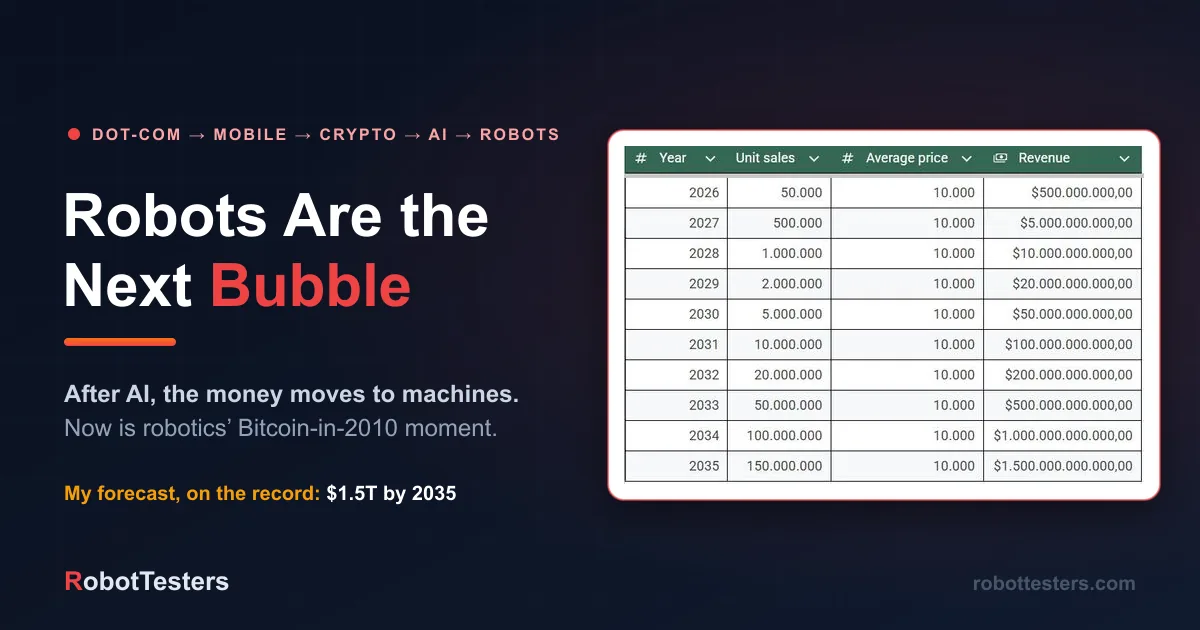
This is the investor's version of an argument I've made before, that robots are the next global trend after AI. Here I want to do something more uncomfortable and more useful: put a number on it, on the record, with my name on it. My call is a humanoid-robot market worth roughly $1.5 trillion a year by 2035. The full table is below — and so is an honest reckoning of how aggressive that is next to what Goldman Sachs and Morgan Stanley are actually forecasting. If I'm wrong, this page will say so forever.
- The pattern: dot-com (2000) → smartphones (2007) → crypto (2010s) → AI (2022) → robots (now). Roughly one general-purpose tech wave per decade.
- Where we are: I'd argue robotics is at its "Bitcoin in 2010" moment — early, cheap, and widely dismissed.
- The banks agree on direction: Goldman Sachs ~$38B by 2035 (base case), Morgan Stanley ~$5 trillion by 2050, Citi ~$7 trillion / 648M humanoids by 2050, Bank of America 3 billion humanoids by 2060.
- My on-the-record call: ~$1.5 trillion in annual humanoid revenue by 2035 — deliberately earlier and bolder than the sell-side. Hold me to it.
- Important: this is opinion and analysis, not investment advice. Bubbles are called bubbles for a reason — see the bear case near the end.
Every decade gets its bubble — and its winners
Before anyone accuses me of hype, let's be precise about the pattern, because the numbers are real and they rhyme. Four times in 25 years, a new general-purpose technology has gone from punchline to the biggest wealth-creation event of its decade. Each time, the people who saw it early looked reckless — until they looked like geniuses.
2000 — the dot-com bubble
The Nasdaq Composite peaked at a record 5,048.62 on March 10, 2000, then fell roughly 78% to its 2002 trough, erasing more than $5 trillion in market value. It took about 15 years — until April 2015 — for the index to reclaim that high. Pets.com went public in February 2000 and was liquidated 268 days later. And yet the internet was not fake: Amazon, which fell about 92% (from $106.69 to $8.37) in the crash, went on to become a trillion-dollar company. The bubble was real and the trend was real. That is the single most important thing to understand about what follows.
2007 — the smartphone wave
Apple put the first iPhone on sale on June 29, 2007, and launched the App Store on July 10, 2008. Global smartphone sales went from 139 million units in 2008 to 1.4 billion in 2015 — a tenfold rise — and by 2015 Apple had paid developers a cumulative $25 billion. The lesson here is about who captures the value: by the end of that wave, Android and iOS owned 98% of the market. A platform shift mints a tiny number of enormous winners and buries everyone who showed up late.
2010 — when Bitcoin cost cents
In 2010, a single bitcoin traded for pennies. The famous "pizza day" transaction on May 22, 2010 paid 10,000 BTC for two pizzas — worth about $41 at the time, or roughly $0.004 a coin — and the first exchange trade that July priced bitcoin at $0.0495. Eleven years later the total crypto market hit roughly $3 trillion (November 9, 2021). I'm not telling you crypto was a good investment morally or otherwise; I'm pointing at the shape of the curve. The maximum asymmetry — the moment when being early paid the most — was precisely when it looked most like a joke.
2022 — the AI boom
ChatGPT launched on November 30, 2022 and hit a million users in five days. In the wake of it, Nvidia went from a $1 trillion market cap (first reached May 30, 2023) to $3 trillion (June 5, 2024) to becoming the first company ever worth $4 trillion (July 9, 2025), and OpenAI was valued at $852 billion in March 2026 — the largest private financing in history. AI minted the most valuable company on Earth in about three years. That wave is now mature and largely priced in. So the obvious question for anyone paying attention is: what's next?
Dot-com, smartphones, crypto, AI. The interval between the world's great technology waves is collapsing, and the answer to "what's next" is hiding in plain sight — it's the one technology that takes everything AI learned to think and gives it a body.
Why robots are where Bitcoin was in 2010
Here's the part that should feel familiar. Look at humanoid robots today and they seem early and underwhelming. The cheapest one you can actually buy, Unitree's R1, starts around $4,900; Figure has shipped a few hundred units; and at the ICRA 2026 conference a lot of the "autonomous" humanoids on the show floor were still being driven by a human with a joystick. To most people, that reads as "not ready." To me, it reads as 2010.
Because the thing that was actually missing just arrived. For decades robotics had decent bodies and no brain — no general way for a machine to look at an unfamiliar scene, understand a spoken request, and act. That is exactly what the AI wave produced: vision-language-action models, the robot equivalent of what GPT did for text. The body problem was mostly solved; the brain problem is now being solved on top of the AI boom. When the two halves finally meet, you get the same step-change that turned the iPhone from a nice phone into a platform the day the App Store opened.
And the clearest tell is who is saying it out loud. At CES in January 2025, Nvidia's Jensen Huang declared that "the next frontier of AI is physical AI" and that "the ChatGPT moment for general robotics is just around the corner." When the person selling the picks and shovels to every gold rush tells you a new rush is starting, it's worth at least checking the map. We laid out how you separate a real working humanoid from a demo — and the honest answer is that the gap is closing fast.
My forecast, on the record
So let me commit. The napkin math here isn't complicated — I ran the basic version before: a million robots at a $10,000 average price is $10 billion in revenue. What I'm doing now is putting that math on a calendar, year by year, and signing it. Below is my forecast for annual humanoid-robot unit sales and the revenue they imply, holding the average price flat at $10,000.
| Year | Humanoids sold (that year) | Avg. price | Annual market |
|---|---|---|---|
| 2026 | 50,000 | $10,000 | $500 million |
| 2027 | 500,000 | $10,000 | $5 billion |
| 2028 | 1,000,000 | $10,000 | $10 billion |
| 2029 | 2,000,000 | $10,000 | $20 billion |
| 2030 | 5,000,000 | $10,000 | $50 billion |
| 2031 | 10,000,000 | $10,000 | $100 billion |
| 2032 | 20,000,000 | $10,000 | $200 billion |
| 2033 | 50,000,000 | $10,000 | $500 billion |
| 2034 | 100,000,000 | $10,000 | $1 trillion |
| 2035 | 150,000,000 | $10,000 | $1.5 trillion |
A few honest caveats, because I'd rather you trust the reasoning than the round number. The $10,000 average price is my assumption: today the floor is Unitree's ~$4,900 R1 and Tesla is targeting $20,000–$30,000 for Optimus, so a $10k blended price is a defensible mid-point — though in reality prices fall hard as volume scales, which I'm holding flat for simplicity. These are annual figures (units sold that year × price), not the cumulative installed base. And the steep part of the curve is exactly that — steep. This is a bet on the shape of an S-curve, not a spreadsheet that proves itself.
Am I sane? Here's where my number sits against the banks
I'm not going to hide behind my own optimism, so here is my call lined up against the people paid to model this for a living. The honest summary: for 2035 specifically, I am far more aggressive than the sell-side — my number looks more like their 2040–2050 forecasts pulled forward a decade.
| Source | Forecast | By | vs. my call |
|---|---|---|---|
| My call (this article) | ~$1.5 trillion · 150M units/yr | 2035 | — |
| Goldman Sachs (base) | $38 billion · ~1.4M units | 2035 | I'm ~40× higher |
| Goldman Sachs (blue-sky) | up to $154 billion | 2035 | I'm ~10× higher |
| Macquarie | $139 billion · 6.3M units | 2035 | I'm ~10× higher |
| Morgan Stanley | ~$5 trillion · ~1B units | 2050 | similar size, 15 yrs earlier |
| Citi | ~$7 trillion · ~648M humanoids | 2050 | bigger — but a 2050 number |
| Bank of America | 3 billion humanoids in use | 2060 | same direction, far out |
Read that table honestly and you can see my bet stated plainly. Goldman Sachs pegs the 2035 base case at $38 billion (it already revised that figure up sixfold from $6 billion, mind you); Macquarie says $139 billion. My $1.5 trillion is roughly 10–40× either of them for the same year, and my 150-million-units figure is more than ten times Morgan Stanley's "about 13 million in service by 2035" or Bank of America's "10 million shipped in 2035." I'm not claiming the banks can't add. I'm betting their adoption curve is too shallow and too slow — that once the brain problem is cracked and a handful of carmakers turn their factories loose, humanoids scale the way smartphones did, not the way industrial robots did. I might be a decade early. That's the whole point of writing it down.
The XPeng moment: when a car company surprises the market
If you want evidence that the smart money is already moving, watch what happens every time a serious manufacturer reframes itself around robots — and watch how the market reacts. The cleanest example is XPeng. At its AI Day on November 5, 2025, CEO He Xiaopeng repositioned the EV maker as "a mobility explorer in the physical AI world and a global embodied intelligence company," claiming XPeng is the only company in China to have built a full-stack, self-developed physical-AI system. Its IRON humanoid — 178 cm, 70 kg, 22 degrees of freedom in each hand, powered by three in-house Turing chips delivering 2,250 TOPS — is targeted for mass production by the end of 2026, with a goal of a million units a year by 2030.
Then came the moment that tells you exactly where we are. Footage of IRON walking looked so natural that viewers accused XPeng of hiding a person in a suit. He Xiaopeng's response was to walk on stage and cut open the robot's leg covering and unzip its back panel to reveal the machinery inside. Sit with that image: robots that are now good enough that people assume they must be fake. That is the 2010-Bitcoin feeling in physical form. He has since taken personal control of the robotics unit and publicly mused that the robot market could top $20 trillion within 10–20 years, eventually outselling cars.
And XPeng is not an outlier — it's the pattern. Tesla's Elon Musk told investors he sees long-run demand for "in excess of 20 billion" humanoids and claims Optimus could one day be 80% of Tesla's value. BYD has been quietly building humanoids under a project codenamed "Yao-Shun-Yu" since 2022. Hyundai, which owns Boston Dynamics, plans to build around 30,000 Atlas-class robots a year by 2028. As I argued in why every carmaker is building a humanoid, the people who already know how to mass-produce tens of millions of complex machines a year are all turning toward robots at once. When that many capable players pivot simultaneously, it stops being a fad and starts being a tell.
So how do you actually "buy in"?
Here's where the Bitcoin analogy breaks, and I want to be straight about it: there is no robot-coin you can buy for cents. You can't put $100 into "robots" the way you could into BTC in 2010. The exposure today is indirect, and it lives in three layers:
- The picks and shovels. Whoever sells the indispensable layer — chips, actuators, the AI brain, the simulation tools — is positioned to become the Nvidia of robotics. Nvidia itself is openly gunning for that role.
- The platform builders. Tesla, XPeng, Unitree, Figure, Boston Dynamics — mostly reachable, where they're listed, through their parent companies, which means you're buying a sliver of a robot bet wrapped in a car or AI business.
- The value-chain basket. Morgan Stanley literally built a map for this — its "Humanoid 100" (February 2025), a list of 100 public companies across the "brain," "body" and "integrator" layers of the humanoid stack.
The case I'm wrong
I called this piece "the next bubble" on purpose, not "the next sure thing." Every wave I admired above was also a graveyard. Pets.com and Webvan vaporized billions. The 2022 crypto winter erased more than $2 trillion and took FTX down with it. The dot-com Nasdaq fell 78%. If robots run the same script — and bubbles usually do — then most of today's 100-plus humanoid startups die, valuations overshoot reality, and there's a brutal shakeout before anything compounds.
The specific ways I could be too optimistic are real and worth naming: autonomy is still half-faked with joysticks; the unit economics at $10,000 are unproven; safety, regulation and public trust could throttle home deployment for years; and my 2035 timing may simply be a decade premature. A reasonable person could read the same facts and land on Goldman's $38 billion, not my $1.5 trillion.
But notice what the bear case doesn't say. The dot-com crash didn't make the internet fake. The crypto winter didn't end crypto. A robot bubble bursting would not mean robots failed — it would mean the market got ahead of the deployment, blew off the froth, and handed the next twenty years to the survivors: the Amazons of robotics. Being early and being wrong look identical right up until they don't.
On the record
So here's my bet, time-stamped at the top of this page. I think 2026 is to robots what 2010 was to Bitcoin and 2007 was to the smartphone — the unglamorous, easy-to-dismiss entry point right before a boom that will look obvious in hindsight. My number is roughly $1.5 trillion in annual humanoid revenue by 2035. It is deliberately aggressive, fully falsifiable, and now permanently attached to my name. Come back in 2035 and tell me whether I was a prophet or just early. Either way, I'm confident about the direction — the only thing genuinely in doubt is the date.