
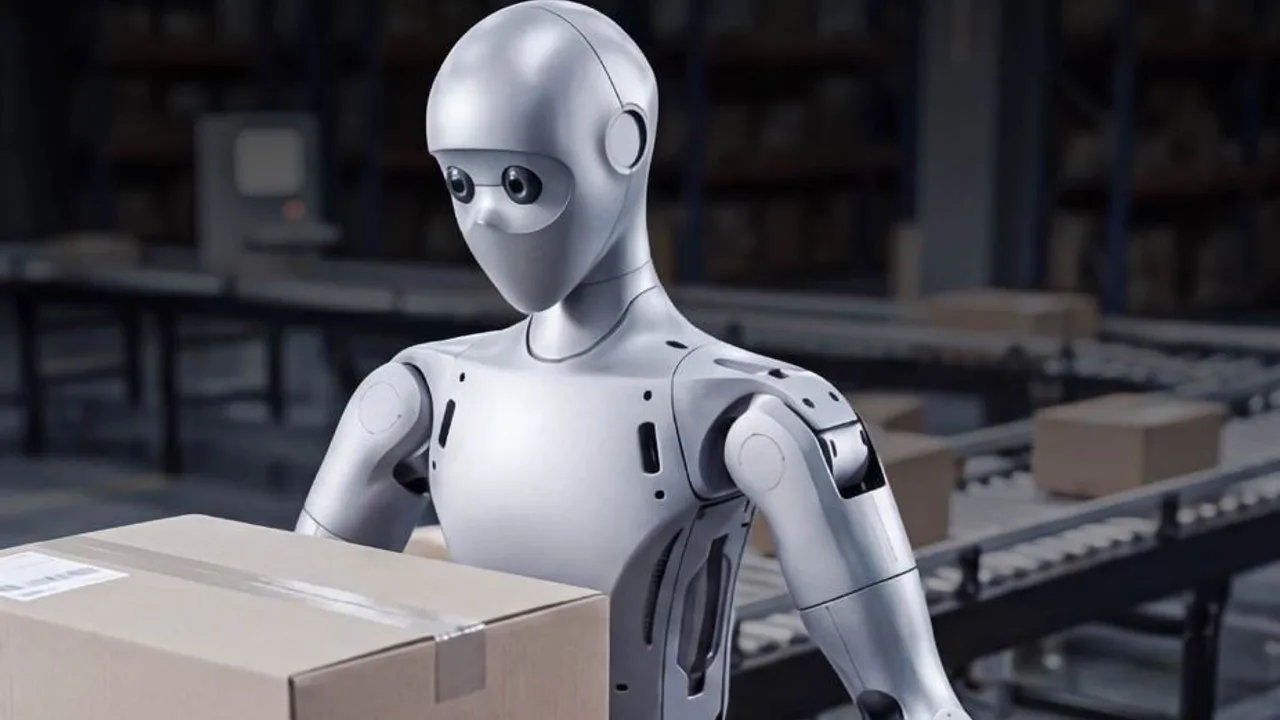
Unitree has spent the last three years doing the same thing over and over: taking a class of robot that used to cost as much as a house and making it cost as much as a car — then a motorbike, then a laptop. The G1 made an advanced humanoid affordable. The R1 made a full-body humanoid cheaper than a second-hand sedan. And now, with the H2 Plus, Unitree goes one step further again — this time by allying with the one company whose name is synonymous with the AI boom: NVIDIA.
Announced on 1 June 2026, the Unitree H2 Plus is an NVIDIA Isaac GR00T reference humanoid — a robot built specifically so that the world's research labs can develop the next generation of embodied AI on a single, standardised platform. It is the clearest signal yet that Unitree no longer just wants to win on price; it wants to sit at the centre of how humanoid intelligence gets built. That is the kind of move that makes history, not just headlines.
But the H2 Plus does not exist in a vacuum. It sits on top of a lineup that already spans from a $4,900 starter humanoid to a $90,000 record-breaker. So which Unitree humanoid is actually right for you? Below is the full lineup — H2 Plus, H2, H1, R1 and G1 — compared head-to-head on specs, price and purpose.
- H2 Plus — the NVIDIA Isaac GR00T research flagship: 75 degrees of freedom, an onboard NVIDIA Jetson AGX Thor computer, dual five-finger hands. Due late 2026, price not announced.
- H2 — the commercial full-size adult humanoid (1.82 m, 70 kg), shipping now from $29,900. The cheapest adult-scale humanoid you can actually order.
- H1 — the performance veteran: holds the bipedal walking-speed record (3.3 m/s) and lifts 30 kg, but costs about $90,000.
- R1 — the price breakthrough at $4,900, with an onboard multimodal LLM. The entry point.
- G1 — the best all-round value at $13,500: up to 43 degrees of freedom and the most mature developer ecosystem.
The Lineup at a Glance
Two of these robots are adult-sized full humanoids (H2 and H2 Plus, both based on the same 1.8-metre H2 body). One is the older performance flagship (H1). And two are compact, lighter machines aimed at developers and, increasingly, individual buyers (G1 and R1). They share a single ROS2-based software foundation, which is a large part of why Unitree's ecosystem has become the default for humanoid research worldwide.
The Specs, Side by Side
| Specification | H2 Plus | H2 | H1 | R1 | G1 |
|---|---|---|---|---|---|
| Status | Late 2026 (preview) | Shipping (Apr 2026) | 2023 | 2025 | 2024 |
| Height | 1.82 m | 1.82 m | 1.80 m | 1.23 m | 1.27 m |
| Weight | ~70 kg | 70 kg | 47 kg | 27–29 kg | 35 kg |
| Degrees of freedom | 75 (31 + 44 hands) | 31 (+ optional hands) | 19 | 20–26 | 23 (up to 43) |
| Hands | Sharpa Wave 5-finger, 22 DOF ea. | Optional Dex5-1 / Dex3-1 | Basic | — | Optional dexterous |
| Max speed | Not disclosed | Not disclosed | 3.3 m/s (record) | Runs (n/d) | 2.0 m/s |
| Arm payload | 7 kg / 15 kg peak | 7 kg / 15 kg peak | 30 kg | ~2 kg | ~2 kg |
| Leg joint torque | 360 N·m | 360 N·m | — | — | — |
| Battery life | ~3 h | — | ~1.5 h | ~1 h (hot-swap) | ~2 h |
| Onboard AI compute | NVIDIA Jetson AGX Thor (2,070 TFLOPS) | Up to ~2,070 TOPS (option) | ROS2 host PC | UnifoLM LLM onboard | ROS2 host PC |
| Software stack | NVIDIA Isaac GR00T | Unitree SDK / ROS2 | ROS2 | UnifoLM multimodal | ROS2 |
| Sensors | Head stereo + wrist cams + IMU | Cameras + IMU | Mid-360 LiDAR + depth | Stereo 220° + 4-mic | Depth + optional LiDAR |
| Price (base) | Not announced | $29,900 | ~$90,000 | from $4,900 | $13,500 |
| Best for | NVIDIA-stack research | Full-size dev & light industry | Speed & payload research | Entry-level & consumers | Best all-round value |
A note on honesty before we go further: the H2 Plus has not been tested by anyone outside Unitree and NVIDIA yet, and several of its figures (top speed, real-world battery life under load) have not been published. Where a number is not officially confirmed, the table says so rather than guessing. The H1, R1 and G1 figures come straight from our own Unitree review database; the H2 and H2 Plus figures come from Unitree's and NVIDIA's own announcements.
The H2 Plus: Unitree's NVIDIA Moment
This is the robot that changes the story. For years, Unitree's pitch was essentially "the same capability for a fraction of the price." The H2 Plus is a different kind of statement. By becoming the official NVIDIA Isaac GR00T reference humanoid, Unitree has positioned its hardware as the body that NVIDIA's robotics brain is designed to run on — a partnership between the company that made humanoids affordable and the company that powers most of the world's AI.
The hardware backs up the ambition. The H2 Plus carries 75 degrees of freedom — 31 in the body plus dual Sharpa Wave five-finger tactile hands with 22 degrees of freedom each — making it dramatically more dexterous than anything else in Unitree's range. Its brain is an NVIDIA Jetson AGX Thor T5000: a Blackwell-generation GPU delivering 2,070 FP4 teraflops of AI performance with 128 GB of unified memory. On top of that runs NVIDIA's Isaac GR00T open software and foundation models, the same stack research labs are using to teach robots general-purpose manipulation.
The catch — and it is an important one — is that the H2 Plus is a research platform, not a product you can buy. It is scheduled for availability in late 2026, aimed at academic and robotics-research institutions, and Unitree has not announced a price. For that reason it carries a "Not Rated Yet" status in our database: we do not assign a value score to a robot we cannot price or test. You can read the full Unitree H2 Plus specs and preview here.
The H2: The Cheapest Adult-Scale Humanoid You Can Order
If the H2 Plus is the moonshot, the standard H2 is the workhorse — and it is the one most readers can actually buy today. At 1.82 m and 70 kg with 31 degrees of freedom, it is a genuine adult-scale humanoid, and it ships from $29,900 in its base configuration (rising to roughly $40,900 for the commercial build and $68,900 for the fully-loaded EDU model through distributors). For context, that base price undercuts most full-size Western humanoids by a factor of three to five.
The H2 offers the same 360 N·m leg-joint torque and 7 kg (15 kg peak) arm payload as its Plus sibling, and can be specced with Unitree's Dex5-1 five-finger or Dex3-1 three-finger dexterous hands. What it lacks, in its base form, is the bundled NVIDIA Jetson Thor brain and the Isaac GR00T software layer that define the Plus. Think of the H2 as the body; the H2 Plus as the body plus NVIDIA's brain and hands, tuned for frontier research.
The H1: Still the Performance King
The H1 is the elder statesman of the group, and on raw physical performance it still wins. It holds the world record for bipedal walking speed at 3.3 m/s and carries a 30 kg arm payload that dwarfs the rest of the lineup. Its Mid-360 LiDAR sensor suite makes it the strongest choice for locomotion and autonomous-navigation research where speed and load matter more than finger dexterity.
The trade-off is price and dexterity. At roughly $90,000 the H1 is by far the most expensive Unitree humanoid, it has only 19 degrees of freedom, and its hands are basic compared to the multi-finger systems on the newer models. It is a specialist's tool, and a brilliant one — see the full Unitree H1 review — but it is no longer the robot most labs should default to.
Unitree H1 vs H2
The Unitree H1 vs H2 question comes down to speed versus dexterity and price. The H1 (~$90,000) holds the bipedal walking-speed record at 3.3 m/s and lifts a 30 kg arm payload, but has only 19 degrees of freedom and basic hands. The newer H2 is taller (1.82 m vs 1.80 m), heavier (70 kg vs 47 kg) and far more dexterous with 31 degrees of freedom plus optional five-finger hands — and it costs a third as much, at $29,900. For most buyers the H2 is the better and cheaper adult-scale humanoid; the H1 only wins when raw walking speed and heavy payload outrank everything else.
The R1 and G1: Where Most People Should Start
For the vast majority of buyers — researchers on a budget, universities, developers, even well-funded enthusiasts — the right Unitree humanoid is the R1 or the G1.
The R1 is the headline-grabber: at $4,900 it is the most affordable full-body humanoid ever sold commercially. Standing 1.23 m and weighing under 30 kg, it runs a UnifoLM multimodal LLM directly onboard for voice and vision, has a hot-swappable battery, and can run, cartwheel and do handstands. It was named a TIME Best Invention of 2025. It is not a heavy-duty manipulator — payload is light — but as a first humanoid it is unmatched on price. Full details in the Unitree R1 review.
The G1, at $13,500, is the one we recommend most often. It offers up to 43 degrees of freedom with dexterous hands, 2.0 m/s movement, strong terrain handling, and — crucially — the most mature developer ecosystem of any humanoid at any price, thanks to full ROS2 support and a large open-source community. If you want a capable humanoid you can genuinely build on without remortgaging the lab, the G1 is the sweet spot. See the Unitree G1 review.
Unitree R1 vs G1
In the Unitree R1 vs G1 match-up, price and purpose separate them. The R1 ($4,900) is the cheapest way in: it is smaller (1.23 m, under 30 kg), runs a UnifoLM multimodal LLM onboard, has a hot-swappable battery and can run, cartwheel and do handstands — but its payload is light and it tops out at 20–26 degrees of freedom. The G1 ($13,500) costs roughly 2.75× more but offers up to 43 degrees of freedom, dexterous hands, 2.0 m/s movement and the most mature ROS2 developer ecosystem in the range. Choose the R1 as a first humanoid on the tightest budget; choose the G1 if you plan to build and develop seriously and want more dexterity and support.
Unitree H2 vs G1
The Unitree H2 vs G1 choice is really adult-scale versus compact value. The H2 ($29,900) is a true 1.82 m, 70 kg adult-scale humanoid with 31 degrees of freedom, 360 N·m leg-joint torque and a 7 kg (15 kg peak) arm payload — the cheapest full-size humanoid you can order, and the pick for light-industry manipulation at human height. The G1 ($13,500) is a compact 1.27 m, 35 kg developer platform with up to 43 degrees of freedom and the strongest software ecosystem, at less than half the H2's price. Buy the H2 if you specifically need adult-scale reach and payload; buy the G1 if value and developer maturity matter more than height.
Where Each One Wins
- You need an adult-scale, full-size humanoid
- You want the NVIDIA Isaac GR00T stack (H2 Plus)
- You need maximum dexterity — dual five-finger hands
- You can wait for late 2026 (H2 Plus) or buy now (H2)
- Light-industry manipulation is the goal
- H1: you need record speed and a 30 kg payload
- G1: you want the best all-round value at $13,500
- G1: you need the most mature ROS2 ecosystem
- R1: you want the cheapest way in, at $4,900
- R1: you want an onboard multimodal LLM out of the box
On Price and Availability: The Honest Version
Four of these five robots are real, priced and either shipping or readily orderable: the R1 ($4,900), G1 ($13,500), H2 ($29,900) and H1 (~$90,000). The fifth — the H2 Plus — is the one generating the headlines, and it is precisely the one you cannot yet buy. Its NVIDIA tie-in is genuinely significant, but "announced as a late-2026 research reference design" is not the same as "on sale." We have flagged it that way deliberately, because the fastest way to lose a reader's trust is to imply a robot is purchasable when it is not.
Unitree H2 Plus Price
The Unitree H2 Plus price has not been officially announced. Unitree unveiled the H2 Plus on 1 June 2026 as an NVIDIA Isaac GR00T reference humanoid aimed at research institutions, with availability scheduled for late 2026, but no base price has been published. Because we cannot price or test it, the H2 Plus carries a "Not Rated Yet" status in our database. For reference, the standard H2 — the same 1.8-metre body without the bundled NVIDIA Jetson Thor brain and Sharpa Wave hands — starts at $29,900, so the H2 Plus, once priced, is expected to sit above that; treat any figure you see before Unitree confirms it as speculation.
Unitree R1 Price
The Unitree R1 price is $4,900 for the base configuration — the most affordable full-body humanoid ever sold commercially. At that price the 1.23 m, sub-30 kg R1 ships with a UnifoLM multimodal LLM onboard and a hot-swappable battery, and it was named a TIME Best Invention of 2025. It is the cheapest entry point in the entire Unitree humanoid lineup.
Unitree's real achievement is not any single robot — it is a ladder. You can step on at $4,900 and climb all the way to an NVIDIA-powered research platform without ever leaving the same software ecosystem.
If you want the future, watch the H2 Plus. The NVIDIA Isaac GR00T partnership is the most consequential thing Unitree has done — a bet that it can be the standard body for embodied AI, not just the cheapest one. But it is a late-2026 research platform with no price, so for now it is a story to follow, not a robot to order.
If you want to buy today, the answer depends on your budget. The G1 ($13,500) is the best all-round choice for most labs and developers. The R1 ($4,900) is the cheapest serious entry point. The H2 ($29,900) is the one to get if you specifically need an adult-scale full humanoid. And the H1 (~$90,000) remains the pick when raw speed and payload outrank everything else.
The throughline is the same one Unitree has been writing for three years: each model pushes the frontier a little further, and with the H2 Plus, the frontier now runs straight through NVIDIA.