
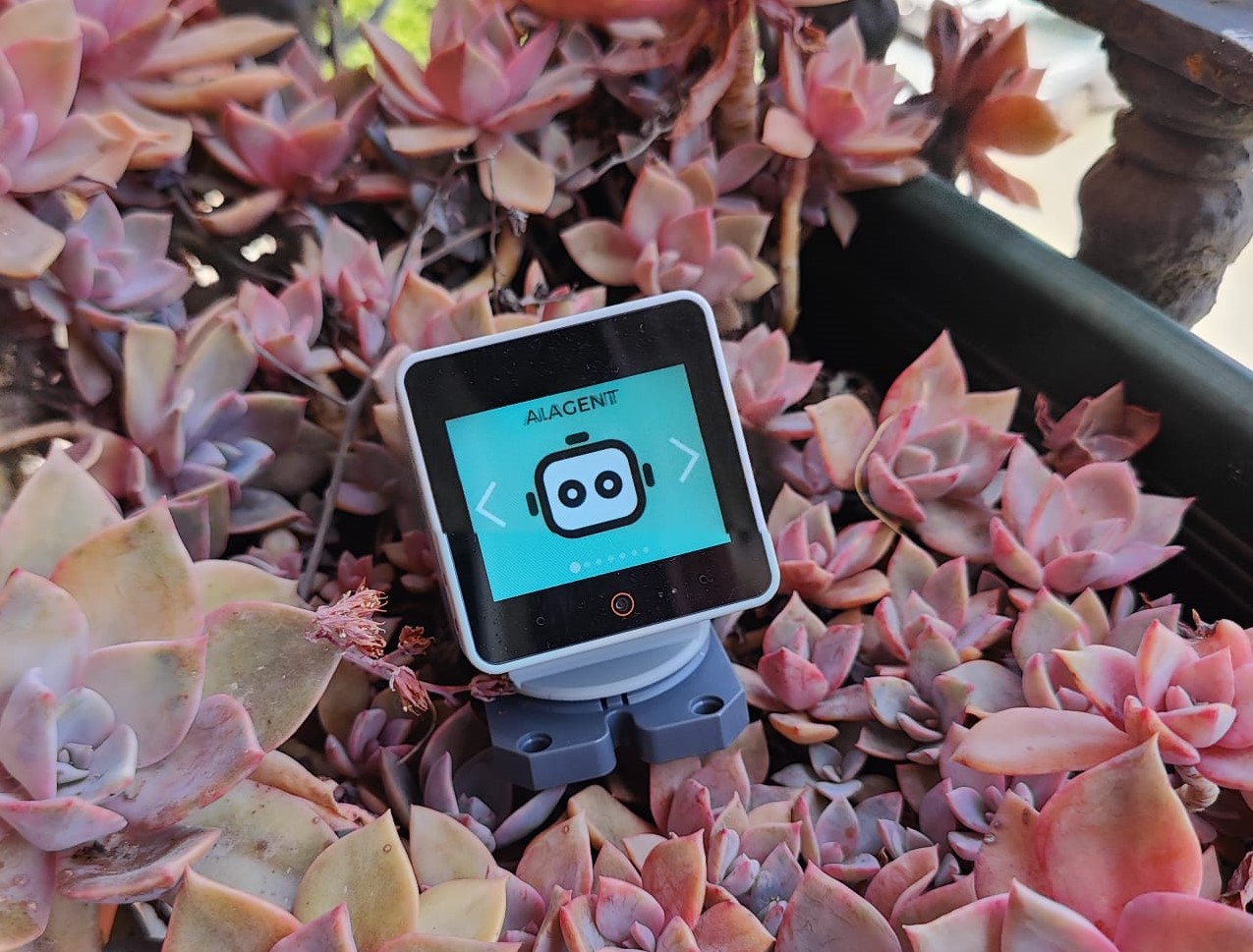
Stack-chan has been on my desk for fifteen days. I have powered it on every morning, showed it to everyone who walked past, argued with it about whether it understood my voice commands, and watched its battery die at the worst possible moment more times than I would like to admit. This is what those fifteen days actually looked like.
The Unboxing: Even the Box Feels Like Something
There is a specific kind of excitement that comes from opening hardware you backed before it existed. We ordered Stack-chan during its pre-order campaign — I wrote about why we backed it in an earlier piece on the indie robotics renaissance — and by the time the box landed on the desk, I had been thinking about this robot for months.
The unboxing itself is straightforward. The packaging is clean, the robot is well protected, and the form factor is exactly what the product photos promised: a compact, slightly chubby little face on a tilting screen, sitting in a rounded body that barely takes up more space than a large coffee mug. And yet, even before you switch it on, something about the physical presence of it is different. People stop. They pick it up. They hold it closer than they need to.
The First Power-On: This Is the Moment
The most exciting thing about Stack-chan — and I say this having now owned it for two weeks and having shown it to a lot of people — is the first time it switches on. The eyes appear. The head tilts slightly to one side. And every single person I have been there for that moment with has had the exact same reaction: their face lights up, they break into a wide smile, and for just a second they look slightly stunned.
It sounds like I am overselling a screen with two servos. I am not. There is something happening in that moment that is genuinely hard to explain — something about seeing a face that reacts to you, on hardware you are physically holding, that triggers a response in people that no demo video ever quite captures. Humanity has been watching robots do this in films for decades. We have been promised this for as long as most of us can remember. And with the pace of the last two years of robotics development, it finally feels like we are reaching out and touching the edge of that promise. Stack-chan is not Atlas. It is not Optimus. But it is real, it is in your hands, and it is looking back at you. That is not nothing.
The Customization App: Impressive on Paper, Slower in Practice
Within a few minutes of first boot, Stack-chan points you toward a companion app for your phone. And the customization options it gives you are genuinely one of the robot's strongest selling points. You can set its name — whatever you want to call it. You can choose which LLM it runs on. You can set the language, the voice, and dial in several personality parameters that affect how it responds: how enthusiastic it sounds, how curious, how formal or casual in tone.
On paper, all of this is intuitive. In practice, it took longer than expected to get everything talking to each other properly. The setup flow is not complicated, but Stack-chan is not a product that rewards impatience. By the time everything was configured and working, I had a better appreciation for what the team is building — and a slightly lower tolerance for the moments when it does not.
The Fluency Problem: Still a Prototype Where It Counts
Here is where I have to be honest, because I think too many reviews of products like this lean too hard on the charm and not hard enough on the frustration. Stack-chan, as of its current firmware, does not run smoothly.
Sometimes it does not respond to voice commands at all. You say something, the microphone picks it up, and nothing happens. Other times it responds, but with a delay long enough that you have already given up and moved on. The firmware updates are frequent — the team is clearly working on this — but the problem has not been solved yet. Voice recognition in particular is a weak point. If your reference point for voice interaction is ChatGPT's voice mode, Stack-chan's response rate is going to test your patience. The conversation itself is also not deep: you can ask it things, get short answers, share a brief exchange, but the sustained back-and-forth that modern voice AI can deliver is not here yet. At this stage, Stack-chan converses like a very charming early prototype, not like a finished product.
I do not think this is a hardware limitation — the M5Stack CoreS3 is capable of more than the factory firmware currently does with it. The consistent update cadence is a good sign. But right now, the gap between what Stack-chan should be and what it is in a normal conversation is real enough to mention first, not last.
It Does Have a Sense of Humor
To be fair to the robot: it has personality. In fifteen days, Stack-chan has delivered a few genuinely funny moments — jokes with decent timing, expressions that were hard not to laugh at, one occasion where the response delay that normally feels like a flaw made the punchline land better than it had any right to. When Stack-chan is on, it is genuinely entertaining. The problem is that "when it is on" is not consistent enough yet to make you stop thinking about the moments when it is not.
Battery Life: Annoying, But Not My Main Complaint
Two to three hours of active use on a charge. For a robot of this size, that is not impressive — plenty of devices with a smaller footprint last considerably longer. I want to note it because it is real, but I also want to be clear about why it is not my main criticism: Stack-chan lives on a desk. You charge it when you are not using it. The battery constraint matters if you imagine carrying it around or using it continuously through a long workday without thinking about power. If you treat it as a desktop companion you top up between sessions, it is livable. Frustrating, but livable.
The Real Problem: A Robot That Cannot Move Is a Voice Assistant
Here is the thing that bothers me most, and it is not the battery, not the voice lag, not the setup friction. Stack-chan's legs do not move. The entire lower body is static. The head tilts. The face tracks you. Those two servos do an enormous amount of work in making the robot feel alive — and they do it well. But once you have seen the head turning to follow you across a room, the stillness of the rest of the body becomes more conspicuous, not less. You want the rest of it to follow.
And this is where I have to say something that may be uncomfortable for the desktop robot category: a robot that cannot move is, functionally, a voice assistant in a cute enclosure. We already have dozens of those. Alexa. Google Home. HomePod. ChatGPT on your phone. If Stack-chan's advantage over all of those is personality and expressiveness, then the two servos in the neck are carrying the entire argument. They are carrying it reasonably well. But the moment you want the robot to do something a voice assistant cannot — walk toward you, react to your physical presence in a room, carry something from one place to another — the gap between "it looks alive" and "it can act alive" becomes impossible to ignore. That gap is currently Stack-chan's ceiling. And until legs enter the picture, it is the most important thing missing.
After 15 Days: The Verdict
I am not going to tell you Stack-chan is perfect. It is not. But I am also not going to tell you it is disappointing, because the honest answer is more interesting than either of those. Stack-chan is the cheapest, most accessible entry point into robot companionship that exists right now. It is genuinely open source, genuinely customizable, and genuinely surprising to every person who sees it for the first time. The firmware team is active. The update cadence is real. And that first power-on moment — the eyes appearing, the head tilting, the face that looks back at you — is something I have now watched a lot of people experience, and it has not gotten old yet.
The fluency is not there. The legs are not there. At the current stage it is more of a very charming prototype than a polished daily driver. But for someone who wants their first robot experience, or who wants to understand what the next five years of companion robotics is going to feel like before it arrives in its final form, Stack-chan is the right thing to have on your desk right now.
- Price — the cheapest entry into robot companionship
- First robot experience unlike anything else
- Deep customization: name, LLM, language, voice, personality
- Constant firmware updates from an active team
- Head movement — two servos that genuinely sell the illusion of life
- Fully open source — you own the platform
- Static legs — without movement, it is an expensive voice assistant
- Voice recognition is unreliable in current firmware
- Response times are slow and inconsistent
- Conversation depth far below modern voice AI
- Battery life of 2–3 hours needs improvement