
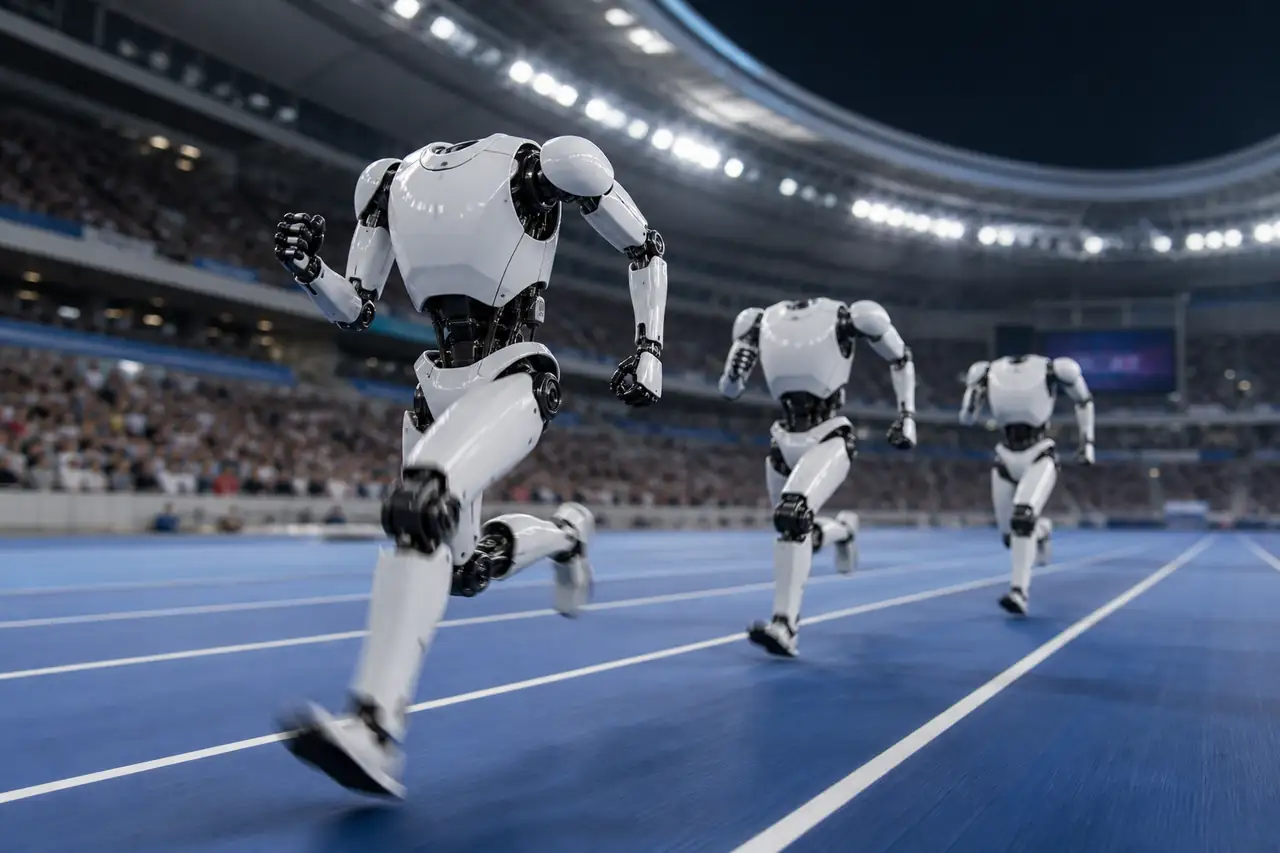
A robot ran 100 metres in 9.39 seconds at the opening of the second World Humanoid Robot Games in Beijing, on 22 August. Usain Bolt's world record is 9.58 seconds. Later heats went 9.34, then 9.32. I should say this is not a fair comparison. Different start, different rules, and the runner is a machine. But last year, at this same event, the winning 100m was 21.50 seconds. In twelve months they cut the time in half. I think that is the story of these Games.
They are being held at the National Speed Skating Oval, and they close on 26 August. Three days in, teams from the Beijing Humanoid Robot Innovation Center are winning the running and jumping. AgiBot is winning the work: fire, a library, hands that pick things up. Unitree, a week after listing in Shanghai, came last in the first 100m heat. The 100m final has not been run yet. Session times are in the watch guide.
Key takeaways
- 100m heats: Tiangong Ultra ran 9.39, then 9.34, then 9.32. Bolt is 9.58. Last year was 21.50s. These are heats, not the final, and not a World Athletics record.
- Also faster than the human records: 400m large in 38.15s, 1500m in 2:21.64, and a standing high-jump demo of 2.8843 m.
- Track golds so far: Innovation Center teams (Tianzhuo, Tiangong, Tianjiao) took the 400m large and small, the 1500m, long jump and 400m hurdles.
- Work events: AgiBot's Spirit G2 and partner teams took fire, library, tai chi and several dexterous-hand golds. AgiBot said it led the overall table after 23 August.
- Unitree: 12.41s in the opening 100m heat. No athletics medals through 23 August.
Last year the 100m took 21.50 seconds
Opening night, first heat, from Xinhua: Tiangong Ultra in 9.39, Honor Lightning in 9.47, Unitree in 12.41. Later heats went 9.34 and 9.32. Beijing Daily said the Ultra ran all three, so this was not one lucky run. Honor also ran 9.32 in a test before the Games. That's training. The heat is what they ran with cameras on.
World Athletics will not count it, and they shouldn't. The start is different. There is no wind gauge of that kind. The runner is a machine. What changed, and what I find more interesting, is the year in between. In 2025 the robots followed a white line painted on the track. People jogged next to them. One of those people got knocked over. This year, except for the obstacle races, you press start and nobody is holding a remote. The robot finishes by itself.
| Event | 2026 mark | 2025 Games | Human record |
|---|---|---|---|
| 100m (heats) | 9.32s — Tiangong Ultra | 21.50s | 9.58s (Bolt, 2009) |
| 400m large | 38.15s — Tiangong Ultra | 1:28.03 | 43.03s (van Niekerk, 2016) |
| 400m small | 45.66s — Tiangong Omni | — | 43.03s (same human mark) |
| 1500m | 2:21.64 — Tianzhuo Ultra | 6:34.40 | 3:26.00 (El Guerrouj, 1998) |
| Long jump (new) | 7.97 m — Tianjiao | not held | 8.95 m (Powell, 1991) |
| Standing high jump (demo) | 2.8843 m — Tiangong Ultra | 95.6 cm | 1.90 m (Almén, 1980) |
They ran the 400m on 23 August. For the large robots the final was 38.15 seconds. A year ago that race was won in 1 minute 28 seconds, on a Unitree H1. Two Honor Lightning teams took silver and bronze. Tianzhuo won the 1500m in 2:21. Last year that race was 6:34. Yicai said the first three all went under the human record of 3:26. Some robots did not finish at all.
Han Gang, who does motion control at the Innovation Center, told Yicai why. The motors in the joints get hot, and when they get hot they lose strength. So a robot can look strong on the first lap and empty on the third. A 100m is over before that happens. A 400m gives the heat time to catch up. That is why the longer races are the harder test.
Long jump is new this year. Tianjiao jumped 7.32 m, then 7.62, then 7.97. Silver was 7.24 m. Mike Powell's human record, from 1991, is 8.95 m. They have not caught that one.
Omni won a race with its hands on its face
There's a smaller robot called Tiangong Omni. It's 1.35 metres tall, about the height of a child, and it weighs 39 kilograms. It ran the 400m small in 45.66 seconds with both hands over its face. People in China called it shy.
What's interesting is how that pose appeared. Han Gang told Red Star News they did not copy a person. They used a method called reinforcement learning. The idea is simple even if the name is not. You don't draw the running pose. You put the robot in a simulation and let it try. You reward speed and you punish overheating. After enough tries, a way of running survives. In this case the arms came up because that takes weight off the shoulders, and the legs and the waist are stronger, so they keep it from falling. "We did not find a girl and tell it to copy her," he said. The same robot then won the 400m hurdles.
A year ago these robots followed a painted line. This one found a pose in a computer and used it on a real track. They still fall down. They still miss the bend in warm-up. Some couldn't stop at the wall after the 100m, and they folded at the waist. The obstacle race still has a person on the controls. On 24 August that race had two lanes: L-turns, a crawl, a vault, an S-bridge, a spiral stair, a slope, weave poles, hurdles. It looks like a warehouse. If you want to know whether these machines can work, I would watch that one.
The medal table through 24 August
Two days are left. Still to come: the 100m final, weightlifting, 5-a-side football, and the fights. On 23 August the organizers handed out 11 golds, then more on the 24th. The track medals are going to the Innovation Center. The work-event medals are going to AgiBot.
| Event | Gold | Silver | Bronze |
|---|---|---|---|
| 400m large | Tiangong (Ultra), 38.15s | Honor Lightning | Honor Lightning |
| 400m small | Tiangong (Omni), 45.66s | — | — |
| 1500m | Tianzhuo (Ultra), 2:21.64 | — | Honor Lightning |
| Long jump | Tianjiao, 7.97 m | Tianzhuo, 7.24 m | Tiangong, 7.19 m |
| 400m hurdles | Tianjiao (Omni), 4:11.44 | Shanghai AgiBot | Tiangong |
| Freestyle gymnastics | Galaxea Star Fleet | — | — |
| Tai chi | Shanghai AgiBot | — | — |
| Fire / emergency | Shenzhen AgiBot (Spirit G2) | — | — |
| Library scene | AgiBot Spirit G2 | — | — |
| Dexterous hand — powder | Wuhan University–AgiBot | — | — |
| Dexterous hand — blocks | Shanghai AgiBot | — | — |
| Dexterous hand — power tools | Lingxin Qiaoshou | — | — |
| Dexterous hand — tweezers | Chengdu AgiBot | — | — |
| Catering | Beijing Galaxy Star Data | — | — |
After 23 August, AgiBot told Chinese tech press it was leading the overall table. Spirit G2 opened on 2 gold, 3 silver and 2 bronze, and more work titles followed. Honor keeps coming second and third on the track. Unitree won four athletics golds last year. This year it ran 12.41 seconds in the first heat, and it had no track medals through 23 August. They said the factory left no time to prepare race units. I believe them. Building robots you can ship, and building one robot to win this stadium, are not the same job. The 100m gold is still open.
If the times halved in a year, what does 2029 look like?
I keep looking at those year-on-year times. The 100m went from 21.50 seconds to 9.32. The 400m went from 1:28 to 38 seconds. The 1500m went from 6:34 to 2:21. Same races, about half the time. I don't know what the clock will say in 2029. I do think the useful change — robots that help in a house, a hospital, a warehouse — arrives in three to five years. In five to ten years I think robotics is the industry everything else has to make room for. We wrote about that in why robots come after AI and in when a humanoid is actually ready. Beijing put a clock on it.