
This is a research-based review built from Menlo Research's published documentation and independent reporting. We have not physically tested this unit, and there are no affiliate links on this page.
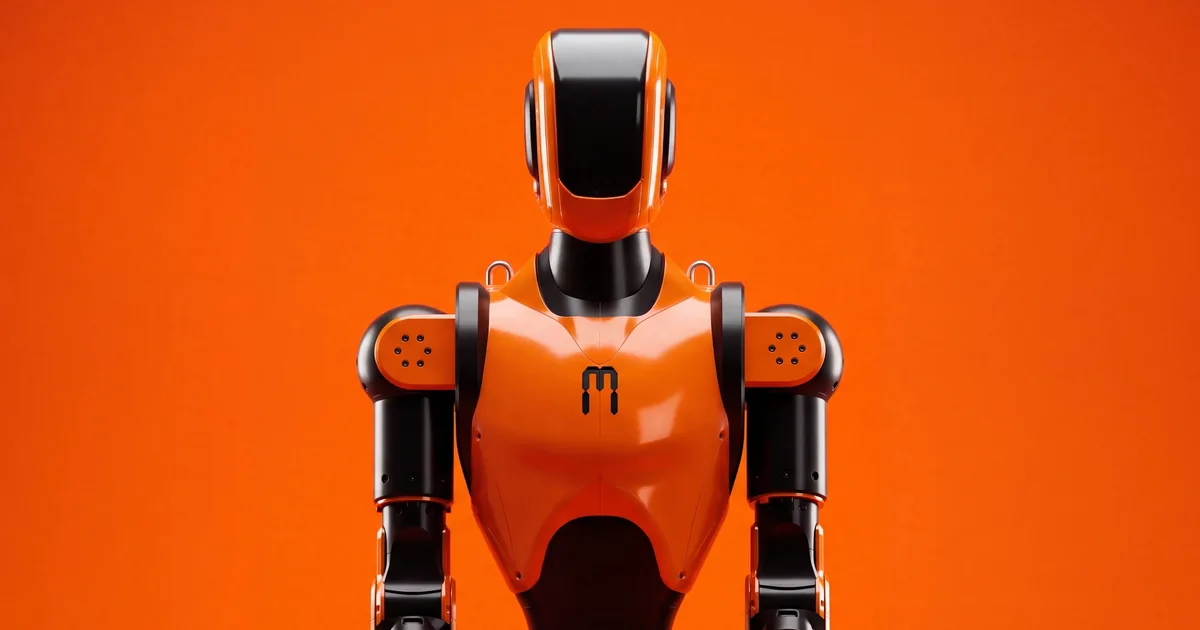
The Asimov 1 is a 1.2 m, 35 kg bipedal humanoid robot from Menlo Research, a Singapore-based lab, and it is sold in a way almost no other humanoid is: as an unassembled kit for $20,000, with the entire design — CAD, wiring, simulation environment and a pre-trained walking policy — published openly on GitHub. It carries 25 actuated degrees of freedom plus two passive toe joints, and Menlo estimates roughly 100 hours of your time to build it.
That framing matters more than any single spec. The Asimov 1 is not competing with Unitree on price-per-capability, and it will lose that fight badly: it ships with no hands, Menlo publishes no battery runtime and no walking speed, and a robot you built in your own workshop carries no warranty and no safety certification. What you are buying instead is total access — the right to see, modify and reprint every part of a walking humanoid. For a university lab or a serious engineer, that is a genuinely different product.
The short version
• What it is: A 1.2 m, 35 kg open-source bipedal humanoid from Menlo Research, Singapore — sold as a kit you assemble.
• Price: $20,000 from Menlo, held with a $499 deposit. Or source the parts yourself from the published BOM.
• Body: 25 actuated DOF + 2 passive spring-loaded toes; CNC 7075 aluminium where loads demand it, Multi Jet Fusion nylon everywhere else.
• Brains: Two boards — a Raspberry Pi 5 for networking and media, a Radxa CM5 for real-time motor control.
• Licences: CERN-OHL-S-2.0 (hardware) and GPL-2.0 (software), open-sourced April 2026.
• Best for: robotics courses, research labs, and engineers who want to modify the hardware, not just the code.
• Not for: anyone who wants a robot that does something useful on day one. It has no hands.
Full Asimov 1 spec page and scores → · About Menlo Research →
What Is the Menlo Asimov 1?
The Asimov 1 is an educational and research humanoid — Menlo's own description is "an educational humanoid for builders, engineers and researchers who want to work with real hardware." Menlo Research open-sourced the design on 27 April 2026, releasing the mechanical CAD, the wiring documentation, a MuJoCo simulation environment and a trained locomotion policy under CERN-OHL-S-2.0 for the hardware and GPL-2.0 for the software. You can, in principle, build one without giving Menlo a cent.
The kit — Menlo calls it the "Here Be Dragons" edition, which tells you something about the intended tone — arrives completely unassembled: structural frame, actuators, motors, sensors, wiring harnesses, assembly manuals and instructional videos. There is a Discord for builders who get stuck. And there is a free browser simulator, Digital Asimov, that lets you write and test control policies against the robot's model before you spend anything at all.
This is a different philosophy from the rest of the humanoid market. Most robots at this price are sold as sealed platforms with an SDK on top; the hardware is the vendor's business and yours stops at the API. Menlo inverts that. Its pitch is "full access to the hardware, so you can build, modify and understand every layer" — which is either exactly what you need or completely beside the point, depending on who you are.
Asimov 1 Specs
These are the figures Menlo Research publishes, cross-checked against independent coverage of the open-source release. Note what is absent: Menlo does not publish a battery capacity, a runtime, or a maximum walking speed, so we do not quote any. Spec aggregators listing a "1.5 hour runtime" or "3 km/h" for this robot are not sourcing those from Menlo.
| Specification | Menlo Asimov 1 |
|---|---|
| Height | 1.2 m |
| Weight | 35 kg |
| Degrees of freedom | 25 actuated + 2 passive toe joints (6 DOF per leg) |
| Arm strength | ≈ 15 kg bicep curl · ≈ 18 kg lateral raise (per arm) |
| Hands | None — not included |
| Ankle | Parallel revolute–spherical–universal (RSU), 2 DOF roll + pitch |
| Feet | Passive articulated toe hinge (unpowered toe rocker) |
| Onboard compute | Raspberry Pi 5 (networking/media) + Radxa CM5 (real-time motor control) |
| Sensors | 2 MP monocular chest camera, 4-microphone array, onboard IMUs; speaker in torso |
| Materials | CNC-machined 7075 aluminium (load-bearing) + MJF-printed PA12 nylon |
| Simulation | MuJoCo with processor-in-the-loop; free browser sim (Digital Asimov) |
| Licences | CERN-OHL-S-2.0 (hardware) · GPL-2.0 (software) |
| Battery / speed | Not published by Menlo |
| Assembly | Ships unassembled — ≈ 100+ hours of build time |
At 25 actuated joints, the Asimov 1 sits at the low end of the humanoid DOF range — for comparison, a Unitree G1 has 23 to 43 depending on configuration, and XPeng's IRON runs 82. That is not a failure of ambition; it is a joint count chosen so the robot can be built, wired and debugged by one person. Our explainer on what degrees of freedom actually mean covers why the number alone tells you less than people assume.
The Engineering Choices That Actually Matter
Strip away the open-source framing and the Asimov 1 is a set of deliberate decisions about reproducibility — every one of them optimised so that a stranger with a 3D printer can rebuild the robot.
7075 aluminium where it counts, printed nylon everywhere else
Menlo uses CNC-machined 7075 aluminium for load-bearing parts and Multi Jet Fusion PA12 nylon for the rest. MJF matters here: it produces strong, dimensionally consistent nylon parts without the tooling cost of injection moulding or the machine time of milling everything. The practical consequence for an owner is that a broken shell or bracket is a print job, not a purchase order — and the CAD to print it is already public.
A parallel RSU ankle and a toe that isn't motorised
The ankle is a parallel revolute–spherical–universal (RSU) mechanism giving 2 degrees of freedom, roll and pitch, driven by two motors sharing the load. Parallel ankles are the current consensus in bipedal design for good reason: torque sharing means two smaller motors do the work of one large one, and the arrangement is more backdrivable, so the foot reacts to the ground rather than fighting it.
The foot then adds a passive, articulated toe hinge — no motor, just a spring-loaded joint that provides toe-rocker behaviour during push-off. It is a cheap, elegant trick: you get a meaningful chunk of human-like gait mechanics for the price of a hinge instead of two more actuators, two more drivers and two more failure modes. This is what the "25+2 DOF" figure on Menlo's site is describing.
Two brains, split by job
Rather than one big compute module, the Asimov 1 runs a Raspberry Pi 5 for networking and media and a Radxa CM5 for real-time motor control. Splitting soft real-time work from hard real-time control onto separate boards is standard practice in serious robotics and unusual at this price point — and both boards are commodity parts you can replace from any electronics distributor, which is the whole point.
Modular mounts
Legs, arms, torso and head connect through universal motor mounts, so a limb can be swapped or redesigned without touching the rest of the platform. If you are a lab testing a new arm design or a new hand, that modularity is worth more than a couple of extra DOF.
How It Learns to Walk
The software story is the most technically interesting part of the Asimov 1, and it is the part most coverage skips.
Menlo trains locomotion in MuJoCo using asymmetric actor-critic reinforcement learning — the critic sees privileged simulator state during training, the actor only sees what the real robot's sensors will see, so the resulting policy can be deployed without cheating. On top of that, Menlo runs what it calls processor-in-the-loop (PIL) simulation: the training environment deliberately injects the imperfections of the real machine, including CAN-bus latencies of up to 9 milliseconds and noisy sensor readings.
That is the right instinct. The reason sim-trained policies fall over on real hardware is almost never the physics — it is that the simulator's motors respond instantly and its sensors are clean, while the real robot's commands arrive late through a bus and its IMU lies a little. Training against those specific defects is why Menlo reports zero-shot sim-to-real transfer for forward and backward walking and push recovery: the policy goes from simulation to the robot without on-hardware fine-tuning. We wrote about why this gap is the hardest problem in the field in our piece on sim-to-real transfer.
For a buyer, the practical upshot is that the robot ships with a walking policy that works, and — more importantly — with the training environment that produced it. You are not reverse-engineering somebody's binary; you are retraining their pipeline.
The Price: $20,000, and the $15,000 That Was Announced
Menlo Research lists the Asimov 1 kit at $20,000, reserved with a $499 deposit, and states that buying the kit rather than sourcing the parts yourself saves roughly $11,000 — the company negotiates bulk pricing on the core hardware, and buying actuators one at a time is punishingly expensive. Menlo also warns that the final price varies by destination country because of tariffs and shipping.
Be aware of one wrinkle in the record. When the DIY kit was announced in May 2026, it was widely reported at a $15,000 target price, and Menlo's own engineering write-up on the legs put the anticipated manufacturing cost of a full system at under $20,000. The listed kit price today is $20,000. We have no statement from Menlo explaining the difference, so treat the earlier $15,000 figure as an announcement target rather than a price you can still get — and confirm the current number with Menlo before committing, especially outside the US.
How does that compare? Badly, if you measure in capability per dollar. A Unitree G1 is $13,500, assembled, with hands, an onboard AI stack and a support organisation behind it. A Unitree R1 starts at $4,900. A Booster T1 at $33,949 is a championship-proven research biped that arrives working. On raw specs the Asimov 1 loses to all three.
It wins on a different axis entirely: none of those robots hand you the CAD. If your research question is "what happens if I change the ankle," the Asimov 1 is the only one of the four that lets you answer it.
What the Kit Doesn't Include
This is the section that should decide the purchase, so we will be blunt about it.
No hands. Menlo says so directly. The arms are rated for roughly a 15 kg curl and an 18 kg lateral raise, which is genuinely strong for a 35 kg robot — and completely academic without an end effector. Any manipulation work starts with you designing or sourcing hands.
No published battery figure. There is no capacity, no runtime, no charge time on Menlo's product page or in its documentation. For a mobile robot that is a significant gap, and it is the single number we would most want before buying.
No walking speed. Menlo publishes locomotion capability (forward, backward, push recovery) but no m/s or km/h figure. We do not quote one, and neither should anyone else.
Thin sensing. One 2 MP monocular camera, a four-mic array and IMUs. There is no depth camera and no lidar. For locomotion research that is defensible; for anything involving perception you are adding sensors yourself.
No warranty, no certification. A self-assembled 35 kg bipedal machine is your responsibility in every sense — mechanical, electrical and legal. Support is a Discord channel, not an RMA process.
Documentation still in flight. At the time of writing, Menlo's own docs list the electronics release manifest as to-be-confirmed, with full schematics, PCB files and the mobile app still pending, and the detailed BOM behind an access request. The mechanical CAD is public; the electrical side is less finished than the headline "fully open source" suggests.
Who the Asimov 1 Is For
Buy it if you are a university robotics course, a research lab, or an engineer with a workshop and a specific hardware question. In a teaching context the 100-hour build is a feature, not a cost — assembling a humanoid from a frame and a pile of actuators teaches more about bipedal robots than a semester of driving one through an SDK. And the licences mean anything you design on top can be published, forked and built on, which is exactly what a research group wants.
Skip it if you want a robot that does something. No hands means no manipulation; no published runtime means no planning around it; no warranty means every failure is your weekend. If the goal is a working humanoid on a lab bench next month, the Unitree lineup will get you there for less money and considerably less pain. And if you are shopping the whole market, start with our guide to the best humanoid robots you can actually buy in 2026.
The Verdict
The Asimov 1 is the most genuinely open humanoid robot you can currently buy, and that is not a small thing — publishing CAD, a bill of materials, a simulation environment and a working locomotion policy under CERN-OHL-S and GPL is a materially more generous act than the "open" labels the rest of this industry hands out. The engineering behind it is thoughtful in the ways that count: a parallel RSU ankle, a passive toe that buys gait quality for free, commodity compute split by real-time requirement, and printed parts you can replace yourself.
But $20,000 buys you a kit, not a robot, and the gaps are real: no hands, no battery figure, no speed figure, minimal sensing, a documentation set that is still filling in, and a price $5,000 above what was announced three months ago. It scores 52.2 in our catalogue — 13th of the 15 priced humanoids we rate — and that is the honest number for a machine whose value lives almost entirely in its openness rather than its capability.
Judge it as a teaching platform and a hardware research base and it is excellent, arguably unique. Judge it as a robot and it is expensive and incomplete. Menlo, to its credit, is not pretending otherwise — the kit is literally called "Here Be Dragons."
Full Asimov 1 spec page and scores → · Menlo Research's Asimov 1 page ↗