
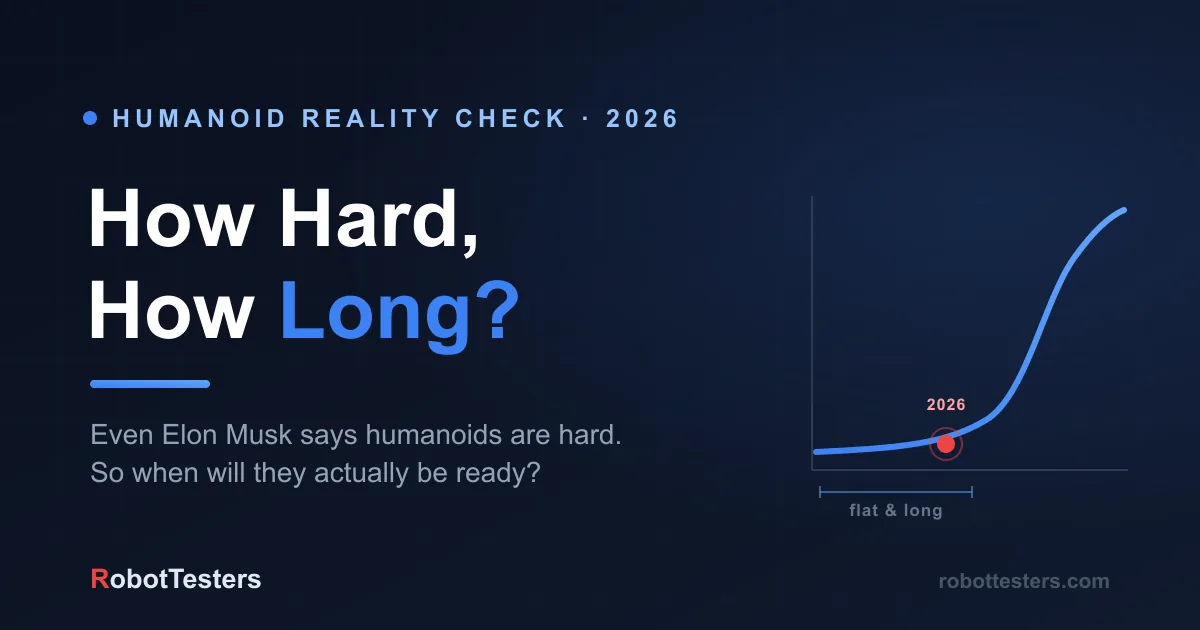
For years, the loudest voice in humanoid robots was also the most confident one. So it landed hard when, on Tesla's July 23, 2026 earnings call, Elon Musk called Optimus the hardest product to scale in manufacturing Tesla has ever made, warned that the early part of its production curve would be "quite flat and long," and admitted that "everything on the robot is new." Wall Street heard the change in tone, and Tesla stock fell about 14% in the days that followed.
Here's the thing worth saying out loud: none of this is bad news, and none of it is surprising. The difficulties Musk described aren't a Tesla problem — they're the whole industry's, and everyone actually building these machines has known it for years. The honest read on 2026 is that the humanoid race is crowded, some players are genuinely ahead, and yet no one has a robot that does what buyers expect it to do the day they switch it on. That gap is exactly why humanoids will take a few more years — but a few, not the "50 years away" that skeptics still repeat. My own call is more aggressive, and I'll put a number on it below.
Key takeaways
- Musk said the quiet part loud: Optimus is the hardest product Tesla has ever tried to scale, the ramp will be "flat and long," and the human hand still isn't solved.
- The market flinched: Tesla stock fell ~14% after the call — a reaction to candor about robot difficulty as much as to a quarter with negative free cash flow.
- Money is racing ahead anyway: the same month, Unitree won approval for a record ~$618M IPO on Shanghai's STAR Market — on track to be the first pure-play humanoid maker on China's A-share market.
- The difficulties are universal: hands, real autonomy, endurance and cost are walls every maker faces. Musk even admitted rival demos are "preprogrammed or remote controlled."
- There is no MVP humanoid yet: nothing on sale reliably does general home or work tasks out of the box. My timeline: 5–10 years for the mainstream version, and I'd personally bet 2–5 years — hopefully less.
What Musk actually said — and why the market flinched
Strip away the headlines and Musk's message on the call was refreshingly blunt. He framed Optimus not as a finished miracle but as the single hardest thing Tesla has attempted, precisely because there's no existing template to copy. "Everything on the robot is new," he said, "and the difficulty of scaling the production ramp is proportionate to the newness." He borrowed the classic technology S-curve to set expectations: the beginning would be "quite flat and long" before it ever bends steeply upward. In plain terms — don't expect a hockey-stick launch.
The specific villain, again, is the hand. Musk has repeatedly described the human hand as an almost absurdly hard thing to copy — a dense package of tendons, sensing and fine control that no robotics company has fully replicated — and he's said the electromechanical hand and forearm represent a huge share of the total Optimus challenge. Tesla has already thrown out at least one hand design (a widely-patented 25-actuator, 22-degree-of-freedom version) because it "ultimately didn't work," and is moving to a far more complex hand with around 50 actuators. Worse, the supply chain for those precision parts barely exists — Tesla has to build much of it from scratch. We went deep on this body-vs-brain gap in our breakdown of Optimus Gen 3 and why the brain lags the body.
Investors weren't spooked by any single fact; they were spooked by the tone. When the industry's most bullish figure spends an earnings call managing expectations downward — and the quarter shows negative free cash flow of roughly $1.1 billion even with 26% revenue growth — the market re-prices the optimism it had baked in. Hence the ~14% slide. If you're wondering why a robot that isn't for sale can move a trillion-dollar stock, it's because Musk keeps saying Optimus could ultimately become Tesla's largest product. The valuation isn't priced on the cars anymore; it's priced on the robot. That's also the backdrop to our take on why robots are the next bubble after AI.
"When the most confident person in the room starts talking about how hard the problem is, that's not a red flag — it's the first honest status update the category has had in a while."
The other market story: Unitree rings the bell while Musk sounds the alarm
Now the delicious contrast. In the very same window that Musk was cooling expectations, a competitor was heading for the stock market on a wave of enthusiasm. In July 2026, China's securities regulator approved an IPO for Unitree Robotics — the Hangzhou company famous for cheap robot dogs and the $4,900-and-up Unitree humanoid lineup — on Shanghai's STAR Market. Unitree aims to raise about 4.2 billion yuan (roughly $618 million) by issuing at least 40.45 million shares, at a reported valuation near 40 billion yuan (about $5.9 billion). It's on track to become the first pure-play humanoid developer to list on China's mainland A-share market, and it got one of the fastest approvals the STAR board has granted — a signal of just how badly Beijing wants to back the sector.
So within a few days you had both faces of this market at once: in the West, the field's biggest name warning that the hard part is still ahead and watching his stock drop; in China, a rival being cheered onto the exchange at a multibillion-dollar valuation, with peers like Deep Robotics and Leju reportedly lining up their own listings. Capital is sprinting toward humanoids faster than any finished product actually exists. That's not a contradiction — it's how every platform shift looks up close. But it's a reminder to separate the investment story (real, hot, and moving now) from the product story (real, but years from mainstream). We mapped who's actually shipping today in who's really mass-producing humanoid robots in 2026.
None of this is news to the people building robots
If you follow the field closely, Musk's "confession" reads less like a bombshell and more like someone finally saying on the record what engineers have muttered for years. Every serious humanoid maker hits the same walls, in roughly the same order:
The human hand is the hardest subsystem in robotics — force, sensing and control in a tiny package, with almost no off-the-shelf supply chain. It's the piece Musk keeps flagging, and it's why demos grip a box but can't fold your laundry.
Walking is largely solved; deciding what to do, unsupervised, in a messy home is not. The gap between a polished demo and a robot that improvises is still measured in years, not months.
A useful worker needs a full shift of runtime and thousands of hours between failures. Most humanoids still measure battery life in a couple of hours and reliability in careful demos.
A robot people will actually buy has to be affordable and mass-manufacturable. That means actuators, reducers and sensors at automotive scale — a supply base that, for humanoids, is only now being built.
The most damning line of the whole call wasn't about Tesla — it was about everyone else. Musk flatly said the jaw-dropping clips you scroll past are "preprogrammed or remote controlled," and that "there is no humanoid robot that is actually able to do generalized tasks." Coming from a direct competitor, that's worth taking seriously, because it matches what we saw with our own eyes. At ICRA 2026 in Vienna, a striking number of "autonomous" humanoids on the show floor were quietly being driven by a human with a joystick. XPeng's IRON face-planted on stage in front of the cameras. The viral-demo era taught the public to expect finished robots; the reality is that most of what looks autonomous still has a person in the loop. That's why we keep arguing you have to test humanoids on real jobs, not backflips.
A crowded race with real leaders — and no MVP yet
So where does that leave the standings? It's a genuine race with a dozen credible entrants, and some are clearly ahead: Unitree on price and volume, Figure on Western factory pace, Agility on real deployments, Boston Dynamics' electric Atlas on raw capability, and Tesla on the sheer manufacturing muscle it could eventually bring. But "ahead" is not the same as "done." Here's the uncomfortable truth that ties the whole story together: not a single company has shipped an MVP humanoid — a minimum viable product that meets the baseline most people picture when they hear "buy a humanoid robot."
What would that MVP actually need? Four things, together, reliably, at a price a normal buyer will pay:
| What buyers expect from an MVP humanoid | Why it's the wall | State in 2026 |
|---|---|---|
| Do useful tasks unsupervised | Real autonomy in a messy, changing home or workplace | Not yet |
| Human-level hands | Grasp, feel and manipulate everyday objects reliably | Not yet |
| All-day endurance & reliability | A full shift of work with few failures, not a 2-hour demo | Partial |
| Works out of the box | Little setup, no teleoperator quietly driving it | Not yet |
| Affordable at scale | Mass-manufacturable near a consumer price point | Getting there |
The robots you can actually buy in 2026 — the Unitree R1 and G1, AgiBot X2, Booster T1 — are real and genuinely produced at volume, but they're developer and industrial platforms, not do-it-all home helpers. The mass-market machines everyone pictures — Optimus, Figure 03, 1X NEO — are the ten you still can't buy. You can live with a humanoid today, but only as a pioneer who accepts rough edges — a case we made in the robot early-adopter window is open now. The MVP that just works, for everyone, hasn't been born yet.
So how many years — really? Not 50. Try 5 to 10 (I'd bet 2 to 5)
This is the question that actually matters, so let me answer it directly instead of hiding behind "it depends." The old "humanoid robots are 50 years away" line is dead. It made sense when bipedal walking was an open research problem and AI couldn't reason about the physical world. Neither is true anymore. Bodies already walk, run half-marathons and dance; large AI models are closing the autonomy gap month by month; capital is flooding in through record IPOs and multibillion-dollar valuations; and China is driving the cost curve down while pushing volume up. The hard problems Musk describes are real, but they're engineering-and-scaling problems measured in years — not the fundamental-science problems that would justify decades.
At the same time, the "it's basically here" crowd is wrong too. Musk's flat-and-long S-curve is the honest shape of it: the hand isn't solved, autonomy isn't solved, and reliability at a full-shift, do-anything level isn't solved. Those don't fall in a single product cycle. Put those two truths together and you get a sober middle: a genuinely useful, buy-it-and-it-works humanoid for the mainstream is most likely 5 to 10 years away, with credible early versions arriving sooner for people who tolerate the rough edges.
My personal, on-the-record call is more aggressive than that consensus: I think the first humanoid that meets the core expectations most buyers actually have — useful work, decent hands, works out of the box, at a price that isn't insane — lands in 2 to 5 years, and I'd love to be proven slow. Two forces make me bet short: the AI side is improving faster than the hardware side ever did, and China's manufacturing machine has a habit of collapsing timelines everyone thought were fixed. I could be wrong on the optimistic side — the hand alone could eat a couple of years — but I'd rather be early and adjust than repeat the "50 years" mistake in the other direction.
"Musk admitting it's hard isn't the story. The story is that it's hard and money is pouring in and the bodies already work — which is exactly what the last few years before a breakthrough look like. My bet: 2 to 5 years, hopefully less."
If you take one thing from this: don't confuse a difficult problem with an impossible one, and don't confuse a hot investment with a finished product. The humanoid you're dreaming of is coming, and it's coming soon by any historical standard — just not this year, and not because any one company cracked it alone. It'll arrive because an entire crowded race, difficulties fully admitted, kept grinding the S-curve until it finally bent.