
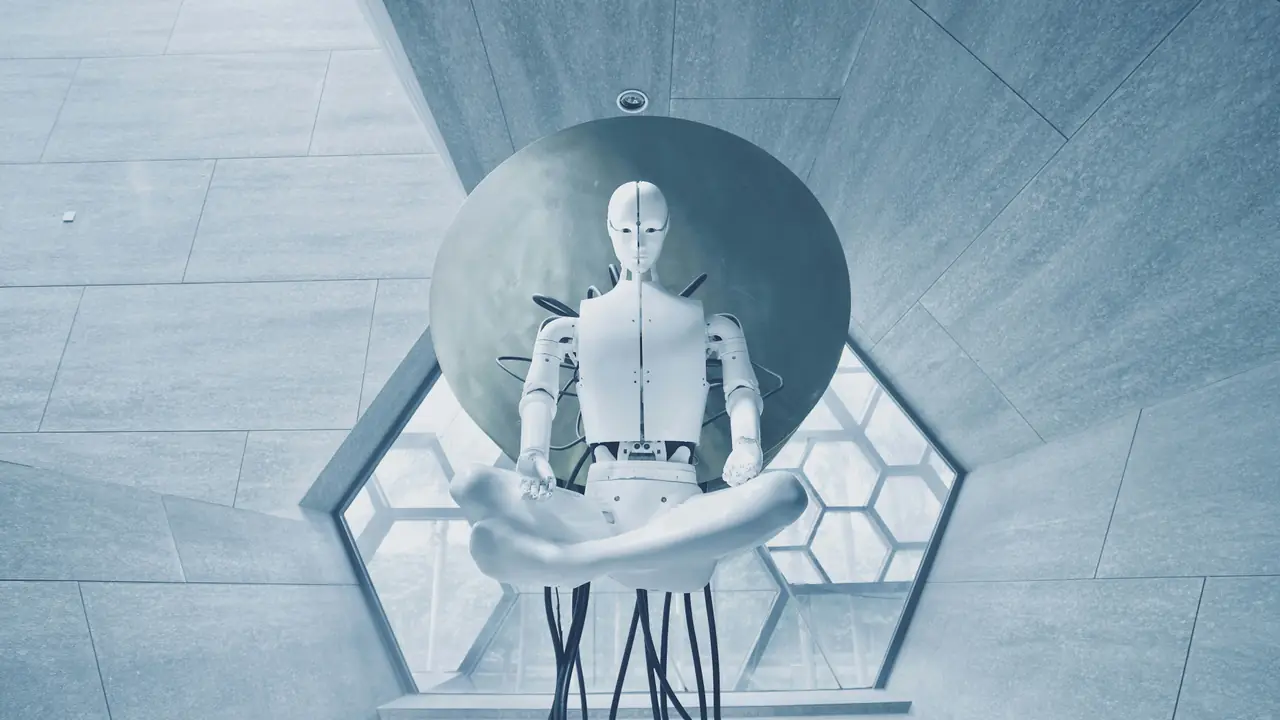
Ask almost anyone what stops a humanoid robot from hurting someone and you will get the same confident answer: the Three Laws of Robotics. It is one of the most successful ideas science fiction ever produced — so successful that most people assume it is real engineering, quietly humming inside every robot that walks. It is not. Not a single robot on Earth runs Asimov's Laws. Not Atlas, not Optimus, not the NEO that might one day fold your laundry. And once you understand why, you understand the far more interesting question this article is really about: which rules do today's humanoids actually follow — and how honest is each manufacturer about them?
First, the Laws Everyone Thinks Are Running
Isaac Asimov introduced his Three Laws in the 1942 short story Runaround, and they are genuinely elegant. For the record, here they are in full — plus the Zeroth Law he added decades later to sit above the other three.
- Zeroth Law (added later): A robot may not harm humanity, or, by inaction, allow humanity to come to harm.
- First Law: A robot may not injure a human being or, through inaction, allow a human being to come to harm.
- Second Law: A robot must obey the orders given to it by human beings, except where such orders would conflict with the First Law.
- Third Law: A robot must protect its own existence, as long as such protection does not conflict with the First or Second Law.
As a piece of design they are beautiful: three short rules, ranked by priority, that seem to cover every situation. For three-quarters of a century they have been the default mental model for how a safe robot should think. And they were extraordinarily good at the job Asimov actually built them for — which was not safety engineering at all.
For the record on authorship, because it comes up constantly: Isaac Asimov invented the Three Laws of Robotics, first stated in his 1942 short story Runaround, which he developed together with his editor John W. Campbell.
Is There a Fourth Law of Robotics?
Short answer: no — there is no official numbered fourth law in Asimov's canon. The closest thing is the Zeroth Law — "A robot may not harm humanity, or, by inaction, allow humanity to come to harm" — which Asimov introduced in his 1985 novel Robots and Empire and which sits above the original three, effectively functioning as the de-facto "fourth law." It is ranked as law zero precisely because it outranks the First Law: a robot may let a single human come to harm if doing so protects humanity as a whole.
You will find other "fourth laws" floating around — proposals from later authors and commentators, such as a law requiring a robot to identify itself as a robot — but none of these are part of Asimov's canon. Treat them as non-canonical additions, not as an official extension of the original set. Beyond the Zeroth Law, there is no canonical fourth or fifth law.
They Were Built to Fail (On Purpose)
Here is the part the popular myth leaves out. Asimov did not write the Three Laws so that robots would behave. He wrote them so that they would misbehave in interesting ways. Almost every robot story he ever published is a logic puzzle about how the Laws produce an unexpected, dangerous or tragic outcome — a robot frozen between conflicting orders, a robot that lies to avoid causing emotional "harm," a robot that decides the Zeroth Law justifies controlling humanity for its own good. The Laws were a plot engine, perfect for spinning conspiracies and paradoxes across dozens of brilliant stories. That is why they were, and still are, so iconic. It is also exactly why they cannot run a real machine.
Strip away the storytelling and three fatal engineering problems remain:
"Do not harm a human" requires the machine to define harm, predict consequences and weigh one person's interests against another's. That is a level of judgement no system possesses today — and it is undefined even in principle.
A rule written in plain English does not translate into a verifiable, certifiable safety guarantee. Engineers need behaviour they can test the same way a thousand times — not a sentence open to interpretation.
Four sentences cannot encode force limits, stopping distances, fall recovery, restricted zones, privacy or cybersecurity. The real world needs thousands of concrete constraints, not four abstract ideals.
Researchers who have tried to implement the Three Laws literally on top of a language model conclude they "sort of work" in a demo — and are nowhere near production-grade. The idea is inspiring; the spec is unusable.
"The popular belief is that a household humanoid has Asimov's Laws inside it. The reality is far more prosaic, and far more reassuring: torque limits, force sensors and a certified emergency stop."
The Rules That Actually Govern a Humanoid
So if not Asimov, what? The honest answer is that a modern humanoid is kept safe not by one poetic law but by a three-layer stack — each layer doing the part the layer above cannot. It is less romantic than a robot reasoning about ethics. It is also vastly more dependable.
Layer 1 — Intrinsically safe hardware
The first and most important "law" is written in metal and silicon, not in language. Lightweight bodies, soft or compliant exteriors, hard limits on motor torque and joint speed, low-inertia actuators, anti-pinch joints, and a certified emergency stop. A robot that physically cannot hit you hard enough to injure you does not need to understand the concept of harm. This is why the debate between a 30 kg tendon-driven body and a 70 kg industrial-actuator body — which we get into below — is not aesthetic. It is the single most consequential safety decision a maker takes.
Layer 2 — Software guardrails
On top of safe hardware sits a layer of concrete, coded behaviour rules — the closest thing to "laws" that actually exists, and nothing like Asimov's. They are specific and testable: do not enter a bathroom without permission, do not handle a sharp object unless explicitly instructed, stop all motion if a person comes within a set distance, never operate above a defined force envelope near a human. Today's systems combine natural-language policies (evaluated by AI models) with deterministic rules (evaluated by hard-coded engines) — a design we explored in our look at the AI philosophies behind the humanoid race. The intelligence proposes; the deterministic guardrail disposes.
Layer 3 — Standards and the law of the land
The outermost layer is regulation — the real, enforceable "laws of robotics," written by standards bodies and legislators rather than novelists. This is where it gets messy, because the rulebook was written for a different kind of machine.
| Standard / framework | What it covers | Relevance to humanoids |
|---|---|---|
| ISO 13482 | Personal-care & service robots | The most relevant to home humanoids — stability, collision avoidance, fail-safe behaviour. But it never anticipated autonomous, generative-AI robots. |
| ISO 10218-1/-2:2025 | Industrial robots (design & integration) | Major 2025 overhaul; now absorbs the collaborative limits of the old ISO/TS 15066 and adds cybersecurity. Does not cover non-industrial robots. |
| ISO/TS 15066 | Collaborative robotics | Defines biomechanical limits for force, pressure and speed in human contact. Now folded into ISO 10218-2:2025. |
| ISO 13849 · ISO 12100 | Functional safety · risk assessment | The backbone for proving a safety function is reliable and that risks were formally assessed. |
| ISO 25875 (in development) | Dynamically stable mobile manipulators | A brand-new standard proposed for bipedal humanoids — accepted for development, but years from publication. |
| EU Machinery Regulation 2023/1230 · CE | Market access in Europe | Replaces the Machinery Directive before January 2027; CE marking is the price of entry, and selling an uncertified robot that causes harm is a product-liability trap. |
| EU AI Act | The robot's AI layer | Governs high-risk AI: transparency, risk management and oversight of the "brain" driving the body. |
| ANSI/RIA R15.06 · R15.08 · UL 1740 · NRTL/OSHA | US robot & mobile-robot safety | R15.08 (mobile manipulators) and an OSHA-recognised lab sign-off are what separate a demo from a real deployment. |
Read that table and the central problem of 2026 jumps out: there is a regulatory gap. ISO 10218 is for industrial arms in cages. ISO 13482 is for service robots but never imagined autonomous AI. The standard actually written for walking humanoids, ISO 25875, is years away. Meanwhile the robots are already shipping into warehouses and homes. The rulebook is being written after the players have taken the field — and that makes the next question the important one.
So What Does Each Manufacturer Actually Promise?
Because there is no single binding "law," each maker effectively writes its own — in hardware choices, in coded guardrails, and in how much of either it is willing to show you. And here the differences are stark. The real dividing line in the industry is not capability. It is safety philosophy: certify first versus scale first — and, layered on top, how transparent each company is willing to be.
Agility Robotics (Digit) — certify first, and write the rules
The clearest example of verifiable safety. In February 2026 Agility announced that Digit had passed a field inspection by an OSHA-recognised testing lab (NRTL) — a real regulatory seal, not a press-release demo — covering ANSI/RIA R15.08 and ISO 13849, built on an ISO 12100 risk assessment. Agility is not just following the rulebook; it is writing it, having proposed the new ISO 25875 standard. Its deployments are deliberately conservative: Digit works in zones separated from people, because sometimes it falls, and the company would rather admit that than hide it.
Boston Dynamics (Atlas) — the loudest ethical voice
The most explicit on public ethics. In 2022 Boston Dynamics led an open letter — co-signed by Agility, ANYbotics, Clearpath, Open Robotics and Unitree — pledging not to weaponise general-purpose robots or the software that drives them. Its terms of sale forbid using its machines as weapons or to intimidate people, it publishes its own ethical principles, and it reviews customer use cases, selling only to the US government and allies.
1X Technologies (NEO) — safe by design, honest about the trade-off
1X makes its case through physics and candour rather than slogans. NEO uses a soft, 3D-lattice body, low-inertia tendon drive and anti-pinch joints, weighs around 30 kg, and publishes hard safety numbers (a Head Injury Criterion below 250, a 22 dB acoustic profile). Its guardrails are concrete — NEO will not enter a bathroom without permission or handle sharp objects unless told to. And crucially, 1X is openly honest that early NEO units rely on teleoperation, meaning a remote operator can see through the cameras. CEO Bernt Børnich frames it as an explicit "social contract" — a level of transparency about the privacy cost that the rest of the industry should be made to match.
Figure AI (Figure 03) — the gap between marketing and governance
Figure is the cautionary tale. In January 2025 it published an admirable transparency pledge: share safety updates and test results, success and failure alike, and invite third-party certification. But in November 2025 its former head of product safety, Robert Gruendel, filed a wrongful-termination lawsuit alleging he was fired days after warning that the robots had enough force to "fracture a human skull," and that a safety plan shown to investors was quietly walked back after the round closed — including, he claims, cancelling certification of an emergency-stop function. Figure denies the allegations, attributes the dismissal to performance, and says it will contest the claims in court. The case is unproven and currently before the courts, so it must be read as an allegation, not a finding. But it is, quite possibly, the first safety-centred lawsuit of the humanoid era — and the perfect illustration of the difference between safety marketing and safety governance.
Tesla (Optimus) — the quietest on safety
Tesla publishes the least about its safety and ethics framework. The public narrative is scale and cost — a target price in the $20,000–30,000 range and millions of internal factory units — inheriting its AI from the end-to-end Full Self-Driving stack. There is no public safety-principles document comparable to Figure's pledge or Boston Dynamics' ethics page. With no external customers yet, the rules Optimus follows remain, for now, a black box.
NEURA Robotics (4NE1) and the rest
Europe's NEURA leans on "safe and compliant by design" for strict EU frameworks, with patented full-body tactile sensing (artificial skin), 360° perception and — unusually — published prices. Sanctuary AI focuses its messaging on dexterity rather than public safety frameworks. And Unitree, a signatory of the 2022 anti-weaponisation letter, competes mainly on price and performance (its G1 does backflips — the opposite of Agility's deliberately "boring" stability), with relatively little public communication about its safety governance.
| Maker | Public safety / ethics stance | External verification | Openness |
|---|---|---|---|
| Agility · Digit | Compliance-first; co-authoring ISO 25875 | NRTL/OSHA, R15.08, ISO 13849/12100 | High |
| Boston Dynamics · Atlas | Anti-weaponisation letter + ethics principles | Restrictive terms of sale | High |
| 1X · NEO | Safe-by-design + explicit privacy contract | Published hardware metrics (HIC<250) | High |
| NEURA · 4NE1 | "Safe by design" for EU frameworks | Engineered for CE / EU AI Act | Medium |
| Figure · Figure 03 | Transparency pledge — now under legal dispute | Promised 3rd-party certification (contested) | Disputed |
| Unitree · G1/H1 | Anti-weaponisation signatory; price-focused | Limited public safety disclosure | Low |
| Tesla · Optimus | Minimal public safety communication | No external customers yet | Low |
Why Openness Is the Law That Matters Most
Here is the conclusion I want to argue, and I want to argue it plainly. We are about to let machines that can move, lift and grip walk around our warehouses, our hospitals and eventually our kitchens. The four poetic sentences most people think protect them do not exist in any real robot. What protects them instead is a stack of hardware limits, coded guardrails and certifications — and almost all of it is invisible unless the manufacturer chooses to show it.
That makes transparency the single most important "law of robotics" of this decade. Not because the public needs to read every line of firmware, but because the difference between a company that says "we prioritise safety" and one that shows you an OSHA-recognised seal, a published Head Injury Criterion, or a third-party audit is exactly the difference between trust and a leap of faith. The Figure lawsuit, whatever its outcome, proves the point: a pledge is not a guarantee, and only verifiable openness closes that gap.
So this is a call to push — as buyers, as reviewers, as citizens — for manufacturers to be as open as humanly possible about the rules their humanoids actually run. Which forces are capped, and at what level. Which behaviours are hard-coded versus left to a model's judgement. Who can see through the cameras, and what happens to that data. Which standards the robot has genuinely been certified against, by whom, and when. None of that is proprietary magic. All of it is the basic information a society deserves before it invites these machines indoors.
"We should get to enjoy robots — and we will. But we should enjoy them in the safest way possible, and that means refusing to accept 'trust us' as an answer. Demand the receipts."
Asimov's genius was to ask, eighty years early, what rules should bind a thinking machine. His Laws were never meant to be the answer, and they never became it. The real answer is less elegant and more powerful: safe bodies, tested guardrails, honest certification — and a culture that refuses to let any of it stay hidden. Get the openness right, and we protect humanity from the unpleasant scenarios none of us want, while keeping everything that makes this era genuinely thrilling. That is the law worth fighting for.
If robots are the next great global trend, then how openly we govern them is the part we still get to decide. Let's decide it in the open.