
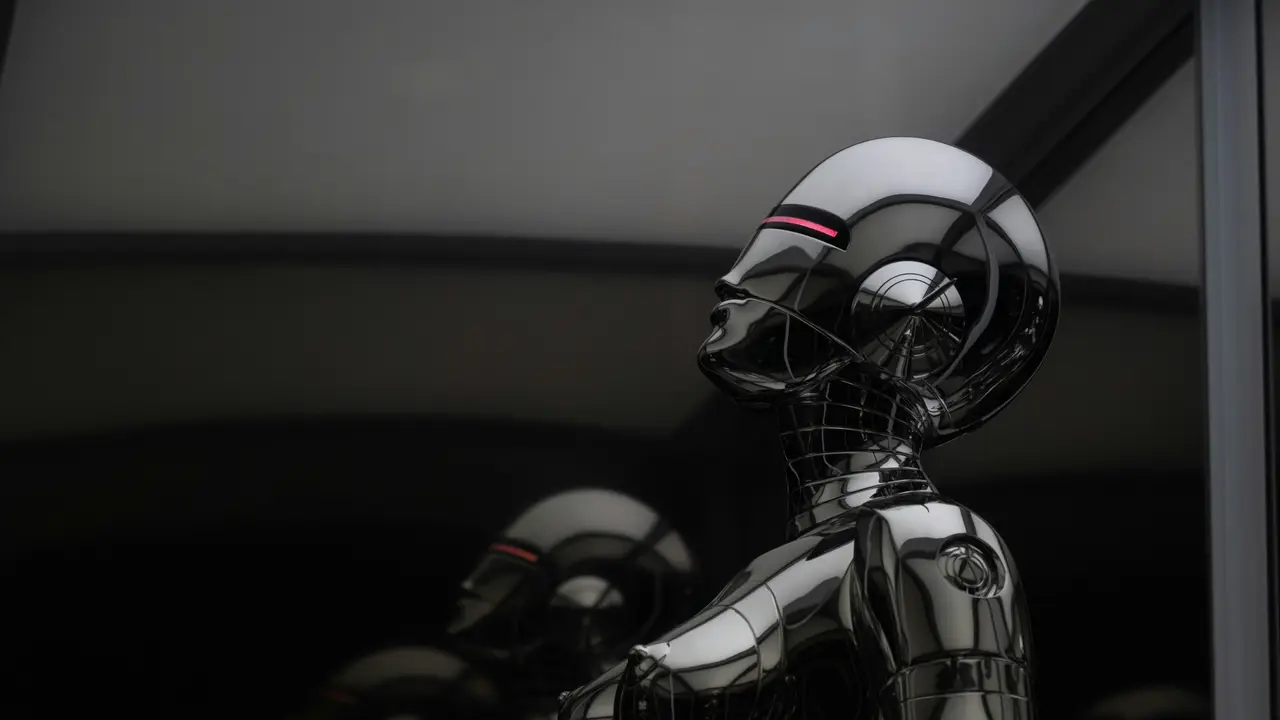
Here is the uncomfortable truth that no humanoid company will print on a banner: not one of the robots racing toward production is actually good at everything a production robot needs to do. The one with the strongest arms can't recharge itself. The one with the smartest brain isn't for sale. The one already working in warehouses has the dexterity of a pair of oven mitts. Every machine in the field is a brilliant compromise.
So we ran the thought experiment we've wanted to run since we started scoring these things. We have 18 humanoid robots in the RobotTesters database, each one broken down into the same scored subsystems — mobility, intelligence, build quality, value, developer experience and ecosystem. What if we ignored brand loyalty entirely and, for each subsystem, simply took the best part in the building? What would the perfect production humanoid look like if you could bolt Atlas's back onto Tesla's hands and run Figure's brain on top?
What follows is that machine, assembled one component at a time, with the winner of each round decided by our scores and the hard specs behind them. It is a Frankenstein robot — and like Frankenstein's monster, you'll see at the end exactly why it can't actually be built. But the exercise does something more useful than crown a single robot: it draws the precise outline of what "production-ready" really demands, and shows how far the best shipping machine still is from the whole package.
- Legs & speed: Unitree H1 — 3.3 m/s, the bipedal walking record
- Body & weatherproofing: Deep Robotics DR02 — the only IP66 humanoid, −20 °C to +55 °C
- Arms & payload: Boston Dynamics Atlas — 50 kg lift, 2.3 m reach
- Power & uptime: Apptronik Apollo — hot-swap battery in seconds, built for back-to-back shifts
- Hands: Tesla Optimus Gen 3 — 22 DOF and 50 actuators per hand
- Skeleton & compute: Unitree H2 Plus — 75 DOF, NVIDIA Jetson Thor
- The working brain: Figure 03 — Helix 02 doing real household tasks
- Safety: 1X NEO Beta — gear-free, the only design with no crush risk
- Software & value: Unitree G1 — best SDK and ecosystem at $13,500
- Proven in production: Agility Digit — already working in Amazon warehouses
The Legs: Locomotion and Speed — Unitree H1
A production robot that can't move quickly between stations is a very expensive statue. The first part we need is a pair of legs that can actually cover ground, and the benchmark here belongs to the Unitree H1. It holds the world record for bipedal humanoid walking speed at 3.3 m/s — faster than a brisk human walk — and it's the only humanoid in our database to score a perfect 10 on max speed. The H1 pairs that pace with a mid-360 LiDAR sensor suite and a 30 kg payload, which is why it's been a fixture in serious locomotion research since 2023.
Tesla Optimus Gen 3 matches the 3.3 m/s figure on paper and the wheel-less quadrupeds go faster still, but for a walking, human-shaped machine that has to share a factory floor with people, the H1's proven, record-setting gait is the part to graft on.
3.3 m/s bipedal walking record, the only 10/10 for max speed in our database. The fastest pair of human-shaped legs money can buy.
The Body: All-Terrain, All-Weather Durability — Deep Robotics DR02
Most humanoids are quietly indoor pets. Point them at rain, dust or a cold morning and the warranty evaporates. The Deep Robotics DR02 is the exception that should define the shell of our perfect robot: it is the world's first IP66-rated humanoid, certified to keep working in rain and dust across an operating range of −20 °C to +55 °C. It's the only humanoid besides Atlas to earn a perfect 10 for both durability and terrain adaptability, and it backs that up with a 4.0 m/s top speed, a 20° slope rating and 25 cm continuous stair climbing.
For a robot that's supposed to go into production — construction sites, energy infrastructure, outdoor logistics — weatherproofing isn't a luxury, it's the price of admission. The DR02 is the only one that's paid it.
The first and only IP66 all-weather humanoid: rain, dust and −20 °C to +55 °C. Perfect scores for durability and terrain.
The Arms: Strength, Payload and Reach — Boston Dynamics Atlas
Now for the muscle. If the job is moving real loads, nothing in the field touches Boston Dynamics Atlas. The fully electric Atlas that arrived at CES 2026 lifts a 50 kg arm payload across a 2.3-metre reach — the only humanoid in our database to score a perfect 10 on payload capacity, and it does it on custom Hyundai Mobis actuators with aerospace-grade build quality. Unitree's H1 (30 kg) and Apptronik's Apollo (25 kg sustained) are strong, but Atlas is in a different weight class, literally.
Atlas is also the most capable machine in our entire database on raw mechanical specs, full stop. We'll borrow its arms and reach here — and resist the temptation to just clone the whole robot, because as you'll see, Atlas has its own production-grade weaknesses.
50 kg arm payload and a 2.3 m reach — the only perfect-10 payload score in our database, on aerospace-grade Hyundai actuators.
The Power System: Endurance and Zero-Downtime Uptime — Apptronik Apollo
Here's the spec the demo videos never show you: how long can it work without stopping? In production, downtime is the whole ballgame. A robot that runs eight hours then charges for two means you buy a second robot to cover the shift. The part to borrow is Apptronik Apollo's power system: a battery you can hot-swap in seconds, on top of roughly four hours of runtime, purpose-built so a unit keeps working across back-to-back shifts. Apollo carries 12-plus years of NASA and DARPA engineering and the backing of Samsung and Google, and it was designed from the start around logistics uptime rather than stage demos.
Two rivals deserve a nod. Boston Dynamics Atlas goes one better in theory with a battery it swaps itself, autonomously — no human in the loop at all. And Tesla Optimus Gen 3 claims the longest single charge at around five hours, while Figure 03 docks and wirelessly recharges itself. The ideal production robot would fuse Apollo's hot-swap speed with Atlas's autonomy, but if we're picking one shipping power system built for real shift work, Apollo is it.
Hot-swappable battery in seconds plus ~4 h runtime, engineered for continuous logistics shifts. Atlas (self-swap) and Tesla (~5 h) are the runners-up.
The Hands: Dexterity and Fine Manipulation — Tesla Optimus Gen 3
Legs get a robot to the work; hands decide whether it can actually do the work. Hand design is the hardest unsolved problem in humanoid robotics, and the most advanced fingers targeting production belong to Tesla Optimus Gen 3: 22 degrees of freedom and 50 actuators per hand. "Gen 3" literally refers to this new hand grafted onto the proven Gen 2 body — the single area where Tesla is unambiguously pushing the frontier, with tactile sensing aimed at gripping an egg and a metal bolt with the right force for each.
The competition is closer here than anywhere else. Unitree's H2 Plus matches the 22-DOF-per-hand count with tactile Sharpa Wave five-finger hands; Figure 03 runs 16 DOF per hand and uses them for real chores today; and Fourier's GR-2 packs 12 DOF per hand into an open-source research platform. But for sheer articulation per hand, Tesla's is the part to bolt onto our wrists.
22 DOF and 50 actuators per hand — the most dexterous fingers targeting production. Unitree H2 Plus and Figure 03 are right behind.
The Skeleton and Compute: Articulation Meets On-Robot AI — Unitree H2 Plus
Behind the hands sits the question of how many ways the whole body can bend, and how much thinking it can do without phoning home. Unitree's H2 Plus answers both at once. It carries 75 degrees of freedom — 31 in the body plus dual 22-DOF Sharpa Wave hands — the highest articulation count in our database, ahead of Atlas's 56 and Fourier's 53. And it runs on the NVIDIA Jetson AGX Thor T5000, a Blackwell GPU delivering 2,070 FP4 teraflops with 128 GB of unified memory: flagship on-robot AI compute, shipped as an open NVIDIA Isaac GR00T reference design.
That combination — a body that can strike almost any pose, with a brain powerful enough to run modern foundation models locally — is exactly the structural core a production robot needs. Deep Robotics' 275 TOPS and Tesla's AI5 chip are serious silicon too, but the H2 Plus pairs the most articulation with the most headroom.
75 DOF — the most in our database — on an NVIDIA Jetson Thor (2,070 FP4 TFLOPS, 128 GB). The richest body-plus-brain hardware combo.
The Brain: AI That Actually Does the Work — Figure 03
Compute is potential; intelligence is what you do with it. For the part that turns "I can see a basket of laundry" into "the laundry is folded," the standout is Figure 03 and its Helix 02 AI model. It shares the top of our intelligence scoring with Tesla — both earn a perfect 10 on AI capabilities and task learning — but Figure 03 is the one you can already watch doing the job. It doesn't demo capability in the abstract; it performs real household tasks end to end — folding laundry, washing dishes, watering plants — and was named TIME's Best Invention of 2025 for exactly that.
Tesla's AI5 chip and its FSD-derived data flywheel are the most credible challenger on learning at scale, and on a longer horizon that pipeline may pull ahead. But if we're choosing the brain by what it can already be filmed doing in an unstructured environment, Helix 02 is the one to drop into our robot's skull.
Helix 02 scores a perfect 10 on both AI capability and task learning, and does real chores autonomously. Tesla's AI5 + FSD flywheel ties it on raw potential.
The Safety System: Working Next to Humans — 1X NEO Beta
A robot bound for production shares space with people, and a 60-kilo machine with rigid geared joints is a crush hazard the moment something goes wrong. The smartest answer in our database is 1X Technologies' NEO Beta, the only humanoid to score a perfect 10 on safety features. NEO replaces gears with cable-driven, gear-free actuators, eliminating the crushing risk built into conventional designs, and at just 30 kg it is by far the lightest full-size humanoid — a robot designed from day one, with OpenAI backing, to operate safely alongside humans rather than behind a cage.
NEO trades away speed and strength to get there (0.7 m/s is a stroll), which is precisely why we only want its safety architecture — the compliant, soft, human-first actuation — and not the whole machine. Agility's Digit and Ubtech's Walker X bring formal safety certification for shared and public spaces, and we'd borrow that paperwork too.
Gear-free cable-driven actuators remove the crush risk entirely — the only 10/10 safety score — in the lightest full-size humanoid at 30 kg.
The Software Stack: SDK, Ecosystem and Value — Unitree G1
None of the above matters if your engineers can't program the thing or afford to buy ten of them. The part that makes a robot deployable by a real team is its software stack and its price, and the Unitree G1 wins both. At $13,500 it scores a 9 on value, and it's the rare humanoid to earn a perfect 10 for its app marketplace and a 9 for its SDK — a full ROS2 toolchain backed by the largest open-source robotics community in the field, plus the UniStore ecosystem. It's why the G1 holds the highest overall score in our database at 78.8/100.
For the open-source purists, AgiBot's X2 (full-stack open hardware and the GO-1 foundation model) and Fourier's GR-2 (the OpenLoong stack) are worthy mentions, and the Unitree R1 at $4,900 is the value-per-dollar champion. But for the best balance of open tooling, mature ecosystem and a price a lab can actually clear, the G1's stack is the one to flash onto our robot.
Full ROS2 SDK, a perfect-10 ecosystem and $13,500 pricing — the highest overall score in our database at 78.8/100.
The Track Record: Actually Proven in Production — Agility Digit
Every part so far is a spec. This last one is a fact: Agility Robotics' Digit is the only bipedal humanoid in our database already working in real commercial deployment — inside Amazon fulfillment centers, with Amazon Robotics as a strategic partner and investor. It carries a 16 kg payload, runs a 4-hour battery that matches a work shift, and ships with industry-certified safety systems for human co-working. It isn't the strongest, smartest or most dexterous robot here — but it's the only one that has proven it can show up to work and keep doing the job.
That track record is the most underrated "part" in the entire build. Every other donor on this list is selling potential; Digit is the only one selling a deployment history. Our perfect robot inherits Digit's hard-won reliability and its certification — the difference between a machine that demos and a machine that ships.
The only humanoid actually working in Amazon warehouses today, with shift-length battery and certified safety. Reliability you can't spec on paper.
The Finished Machine: A Parts List
Put every winner on one bench and here is the robot we've assembled — the composite our scores point to when you optimise each subsystem independently:
| Subsystem | Donor robot | The spec that won it |
|---|---|---|
| Legs & locomotion | Unitree H1 | 3.3 m/s — bipedal walking record |
| Body & weatherproofing | Deep Robotics DR02 | IP66, −20 °C to +55 °C, 4.0 m/s |
| Arms, payload & reach | Boston Dynamics Atlas | 50 kg lift, 2.3 m reach |
| Power & uptime | Apptronik Apollo | Hot-swap battery, ~4 h shifts |
| Hands & manipulation | Tesla Optimus Gen 3 | 22 DOF, 50 actuators per hand |
| Skeleton & compute | Unitree H2 Plus | 75 DOF, NVIDIA Jetson Thor |
| AI brain | Figure 03 | Helix 02 — real autonomous tasks |
| Safety architecture | 1X NEO Beta | Gear-free, no crush risk, 30 kg |
| Software & value | Unitree G1 | ROS2 SDK, top ecosystem, $13,500 |
| Proven deployment | Agility Digit | Live in Amazon warehouses |
Ten subsystems, ten different donors, four countries and eight brands. That spread is the real headline: the perfect production humanoid is not hiding inside any one company's lab. Its best parts are scattered across the entire industry.
Why You Can't Actually Build This
And now the catch. This robot is unbuildable, and the reasons are as instructive as the parts list itself.
First, the platforms don't talk to each other. Boston Dynamics, Tesla and Figure publish no public SDK at all — Atlas, Optimus and Figure 03 are sealed boxes. You cannot extract Atlas's actuators or Tesla's AI5 hand controller and expect them to speak ROS2 to a Unitree skeleton. Second, half these robots aren't for sale: Tesla Optimus Gen 3, Figure 03, the H2 Plus, NEO Beta and the DR02 are pre-production, internal-use or quote-only. Third, even if you had all the parts and all the source code, subsystems aren't Lego — Atlas's 50 kg payload exists because of its 89 kg frame and aerospace actuators, and you can't graft that strength onto NEO's feather-light, safety-first body without losing the very thing that made each one special. Every spec is the product of a thousand trade-offs that don't survive being torn out of context.
The perfect production humanoid isn't a robot you can buy. It's a scorecard that tells you exactly how far the best real one still has to go.
So Which Real Robot Comes Closest Today?
If the composite is a fantasy, the honest follow-up is: which shipping machine gets nearest to it? There's no single answer, because "closest" depends on what you're optimising for — and that, again, is the whole point.
- For raw capability: Boston Dynamics Atlas is the most capable humanoid ever built and is in production — if you can absorb a ~$150,000 price and have no need for a developer SDK.
- For deploying right now: Agility Digit is the only one with a real commercial track record, which is worth more than any spec sheet if you need results this year.
- For getting your hands on one: the Unitree G1 at $13,500 — or the R1 at $4,900 — is the most capable humanoid an ordinary team can actually buy, program and deploy today.
Three different robots, three different definitions of "best," and not one of them within reach of the composite on the bench. That gap — between the robot we sketched from the best of everything and the robots you can actually order — is the most accurate map we have of where humanoid robotics is in mid-2026. The parts all exist. Nobody has put them in one body yet.
The perfect production humanoid is a committee, not a champion. Our scores spread its ten best subsystems across ten different robots, eight brands and four countries — Unitree's legs, Atlas's arms, Tesla's hands, Figure's brain, Digit's track record. No single machine holds more than a fraction of the whole.
That's not a failure of the industry — it's a snapshot of a field that's barely two years into real commercialisation. Every part of the ideal robot already exists somewhere; the unsolved problem is integration, and the trade-offs that make each part great are exactly what stop them combining.
If you're buying today, ignore the fantasy and match the robot to the job: Atlas for capability, Digit for proven deployment, Unitree G1 for access. And watch the gap close — because the company that first lands even seven of these ten parts in one shippable, affordable body wins the decade.