
On 24 August 2026, XPeng (NYSE: XPEV, HKEX: 9868) said its robotics business had signed share-purchase agreements raising more than US$900 million — about €770 million — at a post-money valuation above US$6.3 billion. XPeng called it the largest single private round ever recorded in China's embodied-AI industry.
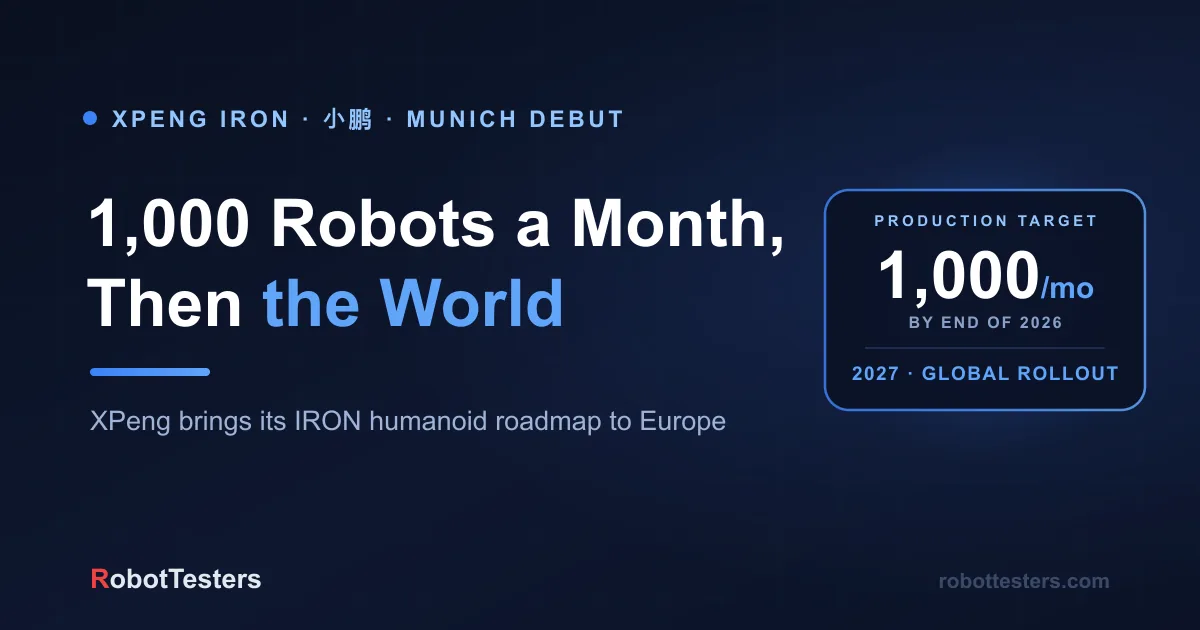
The robotics unit is a subsidiary of the car company. After closing, XPeng keeps controlling ownership and will keep consolidating the unit in the group accounts. The product this money is meant to industrialise is IRON, the humanoid XPeng has been building in-house: 76 degrees of freedom, 21 in each hand, three Turing AI chips on board. Mass production is promised by the end of 2026. First commercial deployments sit in XPeng's own stores and campuses, then a 2027 launch in China and overseas.
Here is the number that should stop you. XPeng's listed market capitalisation sat around US$11 billion in late August 2026. A robotics subsidiary that has not yet started mass production is now marked at more than half of that. The market is already treating the robot as the main story, and the cars as the factory that happens to sit next to it.
Not investment advice. RobotTesters reviews robots, not securities. Market caps and private valuations move. Nothing here is a recommendation to buy or sell anything, and no figure should be treated as live market data. Do your own research.
Key takeaways
- Over US$900 million (~€770m) at a post-money valuation above US$6.3 billion — the largest private embodied-AI round in China to date.
- IDG Capital led. Gaorong Ventures participated. Tencent and Alibaba sat as strategic investors. XPeng keeps control.
- XPeng itself is worth about US$11 billion on the listed boards. The robotics unit is now more than half of that.
- IRON is scheduled for mass production by end of 2026, first inside XPeng's own stores, then deliveries in 2027.
- This is the same capital wave we mapped in Robot Stocks 2026: Unitree's IPO, a 20–30 company listing queue, and Tencent writing a second robot cheque in the same month.
Who wrote the cheques — and what they bought
XPeng's own statement names four external participants. The table is short. The signal is not.
| Participant | Role | What it actually means |
|---|---|---|
| IDG Capital | Lead | A global private-equity house treating a humanoid as a manufacturing bet, not a lab demo. |
| Gaorong Ventures | Participant | The same firm already sat in AgiBot and in autonomous-driving company Momenta. It is doubling down on embodied AI, not rotating out of it. |
| Tencent | Strategic | Tencent's second public robot cheque of August 2026, after taking a strategic slice of the Unitree IPO. |
| Alibaba | Strategic | Cloud, commerce, and a long XPeng relationship. A distribution and compute partner, not a tourist. |
| XPeng group | Controlling shareholder | Stays in charge. The unit remains on the group books. |
That is what the round is. What it buys is more specific. XPeng said the money will go into hardware and software research, training and iteration of its Physical AI models, data generation, end-to-end mass-production facilities, and global commercial expansion. It also said the round creates a market valuation for a business that previously had none, and funds long-term incentives for executives and key talent.
Reporting around the close put the split at roughly US$600 million from outside investors, about US$200 million from an XPeng subsidiary, and about US$100 million from leadership, with the group retaining a stake near 82%. Those figures are not in XPeng's official release. Treat them as the working reconstruction of the book, not as a filing. The official fact that matters is simpler: XPeng stays in control.
IDG's own comment on the deal is the useful one. The firm said embodied AI is moving from technical breakthroughs to scalable manufacturing and commercial deployment, and that XPeng's edge is the full stack — chips, foundation models, complete robots — plus the car business sitting next to it. That is a factory thesis, not a research thesis. The money is priced as if IRON leaves a line.
More than half the listed company is now a robot story
Do the arithmetic once and sit with it. A robotics valuation above US$6.3 billion against a parent worth about US$11 billion is a ratio of roughly 57%. Chinese coverage put the same figure against the Hong Kong market cap on the day of the announcement. Market caps move week to week — XPeng's New York capitalisation was about US$11.03 billion as of 28 August 2026 — but the inversion does not go away because the share price wiggles.
XPeng still sells cars. The group posted tens of billions of yuan of automotive revenue in a single quarter. The robotics unit, by contrast, recorded next to nothing last year and has not started mass production. Capital is not pricing today's accounts. It is pricing the option that a humanoid becomes a product people actually live with. That is why more than half the listed company can sit in a subsidiary that has not yet shipped at scale.
The cars are the operating business. The robot is the story the money is buying. When those two swap places on a valuation sheet, the industry has already changed character — even if most people walking past an XPeng showroom have not noticed.
Tencent is writing the same cheque twice
One extra detail is worth isolating, because it is not unique to XPeng. Tencent took a strategic allocation in Unitree's Shanghai IPO earlier this month — about ¥136 million, sitting next to DeepSeek on a three-year lock-up — and then sat as a strategic investor in this robotics round. That is not two random tickets. It is the same platform company placing capital into robot hardware twice, in the same month, on two different structures: a public listing and a private subsidiary.
We mapped the listed side of this shift in Robot Stocks in 2026. Four robot makers actually trade: UBTech (9880.HK), Dobot (2432.HK), Geek+ (2590.HK) and Unitree (688836.SH). Behind them sit 20 to 30 Chinese humanoid and component companies in IPO coaching, filing or submission across 2026 and 2027. DeepSeek locking nine figures of yuan into Unitree for three years was the statement about where language models end up. Tencent repeating the motion at XPeng is the same statement from a different chair.
I have been saying this in these pieces for a while, and this round is the cleanest illustration yet. The robot industry is the next one that goes fashionable. First the labs. Then the private books. Then the listings. Then the carmakers carve the robot out as its own company so the market can put a number on it. XPeng just did the last of those four steps in public, with a valuation that already outweighs its car story.
A car plant is how a humanoid actually gets built
The second extra idea is industrial, not financial. XPeng can raise this money because it already has the things a pure-play humanoid startup has to invent: a supply chain, automotive-grade quality systems, in-house chips, and a first customer that cannot say no — its own stores. IRON's first job is answering questions on XPeng campuses and showroom floors. That is the same first-job logic BYD is using for Xiao Di, and the same reason Tesla talks about Optimus working in Tesla factories before it talks about selling one to you.
He Xiaopeng took personal command of the robotics unit in June 2026, after the product chief who had built IRON from scratch resigned. We covered that shake-up in He Xiaopeng takes command of XPeng's robots. This round is the capital layer that follows the management layer. The founder is on the robot. The investors are on the robot. The timetable — mass production by year-end, 1,000-plus units a month in the Europe-launch remarks, deliveries in 2027 — is now funded. Whether the line actually holds is a factory question, which is why we keep coming back to what XPeng has actually promised on volume rather than to the valuation.
Bigger than the chat window
The third idea is the one I keep returning to, and I will keep it short because I already wrote the long version in Robots: The Next Global Trend After AI. The world is still staring at language models. That is understandable. ChatGPT was the first time most people felt a new general-purpose technology arrive in their pocket. But I do not think the chat window is the thing that remakes daily life. I think the robot is.
AI rearranges information. A humanoid rearranges labour. The historical rhyme is not the smartphone. It is the car — a new physical object that showed up in the street, took over tasks humans had always done with their own bodies, and then became so ordinary that a house without one started to look incomplete. We are going to get another object like that. We will delegate cooking, carrying, cleaning, walking the dog, minding a shop floor, and a long list of jobs we have not named yet, because we have not lived with the machine long enough to invent the jobs.
Most people are not ready for that sentence. They watch a humanoid stumble on a stage and file the whole field under gimmick. That is the 1905 take on the automobile. The XPeng round does not prove IRON works. It proves that IDG, Tencent, Alibaba and Gaorong are no longer waiting for the rest of the world to notice. A carmaker just let the market mark its robot higher than its cars. That is what a fashionable industry looks like on the way in — loud on the cap table, quiet on the pavement, and about to become very hard to ignore.