
Not investment advice. RobotTesters reviews robots, not securities. This article maps which robot makers are publicly listed and what they actually build; it is not a recommendation to buy or sell anything, and no figure here should be treated as current market data. Do your own research.
Unitree's Shanghai listing got the headlines, but it is not the story. The story is that 20 to 30 Chinese humanoid and robot-component companies are in IPO coaching, filing or submission across 2026 and 2027 — and that the league table of who builds the most robots does not match the list of who you can buy. The single biggest humanoid manufacturer on earth by 2025 shipments is not Unitree, and it is not listed.
This is the map: the fresh detail from Unitree's book that emerged after pricing, the four robot makers that actually trade, the backdoor deal that put a humanoid company inside a Shanghai-listed materials firm, the pipeline behind them, and the component suppliers that most investors end up owning instead. Our full breakdown of the Unitree IPO itself covers the mechanics of that one deal; this is the sector around it.
The short version
• New on Unitree: nine strategic investors took exactly 20% of the deal — including DeepSeek (>¥140m, 3-year lock-up) and Tencent (~¥136m). Retail win rate 0.0181%, reported as the lowest in STAR Market history.
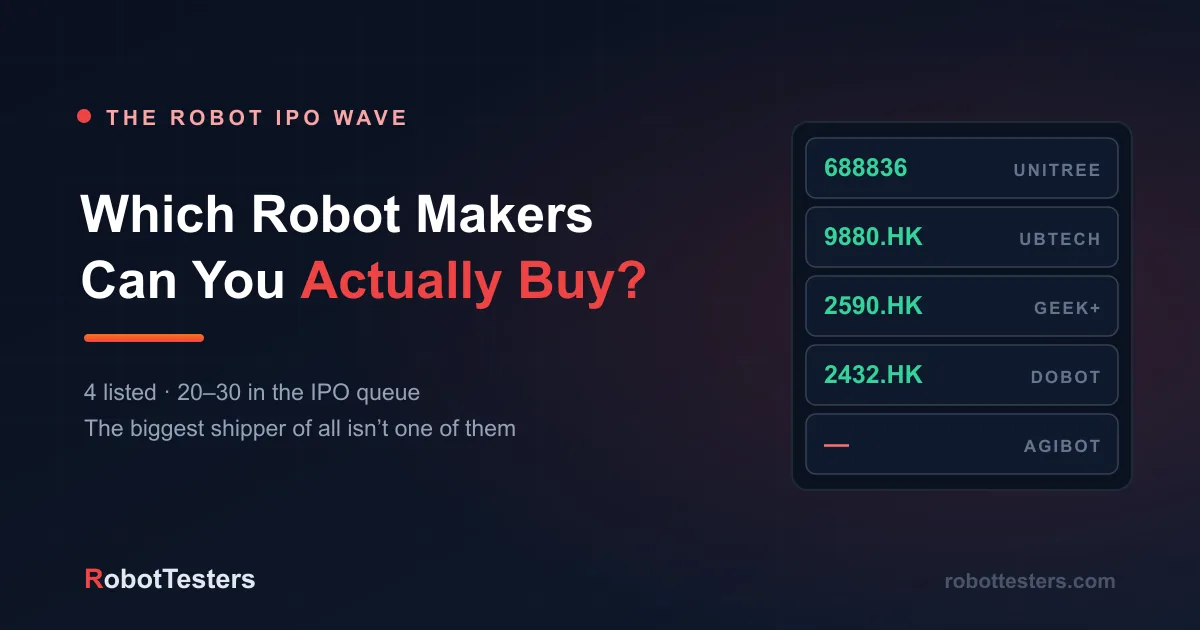
• Listed robot makers: UBTech (9880.HK), Dobot (2432.HK), Geek+ (2590.HK), Unitree (688836.SH). That is essentially the whole list.
• The gap: AgiBot shipped more humanoids than anyone in 2025 (5,100+, 39% share) and has no direct listing — only control of SWANCOR New Material (688585.SH).
• No US humanoid pure-play exists. Figure, 1X and Apptronik are private; Tesla and Hyundai are proxies with a rounding error of humanoid revenue.
• Pipeline: Deep Robotics, AgiBot, Fourier, Robot Era, Galbot, Leju — 2026–27.
• Picks and shovels: Leaderdrive, Sanhua, Tuopu, Zhaowei — and they trade on Tesla news, not Chinese robot news.
What Emerged After Unitree Priced
Three things surfaced after the 6 August pricing that were not public when the deal was announced, and all three are more informative than the valuation.
DeepSeek and Tencent are on the register
Unitree's strategic placement went to nine investors who together took 8,089,286 shares — exactly 20.00% of the offering. The disclosed names are unusually interesting:
| Strategic investor | Allocation |
|---|---|
| DeepSeek (Hangzhou entity) | 933,399 shares · > ¥140m · 36-month lock-up |
| Tencent (Shanghai Qishan Investment) | 903,290 shares · ≈ ¥136m |
| CITIC Securities Investment | 808,928 shares · ¥122m — mandatory sponsor follow-on |
| PetroChina | Disclosed as a strategic participant |
| Others (9 total) | Large insurers, national funds, and Unitree's own senior managers and core staff |
DeepSeek taking a three-year locked position in a robot maker is the detail worth sitting with. The most-watched AI lab in China putting nine figures of RMB into hardware, locked up for 36 months, is a statement about where it thinks language models end up — and it is a considerably stronger signal than any oversubscription number. Tencent's participation runs along the same axis. CITIC Securities was sponsor and lead underwriter, and its follow-on stake is a STAR Market requirement rather than a conviction trade, so read it differently.
The retail lottery was the tightest in STAR Market history
The online tranche produced 19,414 winning numbers at a final win rate of 0.01809759% — reported in Chinese financial media as the lowest ever recorded on the STAR Market. One lot is 500 shares, requiring ¥75,400 on application. That is a scarcity signal about a 10% float in a hot market, not a valuation signal about the business.
It still had not traded
As of writing, 688836 had not begun trading. Payment was due 12 August, and Chinese coverage puts the debut roughly a week after subscription — mid-to-late August — with the Shanghai Stock Exchange's own listing announcement the only binding source. Anyone quoting a first-day pop right now is quoting a forecast, not a price.
The League Table Nobody Puts on a Ticker
Here is the number that reframes the whole sector. Global humanoid shipments in 2025 came to roughly 13,318 units, and the ranking looks like this:
| 2025 humanoid shipments | Units | Share |
|---|---|---|
| AgiBot (智元) | 5,100+ | 39% |
| Unitree (宇树) | 4,200 | 32% |
| UBTech (优必选) | 1,000 | 7% |
| Leju (乐聚) | 500 | 4% |
| EngineAI (众擎) | 400 | 3% |
| Fourier Intelligence (傅利叶) | 300 | 2% |
| Figure AI · Tesla · Agility Robotics | ≈ 150 each | ≈ 1% each |
Two conclusions fall straight out of that table. Chinese manufacturers hold all six top positions, and the three most-discussed American humanoid programmes shipped, between them, about 3% of the world's robots. Whatever you believe about who has the better technology, the manufacturing gap in 2025 was an order of magnitude.
And the awkward one: the largest humanoid manufacturer in the world cannot be bought. AgiBot outshipped Unitree by roughly 20% and has no direct listing.
A necessary caveat on our own words. In our Unitree IPO piece we called Unitree the most advanced humanoid manufacturer at scale, and we stand by that on the axis we actually measure — the G1 is the highest-scoring humanoid in our catalogue at 78.8, and Unitree designs and sells the actuators underneath half this industry. But "most advanced" is not "most shipped," and on units AgiBot is ahead. Worth stating plainly, because our own scores contain the opposite tension too: AgiBot's X2 is the lowest-scoring priced humanoid we rate, at 50.9. Shipping the most robots and building the best one are different achievements, and the market prices a third thing again.
The Robot Makers You Can Actually Buy
Four. That is the entire list of listed companies whose primary business is building robots.
| Company | Ticker | Listed | IPO price |
|---|---|---|---|
| UBTech Robotics (优必选) | 9880.HK | Dec 2023 | HK$90.00 |
| Dobot (越疆科技) | 2432.HK | Dec 2024 | HK$18.80 |
| Geek+ (极智嘉) | 2590.HK | 9 Jul 2025 | HK$16.80 |
| Unitree Robotics (宇树科技) | 688836.SH | Aug 2026 | ¥150.80 |
UBTech (9880.HK) — the humanoid pure-play
Hong Kong's "first humanoid stock," listed December 2023 at HK$90. Its 2025 results, published in March 2026, are the most useful public window into humanoid economics that exists: revenue past ¥2.0bn, up 53.3%; full-size humanoid revenue up 2,203.7%, from ¥35m to ¥821m; gross margin from 28.7% to 37.7%; and net loss narrowed 31.9% to ¥790m. The market took it well — the shares jumped 17% on the print, pushing the company back above HK$50bn.
Read those numbers carefully, because they cut both ways. A 22-fold increase in full-size humanoid revenue is the single clearest evidence anywhere that humanoids are becoming a product rather than a demo. And the company still lost ¥790m doing it. Our review of the Walker S2 covers the robot that is generating that revenue in BYD, Foxconn and Geely plants.
Dobot (2432.HK) — arms first, humanoid second
Listed December 2024 at HK$18.80 — the bottom of its HK$18.80–20.80 range — raising about HK$681m net and opening 4.8% up at HK$19.70, on first-half 2024 revenue of ¥120m and a ¥59.9m loss. Dobot's core business is collaborative robot arms, where it claims a global number-two position by 2023 shipments, with more than 100,000 robots deployed. Q1 2026 revenue grew 111%, and the company has moved to list A-shares in Shenzhen as well — which would make it the first robot company with an A+H dual listing.
Geek+ (2590.HK) — warehouse robots, the biggest HK robotics IPO
Listed 9 July 2025 at HK$16.80, selling 161.4 million H shares for HK$2.71bn gross — the largest non-A+H technology IPO in Hong Kong that year. The Hong Kong retail tranche was 133.6× oversubscribed and the international tranche 30.2×; it opened at HK$17.00 for a market capitalisation above HK$22bn. Geek+ makes warehouse AMRs, not humanoids, which is precisely why it is interesting: it is the one company in this list selling robots that already do a boring job profitably enough to fill warehouses.
AgiBot's Side Door Into Shanghai
The most instructive transaction in Chinese robotics has nothing to do with an IPO.
In July 2025, holding vehicles controlled by AgiBot agreed to acquire up to 66.99% of SWANCOR New Material (688585.SH), a Shanghai-listed composite-materials company, for roughly ¥2.1bn — taking 29.99% by agreed transfer with the original controlling shareholders waiving voting rights, then a tender offer for the rest. The transfer registration completed in September 2025, making Deng Taiyun (邓泰华) — AgiBot's founder and a former Huawei vice-president — the listed company's actual controller.
The market's reaction told you everything: the shares hit three consecutive 20% limit-ups, running from ¥7.78 to ¥13.45, on the announcement alone, and kept going from there. AgiBot has publicly denied that this is a backdoor listing, and technically it has room to say so — under the rules it has a 36-month window, running to July 2028, before injecting qualifying assets would trigger a reverse-merger review.
Whatever you call it, the mechanics are worth understanding: buying control of a small listed company is faster and more certain than queuing for an IPO in a market where the queue is now 20-plus companies long. AgiBot meanwhile reports Q1 2026 revenue above ¥1bn against a full-year target of ¥4bn, 15,000 humanoids produced cumulatively by June 2026 and capacity above 100,000 units a year — and still plans a separate Hong Kong filing in the second half of 2026. For the engineer behind the robots rather than the deal, see our profile of co-founder Peng Zhihui.
The Pipeline: Who Is Next
Chinese industry reporting counts 20 to 30 humanoid and component companies in IPO coaching, filing or submission across 2026–27. The named second wave:
| Company | Status | What they build |
|---|---|---|
| Deep Robotics (云深处) | Shareholding reform done; STAR Market filed, awaiting inquiry | High-payload quadrupeds extending into humanoids; power-grid and mine inspection |
| AgiBot (智元) | Hong Kong filing planned H2 2026 | Humanoids at 10,000-unit scale; flexible industrial lines |
| Fourier Intelligence (傅利叶) | E round closed; STAR Market coaching started | Rehabilitation robots into general-purpose humanoids |
| Robot Era (星动纪元) | Hong Kong filing in preparation | General-purpose humanoids |
| Galbot (银河通用) | Highest-valued unlisted humanoid company in China | Wheeled-base bimanual manipulators for retail and pharmacy |
| Leju (乐聚) | Second-wave candidate | Kuavo humanoids; Huawei partnership |
Reported private valuations put Robot Era, AgiBot and Star Atlas above ¥20bn each, with Fourier above ¥8bn. Set those against Unitree's ¥61bn IPO valuation and you can see the anchor Unitree has just set for everyone behind it — which is exactly why the queue formed. Our piece on mass production in 2026 covers whether the manufacturing claims behind these valuations hold up.
One caution on this table: it is built from Chinese financial media and company statements, and IPO timetables slip constantly. Treat "planned H2 2026" as intent, not schedule.
Picks and Shovels: The Component Layer
This is where most robotics money actually sits, because these companies have been listed for years and sell into every humanoid programme at once.
| Supplier | Ticker | Role in a humanoid |
|---|---|---|
| Leaderdrive (绿的谐波) | 688017.SH | Harmonic reducers — roughly 14–18 per humanoid; Tesla-qualified; supplies UBTech and Unitree |
| Sanhua Intelligent Controls (三花智控) | 002050.SZ | Liquid-cooled rotary joints, from automotive thermal management |
| Tuopu Group (拓普集团) | 601689.SH | Tesla tier-one; linear actuator assemblies for Optimus |
| Zhaowei Electromechanical (兆威机电) | 003021.SZ | Micro-drive modules for multi-DOF dexterous fingers |
Two honest observations. First, these names trade on Tesla news, not on Chinese robot news — an Optimus production update moves Tuopu and Sanhua far more than a Unitree shipment record does. If you buy the component layer expecting exposure to Chinese humanoid volume, you may be buying a Tesla derivative instead.
Second, the reducer count is the number that matters. At 14–18 harmonic reducers per robot, component demand scales with units, not with robot prices — which is why suppliers are the cleanest way to express a belief in volume without picking which brand wins. Our breakdown of the Chinese humanoid supply chain goes through this layer in detail.
Outside China
The short version: there is no listed American humanoid pure-play. Figure AI, 1X Technologies and Apptronik are all private, and the companies that do offer exposure offer very little of it.
Tesla (TSLA) is the most-cited humanoid stock in the West and shipped roughly 150 Optimus units in 2025 — a rounding error against a car business, though the strategic commitment is real and our coverage of the AI5 chip explains where the compute is going. Hyundai (005380.KS) owns Boston Dynamics outright, which is genuinely the most capable robot in our catalogue's athleticism terms and generates almost nothing in revenue against a global carmaker. Xiaomi (1810.HK) has CyberOne, a 177 cm, 52 kg humanoid, on much the same basis.
The nearest thing to pure-plays sit in adjacent categories: Serve Robotics (SERV) in sidewalk delivery, Symbotic (SYM) in warehouse automation, and the industrial-robot incumbents — Fanuc and Yaskawa in Japan, ABB in Switzerland, and Harmonic Drive Systems (6324.T), which invented the reducer everybody else now copies. None of them is a humanoid bet. All of them are real businesses, which is more than most of this list can say.
How to Read All of This
Three patterns are worth carrying away.
The best manufacturers are the hardest to own. AgiBot ships the most and trades only through a materials-company shell. Unitree just listed on an exchange most foreign investors cannot access — see our IPO piece for exactly why. UBTech, the one clean listed humanoid pure-play, is third by units and loses money. The accessibility of a robot stock is close to inversely correlated with the quality of the underlying robot business.
The revenue is real but small. 13,318 humanoids shipped worldwide in 2025 is a rounding error against any mature industry, and UBTech's ¥821m of full-size humanoid revenue — impressive as a growth rate — is a mid-sized business, not a sector. Omdia projects the general embodied-intelligence robot market growing from about 3,000 units in 2024 to 2.6 million by 2035, an 85% compound rate. Every valuation in this article is a bet on that curve, not on today's accounts. We remain sceptical enough to have written the bubble case in full.
Watch the strategic register, not the pop. First-day performance on a 10% float in an 8,289×-oversubscribed book tells you about scarcity. DeepSeek locking capital into robot hardware for three years, and a queue of 20-plus manufacturers forming behind the first listing, tells you what the people closest to the technology think happens next. Those are different signals, and only one of them survives contact with a market correction.