
Not investment advice. RobotTesters reviews robots, not securities. The opinion section of this article is clearly labelled as opinion, it is the author's personal view, and nothing here is a recommendation to buy or sell anything. Do your own research.
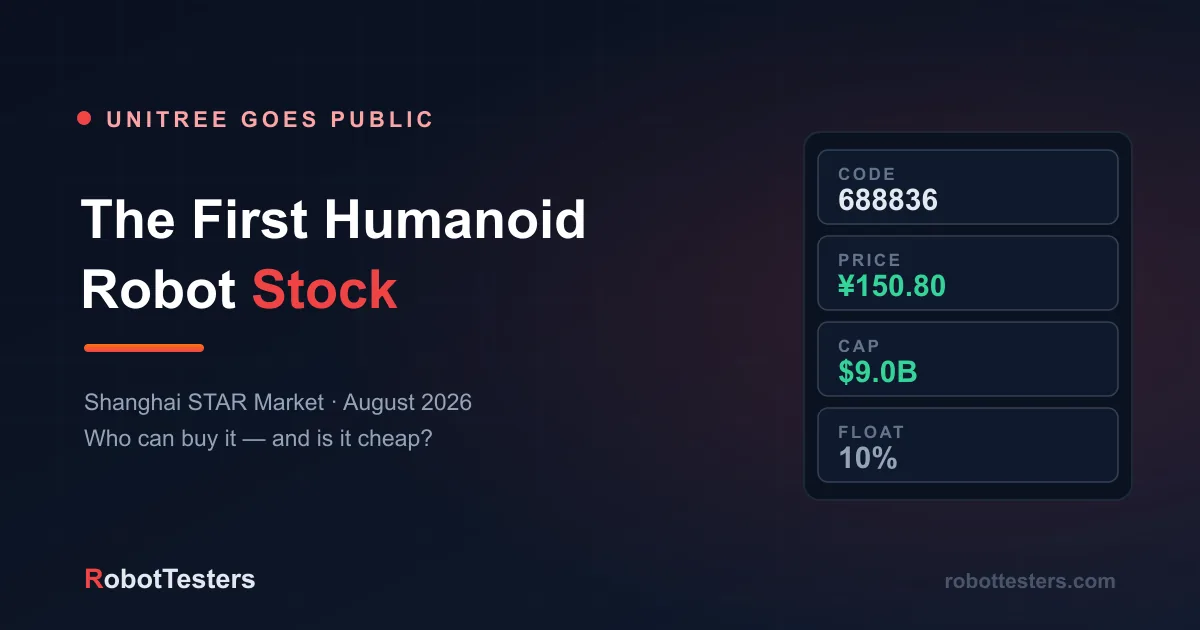
Unitree Robotics priced its IPO at ¥150.80 per share on 6 August 2026, valuing the company at about ¥60.99 billion — roughly $9.0 billion — and making it the first pure-play humanoid robot maker to list on a mainland Chinese exchange. It trades under ticker 688836 on the Shanghai Stock Exchange's STAR Market, selling 40.45 million new shares, about 10% of enlarged capital, to raise roughly ¥6.1 billion.
The awkward answer to the question most readers arrive with: if you are not in mainland China, you almost certainly cannot buy it. Not because of a broker limitation you can shop around, but because of how STAR Market access works. The workarounds are real but indirect, and they are all worse than owning the stock. Below: the full numbers, the timetable, who can actually buy, the routes that exist for everyone else — and then, clearly separated, my own view that this valuation is cheap for what Unitree is.
The short version
• Ticker: 688836, Shanghai STAR Market. (787836 was the subscription code, not the ticker.)
• Price: ¥150.80 per share, set 6 August 2026. One lot = 500 shares = ¥75,400.
• Market cap: ~¥60.99bn ≈ $9.0bn — 219× 2025 earnings, ~36× 2025 sales.
• Float: 40.45m new shares = 10% of enlarged capital, the STAR Market minimum. Raises ~¥6.1bn.
• Dates: subscription 10 Aug · payment 12 Aug · allocations 14 Aug · debut expected mid-to-late August, exchange confirmation pending.
• Demand: retail tranche oversubscribed ~8,289×; allocation odds ~0.018%.
• Foreign access: no direct retail route. ETFs and Hong Kong proxies only.
The Numbers
| Item | Unitree IPO (688836) |
|---|---|
| Exchange | Shanghai Stock Exchange, STAR Market (科创板) |
| Ticker | 688836 (subscription code 787836) |
| Issue price | ¥150.80 per share (≈ $22.34) |
| Shares offered | 40.45 million new shares |
| Float | ≈ 10% of enlarged share capital |
| Gross proceeds | ≈ ¥6.1 billion (≈ $850m) |
| Valuation at IPO price | ≈ ¥60.99 billion ≈ $9.0 billion |
| Valuation multiples | 219× 2025 net profit · ≈ 36× 2025 revenue |
| 2025 revenue | ¥1.70 billion (vs ¥392.77 million in 2024) |
| 2025 net profit | ¥278.21 million |
| Overseas revenue | ¥731.66 million — 43.65% of main-business revenue |
| Retail oversubscription | ≈ 8,289× · lot-winning rate ≈ 0.018% |
| Use of proceeds | R&D, new intelligent robot programmes, smart-manufacturing facility |
Two things in that table deserve a second look. The first is the revenue line: ¥392.77 million in 2024 to ¥1.70 billion in 2025 is a 4.3× increase in a single year, and Unitree did it while staying profitable — ¥278.21 million of net profit. Very few companies at the front of a hardware wave are profitable at all; most are still buying revenue.
The second is 43.65% overseas revenue. Unitree is not a domestic-subsidy story dressed up as an export business. Nearly half its main-business revenue already comes from outside China, which is both a validation of the product and, in the current climate, its single biggest political risk. We covered how that risk is developing in our piece on the proposed FCC restrictions on Chinese robots.
Who Took the Strategic Stock
The strategic placement was disclosed on 6 August, and it is the most informative document in the whole offering. Nine investors took 8,089,286 shares — exactly 20.00% of the deal. Among them:
| Strategic investor | Allocation |
|---|---|
| DeepSeek (Hangzhou entity) | 933,399 shares · > ¥140m · 36-month lock-up |
| Tencent (Shanghai Qishan Investment) | 903,290 shares · ≈ ¥136m |
| CITIC Securities Investment | 808,928 shares · ¥122m — mandatory sponsor follow-on |
| PetroChina | Disclosed as a strategic participant |
| Others (9 in total) | Large insurers, national-level funds, and Unitree's own senior managers and core staff |
DeepSeek locking nine figures of RMB into a robot manufacturer for three years is the signal here — China's most-watched AI lab making a hardware bet with a 36-month cliff says considerably more about where it thinks language models end up than any oversubscription multiple does. Tencent's participation runs the same way. CITIC Securities was sponsor and lead underwriter, and STAR Market rules oblige its investment arm to follow on, so read that line as regulation rather than conviction.
The retail side landed in the record books too: the online lottery produced 19,414 winning numbers at a final win rate of 0.01809759%, reported in Chinese financial media as the lowest ever on the STAR Market.
Unitree is also not the only robot listing in flight — there are 20 to 30 Chinese humanoid and component companies in the IPO queue behind it, and the company that shipped the most humanoids in 2025 is not Unitree and is not listed. We mapped the whole sector in every listed robotics company and the IPO wave behind Unitree.
When Does It Actually Start Trading?
The offering ran on a compressed timetable, and the debut date is the one piece that was still soft at the time of writing.
| Date (2026) | Milestone |
|---|---|
| March | STAR Market listing application accepted |
| 1 July | CSRC registration approved |
| 5 August | Institutional book-building |
| 6 August | IPO priced at ¥150.80 |
| 10 August | Online and offline subscription |
| 12 August | Subscription payment due |
| 14 August | Allocation results announced |
| Mid-to-late August | Trading debut — see caveat below |
Here the sources genuinely disagree, so we will not pretend otherwise. Chinese financial media pointed to a debut on or around 14 August; Western IPO trackers guided to a 17–21 August window, subject to final confirmation from the Shanghai Stock Exchange. As of writing, the exchange had not published the binding listing announcement. If the date matters to you, that announcement is the only source worth acting on — not this article and not any tracker.
Can Foreigners Buy Unitree Stock?
Not directly, if you are an individual investor outside mainland China. This is the part most coverage gets wrong by hand-waving about "restrictions," so here is the actual mechanism, which is two separate gates.
Gate one: Stock Connect eligibility. A STAR Market stock does not become available to Northbound Stock Connect just by listing. It has to first become a constituent of the SSE 180 or SSE 380 index, or be the A-share of a company that is also listed in Hong Kong (an A+H structure). A newly listed Unitree is neither. At debut, 688836 sits outside Stock Connect entirely — not restricted within it, simply absent from it.
Gate two: the institutional-only rule. Even after a STAR stock becomes Connect-eligible, trading it through Northbound is limited to institutional professional investors. That definition excludes individuals — every individual, regardless of net worth or professional qualification. There is no "sophisticated investor" carve-out to apply for.
Foreign institutions have a route: the QFII / QFI regime, which lets a licensed foreign institution hold mainland A-shares directly. That is the pipe through which any Western fund will end up owning Unitree. It is not open to you personally.
If a broker or platform tells you it can sell you Unitree pre-IPO shares, treat that as a red flag. Unitree itself warned in February 2025 that of the pre-IPO equity being marketed in its name, "almost all of it is fake… There is no middleman, middle shareholder or middle company."
The Routes That Do Exist
All three are indirect, and each dilutes the thing you actually wanted to own. Ranked roughly by how much Unitree you end up holding:
1. STAR Market index ETFs (lagged, but clean)
Funds tracking the SSE STAR 50 index hold A-shares through a QFI designation and are freely buyable by retail investors abroad. The main vehicles are KSTR (KraneShares, NYSE Arca) and 3109.HK (CSOP, Hong Kong). The catch is index mechanics: a new listing is not added on day one. Index rules typically require a seasoning period, so realistic inclusion runs months out rather than weeks — commentary on the KSTR route pointed to early 2027 as the plausible inclusion date. You get the exposure eventually, at whatever price the stock is trading by then.
UK and EU investors cannot buy US-listed ETFs at all under PRIIPs rules, which kill KSTR as an option. The workaround is a UCITS-domiciled STAR 50 tracker (ISIN IE00BKPJY434), listed in London, Milan and Frankfurt at around a 0.82% expense ratio — same index, same lag, but legally purchasable.
2. Thematic robotics ETFs
Humanoid and physical-AI thematic funds — KOID being the obvious one — run on different index construction from broad-market trackers, and may therefore pick Unitree up on a faster schedule. Worth checking the actual holdings before you buy: a thematic fund's exposure to any one name is usually a few percent, so this is a bet on the sector with a Unitree kicker, not a Unitree position.
3. Listed shareholders (heavily diluted proxies)
Two Hong Kong-listed companies hold real stakes. Meituan (3690.HK, ADR MPNGY) holds roughly 9.6% of Unitree, and Shoucheng Holdings (0697.HK) about 3.8%. But Meituan is a food-delivery and local-services giant worth vastly more than its Unitree stake — the robotics position is a rounding error in its valuation, and you would be taking on an entire unrelated business to get it. Shoucheng is smaller and therefore a purer proxy, with correspondingly different risks. Neither is a substitute for the stock.
What You Would Be Buying
Strip out the ticker and Unitree is a Hangzhou company founded by Wang Xingxing, who still controls roughly a third of it and whose story — a masters project on a cheap legged robot that became the world's dominant quadruped business — we told in full in our profile of the man who built Unitree. Outside investors include Meituan (~9.6%), HongShan China (~7.1%) and Matrix Partners China (~5.5%).
The business has three legs. Quadrupeds — Go2, B2, A2 — where Unitree holds a reported 60%-plus global market share, and which carried the company financially for years. Humanoids — G1, H1, R1, H2 — which crossed roughly half of revenue in 2025, a remarkable shift given quadrupeds were about 65% of revenue the year before. And components: motors, actuators, reducers, controllers and sensors, more than 90% of them domestically sourced, which is why Unitree can price the way it does.
That vertical integration is the part outsiders consistently underrate. Unitree does not buy actuators; it builds them, and sells them to other robot companies. When your competitor's bill of materials is your revenue line, price wars work differently. Our breakdown of the Chinese humanoid supply chain covers why that matters more than any individual robot spec.
And the products are genuinely good, which is not something we say from a press release. In our own catalogue — scored on the same rubric as everything else, with no thumb on the scale — the Unitree G1 is the highest-rated humanoid we list at 78.8, the R1 sits second at 73.7 for $4,900, and the Go2 tops the quadruped category. Unitree occupies three of the top five slots in our humanoid rankings. That is the underlying reality the IPO is pricing.
The Bear Case, Stated Properly
Before the opinion, the case against, because a valuation of 219× earnings deserves a real one.
The multiple is extreme. 219× 2025 net profit and 36× sales prices in years of flawless execution. Unitree's net profit is ¥278 million against a ¥61 billion valuation; you are not buying today's cash flows, you are buying an assumption about 2030.
The float is tiny. A 10% free float — the STAR Market minimum — mechanically inflates price. Scarcity plus an 8,289× oversubscribed retail book is a recipe for a violent debut that says nothing about fundamentals. First-day pops of three to five times are normal on the STAR Market, and buying into one is a different proposition from buying at the IPO price.
Geopolitics is a live wire. With 43.65% of main-business revenue from overseas, restrictions in the US or Europe hit Unitree squarely. This is not hypothetical — the direction of policy is already visible.
Humanoids may not be a product yet. Plenty of Unitree's humanoid revenue is research units, demo machines and universities, not deployed labour. The gap between "impressive robot" and "profitable fleet" has swallowed a lot of companies. We have been sceptical about this in print — see are robots the next bubble after AI and when humanoids will actually be ready.
My View: I Think It Is Cheap
With all of that on the table, here is my honest opinion, and it is only that — an opinion, from someone who reviews robots for a living, not a financial analyst.
I think $9 billion is a cheap price for Unitree.
The reasoning is not about the multiple, because at this stage the multiple is measuring the wrong thing. It is about what the company is and where the industry goes.
First: Unitree is, today, the most advanced humanoid manufacturer in the world at anything resembling scale. Not the most advanced robot in a lab — Boston Dynamics still owns that argument on raw athleticism. The most advanced manufacturer: a company that designs its own actuators, builds them at volume, ships robots to customers in dozens of countries, sells to nearly half its market abroad, and does it profitably. Everybody else in this field is either a research house with no manufacturing, or a manufacturer with no robot. Our own scores, applied identically across the catalogue, put Unitree machines at the top of both the humanoid and quadruped tables.
Second: the addressable market is not a large market, it is a category error to size it like one. If general-purpose humanoids work — even partially, even only in warehouses, factories and logistics — the market is measured in trillions, because the thing being replaced is not a product category but a share of human labour. Morgan Stanley and others have put out forecasts running into the trillions of dollars by 2050. You do not have to believe the precise number to notice that against that backdrop, $9 billion for the current leader is a small figure. It is roughly what the market pays for a mid-sized regional bank.
Third: I think this changes the world inside five to ten years, not twenty. The rate of visible progress over the last three years — robots that walk, run, recover from shoves, learn tasks from demonstration, and cost $4,900 instead of $250,000 — has been faster than almost anyone in the field predicted. Cost curves in robotics are following the pattern that made drones and EVs ubiquitous, and Unitree is the company doing most to drive them down. If humanoid robots become normal in the way smartphones became normal, the company that industrialised the actuator is not going to be worth $9 billion.
Now, the honest counterweight, because I would rather be useful than bullish. Being right about the industry and right about the company still leaves you exposed on price and access. A stock that opens three times above its IPO price is no longer trading at the valuation I just called cheap. And unless you are in mainland China, you cannot buy at ¥150.80 anyway — the routes available to you all deliver exposure later, at a different price, diluted through an index. My view is about the business at the IPO valuation. It is not a view on what 688836 will do on its first afternoon, and anyone telling you they know that is guessing.
There is also a scenario where I am simply wrong: humanoids stall as a niche research tool, the labour-replacement thesis slips a decade, and a 219× multiple gets marked down hard. I hold my view with that possibility fully in view. I have watched this industry closely enough to know it disappoints on schedule and then surprises all at once.
What Happens Next
Three things worth watching after the debut. Index inclusion is the mechanical event that unlocks foreign money at scale, so track SSE 180/380 additions and STAR 50 rebalances. A Hong Kong listing, should Unitree ever pursue one, would create an A+H structure and pull the A-share into Stock Connect — that is the single change that would most improve foreign access. And the 2026 numbers: whether humanoid revenue keeps compounding at anything like 2025's pace is the entire thesis, and the first interim report after listing is where that gets tested.
For what Unitree actually sells while all this plays out, our comparison of the full Unitree humanoid lineup covers the R1, G1, H1 and H2 side by side, and our take on whether the company is the Nokia or the iPhone of humanoid robots is the strategic version of the same question this IPO is asking.