
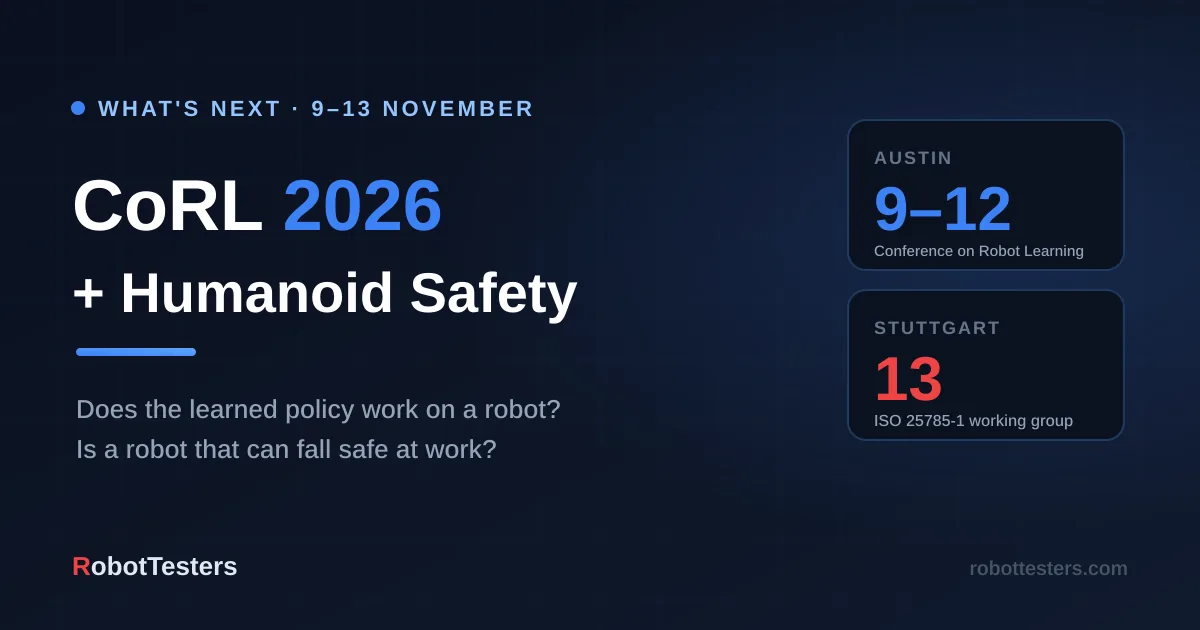
Two rooms this week are asking robots for proof, and they are asking for different kinds. In Austin, CoRL 2026, the Conference on Robot Learning, runs from Monday 9 to Thursday 12 November. It is where researchers show whether a policy, the learned program that turns what a robot sees into what it does, still works once it leaves the dataset and meets a real arm or a real pair of legs. Then on Friday 13 November, in Stuttgart, the Humanoid Safety Summit at ARENA2036 asks the question a factory asks next: if that robot balances on two legs and can fall, what does it take to let it work beside people?
I wrote this on Sunday 8 November from the two official programmes and NVIDIA's CoRL page. Nothing below is a result yet. I will update the page on 12 and 13 November with what actually came out of both rooms.
Key takeaways
- CoRL 2026: 9–12 November, Austin, Texas. Main conference 9–11, workshops on the 12th. Talks at the Hilton Austin, posters and exhibits at the JW Marriott, the day-3 keynote at Bass Hall.
- The keynote list leans toward deployment: Wolfram Burgard on uncertainty, Russ Tedrake on what his company learned in factories, Fei-Fei Li on a world model called Atlas, plus a fireside chat with AMD's Lisa Su.
- NVIDIA lists a keynote by Jim Fan on Monday 9 November at 1:50 pm CST (20:50 in Madrid, CET), and GR00T, Isaac Lab and Newton demos at booth 404 from the 9th to the 11th.
- Humanoid Safety Summit: Friday 13 November, ARENA2036, Stuttgart, the same day the ISO working group writing ISO 25785-1, the first safety standard for robots that balance actively, meets there. Mercedes-Benz, Boston Dynamics, Agility Robotics, A3, TÜV Süd and NVIDIA are on the agenda.
- Also this week: electronica in Munich (10–13 November) and Humanoid Asia's innovation week in Shanghai (12–13 November).
Austin: four days across three buildings
CoRL sits right on the line between robotics and machine learning, so it is where a new training method has to show a robot doing something, not only a curve going down. The official site splits the week into the main conference from 9 to 11 November and workshops on 12 November. Presentations and keynotes on days 1 and 2 are at the Hilton Austin. Posters, exhibits, lunch and breaks are at the JW Marriott. The reception and the day-3 keynote move to Bass Hall, on the University of Texas campus.
The run-up is already public. The accepted papers went up on 19 October, the demos on 27 October, and the late-breaking results on 31 October. The schedule itself lives in the Cvent app the organizers point attendees to. I did not find a public livestream announced on the conference homepage, so if you are not in Austin, expect most of this week to reach you through papers, project pages and clips. CoRL was one paragraph on our year-end events calendar. This is the closer look.
The keynotes keep pointing out of the lab
Read the keynote abstracts together and a pattern shows up. Wolfram Burgard, now at the University of Technology Nuremberg, opens his with the plain fact that no sensor and no actuator is perfect, so a robot has to live with uncertainty. His talk, “Challenges to Realize Embodied AI,” is about combining the older probabilistic methods with deep learning and foundation models to deal with a world that keeps changing.
Russ Tedrake's talk is the one I would sit in the front row for. He is the MIT professor behind the Drake toolkit, formerly in charge of large behavior models at the Toyota Research Institute, and in January 2026 he co-founded Walden Robotics. His abstract says the company put its first robot into a live production environment two months later, and the talk, “Learning in the factories,” is about how performance scales with deployment and how his own view changed on the shop floor. That is a researcher telling a learning conference that the data from real work may matter more than another benchmark. If he brings numbers, they will be the most useful slides of the week.
Fei-Fei Li's talk is about a world model from World Labs that happens to be named Atlas, which has nothing to do with the Boston Dynamics humanoid. A world model is a network that predicts what a scene will look like next, so a robot or a planner can try things inside it before trying them for real. Her abstract describes Atlas as an autoregressive frame generator that joins pixel generation and 3D scene reconstruction. The second half of her session is a fireside chat with Lisa Su, chair and CEO of AMD. The keynote page does not put a day next to each name, so I am not guessing which one lands at Bass Hall.
Monday evening in Europe: Jim Fan on world action models
NVIDIA's CoRL page lists a keynote by Jim Fan on Monday 9 November at 1:50 pm CST. That is 19:50 UTC, and 20:50 in Madrid or Paris. The title is “From Dreaming to Doing: World Action Models and Agentic Robotics.” The description promises research on world models, robot foundation models (one large model trained to drive many skills, instead of one small model per task), and agents that read their own execution feedback to work out why something failed and fix the behavior. It also says the talk will look at how human video, robot data and simulation each feed learning at scale, with examples in humanoid control and manipulation.
One of NVIDIA's listed papers, “World Action Models are Zero-shot Policies,” carries the same phrase, which is a fair hint about where the talk is going: a model that imagines the next moments of a scene and the action that gets there, used directly as the controller. Zero-shot means the policy is asked to do a task it was never trained on specifically. I want to see how often that works on a physical robot, not only in a highlight reel. The company is also running GR00T, Isaac Lab and Newton demos at booth 404 in the JW Marriott from the 9th to the 11th, and a Video-to-Data challenge on the 12th about turning human demonstration video into robot skills.
The argument underneath: real robots or simulated ones
One of the topics going into this CoRL is evaluation. Testing a policy on real hardware is slow, expensive and hard to repeat, because two labs never have the same table, light or robot. Testing it in simulation, or now inside a video world model, is cheap and repeatable, but a robot that succeeds in a simulator can still fail when the friction or the camera is a little different. That gap is the sim-to-real problem, and it has not gone away.
NVIDIA's own paper list shows how much work now sits on the simulated side. StressDream steers video world models to stress-test policies before they meet a robot. SimFoundry generates scenes automatically for policy learning and evaluation. SILO uses simulation in the loop to transfer multi-stage cable routing to hardware. Tedrake's talk sits at the other end, arguing from deployment data. I think both camps are right about something, and the papers I will trust most this week are the ones that publish failure rates on hardware next to their simulated scores.
Stuttgart, Friday: a standard for robots that can fall
On 13 November the ISO working group ISO/TC 299/WG 12, “Safety for Dynamically Stable Industrial Mobile Robots,” meets at ARENA2036, the research campus at Pfaffenwaldring 19 in Stuttgart. Waveye, the safety expert Jens Müller and ARENA2036 are using the visit to host the Humanoid Safety Summit the same day, so German industry can sit in a room with the people writing the rules. Space is limited and pre-registration runs through Eveeno, the event tool named on the page.
The reason this matters is simple once you see it. Classic industrial robot safety leans on stopping. When a person gets too close, the arm cuts power or brakes and stays where it is. A dynamically stable robot, meaning one that has to keep actively controlling its balance, like a humanoid on two legs or a wheeled robot that balances, cannot just cut power. It falls, and a falling machine of that size is a hazard of its own. ISO 25785-1 is being written for that category. The summit page calls it a Type-C standard, the most specific level in machinery safety, written for one kind of machine instead of machines in general. It also says the work fills a gap left by earlier standards such as ANSI/RIA R15.08, which covers industrial mobile robots.
The morning agenda, on Stuttgart time (CET):
- 9:10: Dr. Matthias Borger, Mercedes-Benz Cars Operations, “Enabling the Factory of the Future Through Humanoid Safety.”
- 9:35: Dr. Federico Vicentini, Boston Dynamics, “Challenges in Safety Standards for Dynamically Stable Mobile Robots.” He is also the convenor of WG 12, the person who chairs the group.
- 10:00: Kevin Reese, Agility Robotics, “The Path to Cooperative Safety: A Progression, Not a Breakthrough.” He is the project leader for ISO 25785-1 and leads safety engineering for Digit.
- 10:55: Carole Franklin, A3, on the ISO standards under development for humanoid robots.
- 11:20: Benedikt Pulver, TÜV Süd, “Humanoid Robots: Beyond Today's Standards.”
- 11:45: Dr. Riccardo Mariani, NVIDIA, “Scaling Physical AI Safety with NVIDIA Halos.”
After lunch there is a panel at 14:00, “Humanoids in Industry: Ready, Safe, Go?”, an industrial case study at 14:30, and Waveye's CTO Dr. Gor Hakobyan on safety in general-purpose robotics at 15:00.
Reese's title is the line I keep rereading. A progression means humanoids will probably get permission to work near people in steps: fenced areas first, then shared aisles at low speed, then closer work, each step tied to what the robot can prove. That is my reading of a talk title, not something he has said yet. What I hope Friday gives us is a sense of the timeline for ISO 25785-1, and whether the car makers in the room think it is close enough to plan a line around. If you want the older version of this debate, the one with fiction in it, it is in our piece on the laws of robotics.
What to watch, day by day
| When | Where | What I am watching for |
|---|---|---|
| Mon 9 Nov, 1:50 pm CST (20:50 CET) | CoRL, Austin | Jim Fan's keynote. Whether world action models show up running real humanoids, and how often they fail. |
| Mon 9 – Wed 11 Nov | CoRL, Austin | Keynotes from Burgard, Tedrake and Li. Any deployment numbers from Tedrake's factory work. |
| Mon 9 – Wed 11 Nov | JW Marriott, booth 404 | NVIDIA's GR00T, Isaac Lab and Newton demos. |
| Thu 12 Nov | CoRL, Austin | Workshop day, and the Video-to-Data challenge on turning human video into robot skills. |
| Fri 13 Nov, 9:00–15:30 CET | ARENA2036, Stuttgart | Humanoid Safety Summit. A timeline for ISO 25785-1, and what Mercedes-Benz says it needs before humanoids share a line with workers. |
Also this week
electronica, the large electronics trade fair, runs from 10 to 13 November at Messe München. It is not a robotics show, but its forums cover automation with AI, and the sensors and chips that go inside these machines are on its floor. In Shanghai, the organizers of Humanoid Asia list an Asia Humanoid Robotics Innovation Week on 12 and 13 November, with two parallel conferences on communication and materials. It overlaps CoRL's workshop day, and it is already on the year-end calendar.
If I could only be in one place, I would split it: Tedrake's talk in Austin, then Friday morning in Stuttgart for Vicentini and Reese. Between them, those two rooms decide most of what a humanoid will be allowed to do in a real factory in the next few years: whether it learned the job well enough, and whether anyone can sign off that it is safe to let it try.
Sources
- CoRL 2026, official site. 9–12 November 2026, Austin; main conference 9–11, workshops 12; JW Marriott Austin, Hilton Austin and Bass Hall venues; accepted papers 19 October, demos 27 October, late-breaking results 31 October; Cvent app for the schedule. Read 8 November 2026.
- CoRL 2026, keynotes. Wolfram Burgard, Russ Tedrake (Walden Robotics, founded January 2026, first robot in live production two months later), Fei-Fei Li (Atlas world model, World Labs) and the fireside chat with Lisa Su. Read 8 November 2026.
- NVIDIA, CoRL 2026 event page. Jim Fan keynote Monday 9 November, 1:50 pm CST; accepted papers including “World Action Models are Zero-shot Policies,” StressDream, SimFoundry and SILO; booth 404 demos 9–11 November; Video-to-Data challenge 12 November. Read 8 November 2026.
- ARENA2036, Humanoid Safety Summit. 13 November 2026, Pfaffenwaldring 19, Stuttgart; ISO/TC 299/WG 12 meeting; full agenda and speaker bios, including Vicentini as WG 12 convenor and Reese as ISO 25785-1 project leader; Type-C standard and the gap left by ANSI/RIA R15.08. Read 8 November 2026.
- electronica, opening hours. 10–13 November 2026, Messe München.
- Humanoid Asia, organizer page. Asia Humanoid Robotics Innovation Week, Shanghai, 12–13 November 2026, communication and materials conferences.