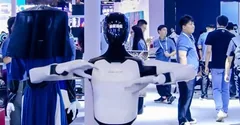
Menlo Research Asimov 1 Here Be Dragons kit
Open-source humanoid you assemble yourself — CAD, BOM and walking policy included
Overview
The Asimov 1 is an open-source bipedal humanoid from Menlo Research, a Singapore-based lab, sold as an unassembled kit for $20,000 with a $499 deposit. It stands 1.2 m, weighs 35 kg and carries 25 actuated degrees of freedom plus two passive spring-loaded toe joints, with a parallel revolute–spherical–universal (RSU) ankle that shares torque between two motors. The structure mixes CNC-machined 7075 aluminium with Multi Jet Fusion nylon, so most parts can be reprinted rather than reordered. Two boards run it — a Raspberry Pi 5 for networking and media, a Radxa CM5 for real-time motor control — behind a 2 MP chest camera, a four-microphone array and onboard IMUs. Menlo open-sourced the design in April 2026 under CERN-OHL-S-2.0 and GPL-2.0, publishing mechanical CAD, the MuJoCo simulation and a walking policy trained with asymmetric actor-critic RL and processor-in-the-loop delays of up to 9 ms. It is a teaching and research platform, not a product: it has no hands, no published battery figure and no warranty, and expects roughly 100 hours of your time before it stands up. RobotTesters has not tested a unit, so this is a specs-based assessment.
Score Breakdown
Available skills
Technical Specifications
Pros & Cons
Strengths
- Genuinely open: CAD, wiring, MuJoCo sim and a pre-trained walking policy under CERN-OHL-S-2.0 and GPL-2.0
- Cheapest way into a 1.2 m, 25-DOF research biped short of Unitree — and you can source the parts yourself
- Modular universal motor mounts: swap arms, legs, torso or head without redesigning the platform
- 7075 aluminium where it matters, MJF nylon everywhere else — you can print your own replacement parts
- Free browser simulator (Digital Asimov) lets you write and test policies before spending a cent
Weaknesses
- Ships with no hands — grasping and manipulation are your problem to solve
- Menlo publishes no battery capacity, runtime or walking-speed figure
- Thin sensing for the money: one 2 MP monocular camera, no depth or lidar
- ~100+ hours of assembly, and a self-built robot carries no warranty or safety certification
- Announced at $15,000 in May 2026; the current listed kit price is $20,000, and tariffs/shipping can push it higher