
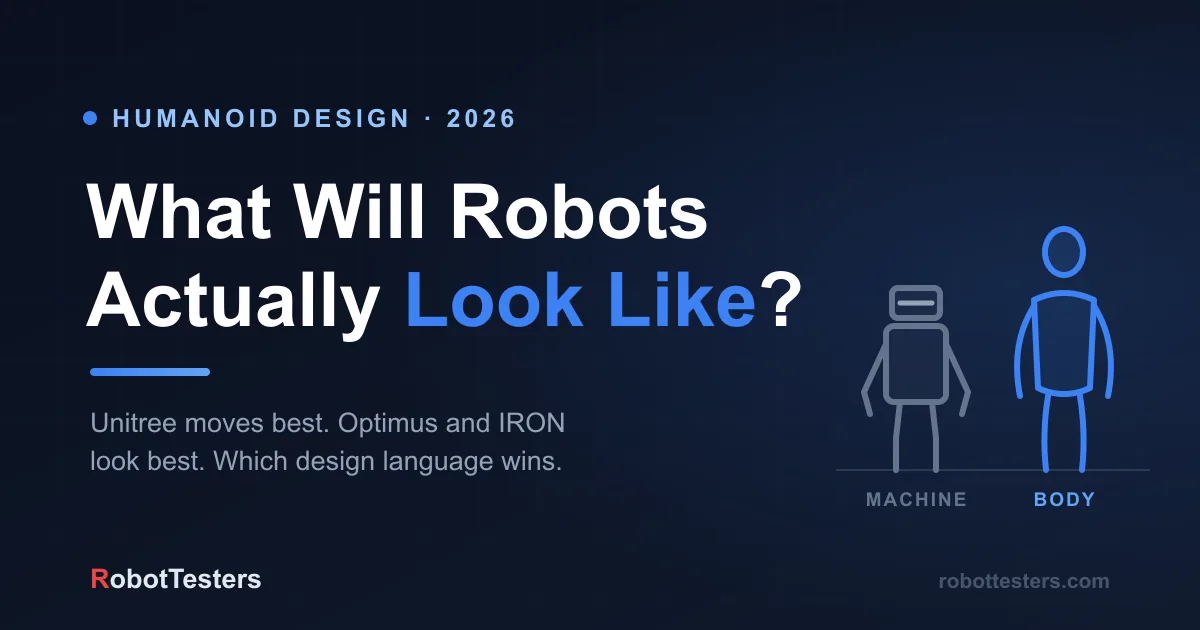
Humanoid robots are splitting into two visual families, and you can tell them apart from across the room. One family looks like laboratory equipment — exposed joints, stubby proportions, a visor where a face should be — and it currently does the most impressive things. The other is built to human dimensions and wrapped in fabric or synthetic skin, and it currently does the most impressive demos. The trend line points hard at the second family, and the reason is not vanity: the world is sized for a 1.7-metre body, and the buyers who will purchase millions of these machines are the ones who have to stand next to them.
The awkward part is that today the best-moving humanoid on Earth is also one of the least attractive. Unitree's G1 is 1.27 m and 35 kg, which is to say child-sized and visibly mechanical, and it does backflips, kip-ups and kung fu that no skinned robot has publicly matched. That tension — the machines that look right can't yet move right, and the machines that move right don't look right — is the most interesting thing in humanoid design in 2026. Here's how the field actually breaks down, what each design choice is buying, and what the median humanoid is likely to look like by 2028.
Key takeaways
- Three schools: engineering-first machines (Unitree, AgiBot, Booster, Boston Dynamics), human-proportioned robots with soft coverings (Tesla Optimus, XPeng IRON, Figure 03, 1X NEO, Fourier GR-3), and hyper-real android faces (Ameca, Anni, Clone) that stay niche.
- Height is expensive: the G1 is 1.27 m and the R1 is 1.23 m because torque, battery and fall damage all scale with height. The lanky Unitree H1 is 1.80 m but only 47 kg — a mass budget, not a styling choice.
- Unitree already conceded the point: the H2 line arrived with a sculpted "bionic" face, animated eyes, human proportions (about 1.80 m, 70 kg) and demo clothing — the same company, a completely different design language.
- Fabric is a safety feature: Figure 03 uses multi-density foam and washable textiles over hard structure; 1X NEO wraps a 3D-lattice body in a knit suit at 29.9 kg and 22 dB. Softness lowers injury risk and insurance risk, not just creep factor.
- Faces are being avoided on purpose: Atlas has a light ring, Apollo and Digit use simple displays, and uncanny-valley research keeps finding that near-realism reads as unsettling. Realistic silicone stays in reception and entertainment.
- The honest caveat: a human-shaped shell does not create capability. XPeng IRON and Tesla Optimus still have to publicly show G1-class dynamic recovery before "looks human, moves human" is more than a promise.
The three design schools of 2026
Almost every humanoid you can name today belongs to one of three families, and each one is a coherent answer to a different question.
Unitree G1/R1/H1, AgiBot A2/A3, Booster T1, UBTech Walker S2, Boston Dynamics Atlas. Structure is the styling: exposed actuators, hard shells, visors instead of faces. Optimised for cost, torque density, serviceability and shift work.
Tesla Optimus, XPeng IRON, Unitree H2, Figure 03, 1X NEO, Fourier GR-3. Built to adult human dimensions and wrapped — in skin, fascia, foam or knitwear — so the machine reads as a body rather than as equipment.
Engineered Arts' Ameca, AnyWit's Anni, Clone Robotics' Protoclone. Enormous facial expressiveness, near-human skin — and almost no useful locomotion. This is theatre, research and reception work, not labour.
School 1 dominates what ships today. School 2 dominates what gets announced for 2027. School 3 is a permanent niche — every attempt to scale it hits the same wall of cost, fragility and the uncanny valley.
The humanoid design league table
The fastest way to see the split is to line the robots up by what covers them, not by what they cost. Heights and weights below are the manufacturers' figures as we hold them in our humanoid catalogue.
| Robot | Height / weight | Body covering | Face | Design logic |
|---|---|---|---|---|
| Unitree R1 | 1.23 m / 27–29 kg | Moulded plastic panels | Visor | Price first — from $4,900 |
| Unitree G1 | 1.27 m / 35 kg | Aluminium alloy + plastic | Sensor visor | Agility per dollar |
| Unitree H1 | 1.80 m / 47 kg | Bare structure | Sensor head | Full height on a mass budget |
| Unitree H2 (Plus) | ~1.80 m / ~68 kg | Smoothed shells, demo clothing | Sculpted bionic face | Unitree goes human-facing |
| AgiBot A3 Ultra | 1.74 m / ~60 kg | Industrial shells | Visor | Factory hardware, 51 DOF |
| UBTech Walker S2 | ~1.76 m / 43–73 kg | Hard panels | Display panel | Shift work, hot-swap battery |
| Boston Dynamics Atlas | 1.5 m / 89 kg | Industrial shells | Light ring | Deliberately not human-limited |
| Tesla Optimus (Gen 3) | 1.73 m / 57 kg | Smooth panels, human silhouette | Blank dark visor | Human proportions, mass production |
| XPeng IRON | 1.78 m / 70 kg | Lattice "muscle" + fascia + soft skin | Smooth featureless head | Retail-facing, 82 DOF, bionic spine |
| Figure 03 | ~1.68 m / ~70 kg | Washable textiles over foam | Screen with animated eyes | Home safety, removable soft goods |
| 1X NEO | ~1.68 m / ~30 kg | Knit suit over 3D lattice | Minimal, no features | Domestic, tendon-driven, quiet |
| Fourier GR-3 | 1.65 m / ~71 kg | Soft-touch shell, warm neutrals | Animal-inspired, micro-expressions | Care work, 31 pressure sensors |
Why the Unitree robots look the way they do
Every complaint about Unitree's aesthetics is really a complaint about a spec sheet decision. Height is the most expensive dimension in a humanoid. Raise the centre of mass and you raise the torque the knee and hip actuators must hold, which raises actuator size, cost, heat and battery draw — and it squares the energy released when the thing falls over. Keeping the G1 at 1.27 m and 35 kg is what lets Unitree sell it at $13,500 and let it throw itself around without a five-figure repair bill. The R1 at 1.23 m and 27–29 kg takes the same logic further: at $4,900 it is priced like a high-end laptop, and it is made of the material a laptop is made of.
The H1 looks lanky for the opposite reason. It is a full 1.80 m but weighs only 47 kg — an adult male frame at roughly two-thirds of an adult male's mass, with 19 degrees of freedom and no cosmetic volume anywhere. There is nothing to fill the silhouette out, because filling it out means carrying it. That is why it reads as a scaffold with a head.
And it works. The unglamorous Unitrees are the machines winning autonomous sprints and martial-arts events at the World Humanoid Robot Games and generating the clips everyone else's marketing department wishes it had. Low mass and high torque density are exactly what dynamic motion needs, and every gram of skin is a gram of payload you no longer have. If you rank humanoids by what they can do rather than how they look, the ugly ones are still ahead — as our head-to-head of the Unitree line keeps finding.
The Unitree H2 is Unitree conceding the argument
The most telling design event of the last year came from the company with the least design-driven products. Unitree's H2 arrived at roughly 1.80 m and 70 kg with 31 body joints, a sculpted bionic face with animated eyes, and demo footage in which the robot wears clothes and dances. Same engineering culture, opposite visual strategy. The H2 Plus research variant in our catalogue pushes the same platform to 75 total degrees of freedom with 22-DOF tactile hands.
You do not add a face to a robot that is going to spend its life in a cage. You add one when you intend to sell it into rooms with people in them. Unitree looked at the same market signal Tesla and XPeng are aiming at and quietly changed the shape of its flagship.
Why AgiBot looks like machine-shop equipment
AgiBot's A3 Ultra is 1.74 m, around 60 kg, and 51 degrees of freedom, with visible structural members, industrial-grade sensor pods and a body that makes no attempt to be liked. That is a rational answer to its buyer. AgiBot sells into factories, logistics and performance work, where the purchasing question is arm payload, uptime, battery swaps and how fast a technician can replace an actuator — not whether shoppers find it charming. Its A2 sibling, aimed at reception and retail, is noticeably softer in the shoulders and gait for exactly the same reason in reverse.
The same logic explains UBTech's Walker S2, with its hard panels and roughly three-minute autonomous battery swap, and EngineAI's 180 cm, 72 kg T800, whose entire aesthetic is a security-patrol threat display. When the robot's job is to be taken seriously by a plant manager, "tosco" is the point.
The Tesla–XPeng school: human proportions as a specification
Tesla's Optimus is 1.73 m and 57 kg — deliberately, almost suspiciously, the dimensions of a median adult. XPeng's IRON is 1.78 m and 70 kg with 82 degrees of freedom, 22 of them per hand. Neither number is an accident. A robot that has to use human stairs, reach a human counter, pass through a human doorway, grip a human tool and — increasingly — wear human clothing has to be built to human dimensions, because the entire built environment is a fixture designed around one body size.
IRON is the most aggressive expression of the idea currently walking. XPeng builds it in layers that read like anatomy: a compact skeleton, a lattice "muscle" structure that also damps mechanical vibration, then a fascia layer and a soft outer skin. It has a five-degree-of-freedom bionic spine and a hip structure tuned for balance, walks at up to 2 m/s, and runs three of XPeng's own Turing chips. The gait is the headline: at its November 2025 debut the walk was smooth enough that viewers publicly accused XPeng of putting a person in a costume, and the company cut a unit open on stage to prove otherwise. Mass production is targeted for late 2026, aimed first at stores, showrooms, offices and guide roles — jobs where the customer is a member of the public standing one metre away.
Tesla is playing the same game with the opposite communication strategy. The V3 body has been kept deliberately hidden — Tesla has said outright that rivals study its footage frame by frame — with only the hands shown in February 2026 and a partial body at AWE Shanghai in March. As of this writing the full V3 has still not been publicly unveiled; the reveal is expected alongside the start of production on the Fremont line that built the Model S and X until May 2026. What has leaked points the same way as everything else here: more human hands, more refined proportions, more joints (37, up nine from Gen 2).
Form is not following function here. Form is following the buyer — and the buyer for the next ten million humanoids is not a plant manager, it's a shop, a hotel lobby or a spare bedroom.
Fabric is a safety feature, not a styling choice
The most under-reported design trend of 2026 is textile. Figure 03 dropped the machined-panel look for soft goods: multi-density foam placed specifically over pinch points, a textile outer layer, and covers that are washable and removable without tools. It is also about 9% lighter than Figure 02. 1X's NEO goes further — a deformable 3D polymer lattice wrapped in a knit suit, tendon-driven actuators, 29.9 kg all-in, and a 22 dB noise floor, which is roughly a quiet library. Fourier's GR-3 care-bot uses a soft-touch shell in warm neutral tones with automotive upholstery, 31 distributed pressure sensors and an animal-inspired head with micro-expressions.
Read those three together and the motive is obvious. A 70 kg machine in a kitchen is a liability question before it is a design question. Softness reduces impact energy, hides pinch points, muffles actuator noise and makes the thing washable when a child or a patient touches it — and it makes the robot legible as a household object rather than as equipment. This is the same reasoning that put fabric on smart speakers, applied to something that weighs as much as you do.
The face is the part nobody has solved
Faces are where design courage collapses, and it is a rational collapse. Boston Dynamics' Atlas has a minimalist light ring and sensor array where a head should be, and three-fingered grippers that look like power tools, because the company's stated philosophy is that a robot should not be limited by human anatomy — Atlas rotates its hips and waist a full 360°, which no human can do. Apptronik's Apollo and Agility's Digit use simple animated displays: enough face to tell you where the robot is attending, not enough to trigger expectations it can't meet. Optimus and IRON both go featureless. Unitree's H2 sculpts a face but stylises it.
At the far end, Engineered Arts' Ameca has 61 degrees of freedom with 27 dedicated to the face alone, wears grey rubber skin and is deliberately genderless; China's Anni, from USTC spin-out AnyWit, claims 34 facial degrees of freedom. Both are extraordinary, both cost roughly a quarter of a million dollars in institutional configurations, and neither does useful physical work. Clone Robotics' Protoclone — 206 polymer bones, over 1,000 fluid-driven "Myofiber" muscles, 200-plus degrees of freedom — is still suspended from a rig, because the skeleton cannot yet support itself standing.
The research backs the caution. Uncanny-valley studies keep finding that highly realistic artificial faces score as most unpleasant, and that the effect fires hardest when almost everything is right and one feature is wrong. A 2026 study testing whether better LLM conversation could rescue hyper-realistic robots found a statistically significant reduction in perceived creepiness, but with small effect sizes and a stubborn subset of people who stayed uncomfortable. If you are shipping a million units, that subset is a product risk. Hence: light rings, screens and blank visors.
Where the "human shape does everything" argument gets weak
Here is the honest counterweight, and it matters if you are placing a bet. A human-looking shell does not contain capability. What lets the G1 recover from a shove lives in actuator torque density, low limb inertia and a control policy trained in simulation — none of which you can see. Skin, fascia and soft goods add mass, trap heat, complicate maintenance and cost money, and every one of those is subtracted from payload and runtime.
So the fair statement about Optimus and IRON today is: they look like the future and they have not yet publicly demonstrated the present. Neither has shown, in uncontrolled conditions, the recovery-from-failure repertoire Unitree posts monthly. Catwalks, handshakes and choreographed dancing are the easiest class of demo to stage; disturbance rejection on a bad floor is the hard one — which is exactly what we look for when testing a humanoid. Until a skinned robot does that in the open, "human form unlocks human tasks" is a hypothesis with excellent production values.
There is also a live counter-school. Boston Dynamics' position — that anthropomorphism should stop exactly where it stops paying — is not a fringe view, and Agility's Digit spent years with bird-like reversed legs precisely because they were better for the job. Expect the industrial half of the market to keep looking like machinery indefinitely, and to be perfectly happy about it.
What the median humanoid will look like in 2028
Putting the trend lines together, here is the specific, checkable prediction. By 2028 the typical general-purpose humanoid intended to work near people will be:
- 1.65–1.80 m and 55–75 kg, with adult human proportions — no more child-sized flagships outside the developer and education tiers.
- Covered, in either a knitted or moulded soft layer over foam, and that layer will be removable and washable. Exposed actuators will read as "industrial", the way exposed wiring does in appliances.
- Faced, but not realistically — a display, a light band or a stylised sculpted face. Photoreal silicone stays in reception, museums, entertainment and research.
- Hand-heavy, with 20-plus degrees of freedom per hand and tactile sensing, because that is where the remaining task value is (and why DOF counts matter).
- Spined. IRON's five-DOF torso is an early sign; a rigid box torso limits reach envelope and makes the gait read as robotic no matter what you wrap it in.
- Warm-toned and quiet. Grey-and-black machine palettes are already giving way to the neutral, domestic tones NEO and GR-3 use, and acoustic noise is becoming a spec line.
The open question is which company gets there with the motion intact. My money is on convergence rather than a winner: the Chinese platform makers keep the dynamics lead and gradually dress their robots, while Tesla, XPeng, Figure and 1X keep the appearance lead and gradually close the motion gap. The first company to put G1-class recovery inside an IRON-class body wins the decade — and the 2026–2027 launch calendar is where that race will be visible.
What this means if you're buying one now
If you're spending your own money in 2026, buy the school that matches the job. Developer, research and education work still points at the engineering-first machines — they're cheaper, they move better, they're serviceable, and nothing about a skin helps you write a control policy. Anything customer-facing, and anything that will share a room with kids or older relatives, points at the covered robots, and it is worth waiting for shipping units rather than reveal videos. And be sceptical of the price of beauty: soft coverings, spines and hands are exactly the parts that make humanoid pricing so slippery. Our current picks are in the best humanoid robots to buy in 2026 guide.