
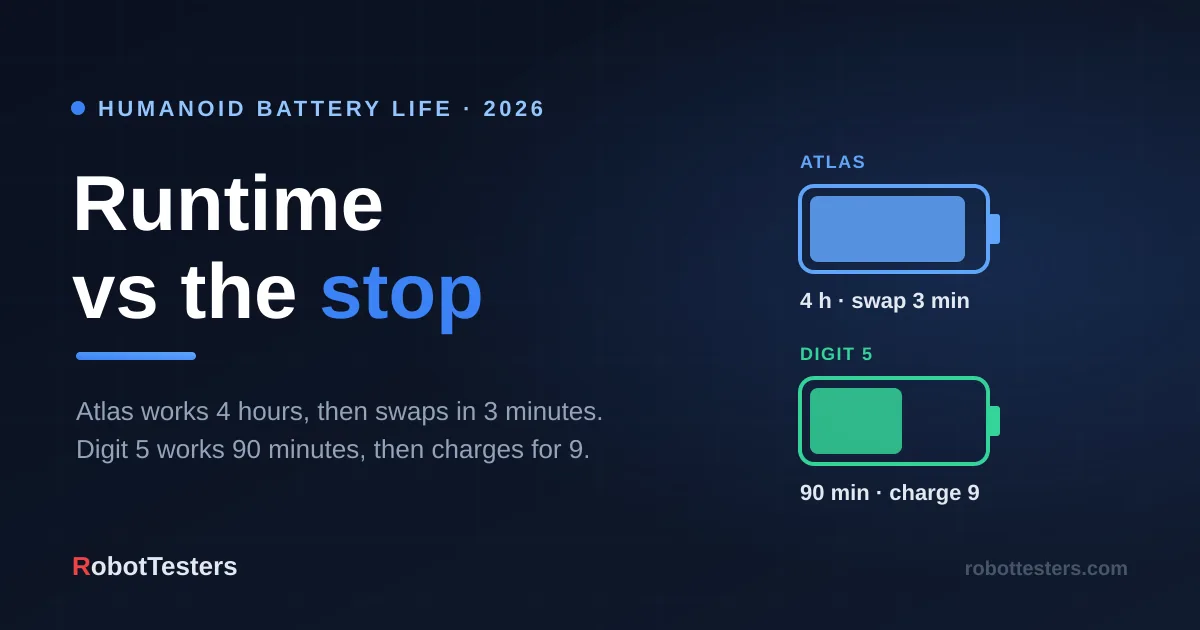
How long a humanoid robot can work is a pair of numbers, not one. Runtime per charge tells you how far the pack gets. Recharge time, or swap time, tells you how long the robot is standing still before it can go again. An eight-hour shift is just those two numbers added up until the clock runs out.
On 15 October 2026 Agility said Digit 5 will work 90 minutes and charge in 9, on a pack from Nyobolt, with early access in the first half of 2027. The same day, Boston Dynamics' Atlas spec sheet, revision dated 15 October 2026, still says 4 hours in typical use, 2 hours with heavy lifting, an autonomous battery swap in 3 minutes, and 1.5 hours to charge the pack that came off. One company is shortening the stop. The other is refusing to stop for a charge at all.
We have not timed any of these packs. The only robot we have lived with is a Stack-chan, and it is not in this table. Every figure below is the manufacturer's, with the page it came from. Where that page is silent, the cell says not published.
Key takeaways
- Atlas: 4 hours typical, 2 hours with heavy lifting, a 3-minute autonomous swap, and 1.5 hours to charge the pack on the shelf. One spare pack covers an 8-hour shift at the typical rating, with a 3-minute stop in the middle.
- Digit 5: 90 minutes of work and 9 minutes of charge, a 10:1 ratio Agility prints itself. Inside an 8-hour clock that is about 7 hours 16 minutes of work and 44 minutes on the charger. Early access is the first half of 2027. The Digit in deployment was quoted at up to 4 hours in March 2025, with the charge time not published.
- Figure 03: 5 hours at peak performance from a 2.3 kWh pack, wireless charging at 2 kW. Minutes to full: not published.
- Still blank: Optimus runtime and recharge, the Unitree H1's hours, and Walker S2's hours per pack. Walker S2 does publish the swap: the robot does it itself, within 3 minutes.
Runtime per charge, from the pages that print it
A runtime without a duty cycle is a soft number. Atlas splits typical use from heavy lifting, and the heavy number is half. Figure's five hours is "at peak performance," which is the hard case, and they still print five. AgiBot's eight hours on the A3 Ultra is a 1:1 mix of standing and walking, and the docs say the real endurance moves with speed and payload. Unitree's "about 2 hours" on the G1 does not say whether that is walking, standing, or a mix. I am keeping each phrase next to the number. Flattening them into one column of naked hours would make the A3 Ultra look twice as capable as Atlas on a job Atlas's own sheet scores at two hours.
The ratio in the last column is runtime divided by the time the robot itself is stopped. For a swap, that stop is the swap, not the hour and a half the empty pack then spends on a charger. Those are two clocks. I say which one I used.
| Robot | Runtime per charge | Recharge or swap | Work / stop |
|---|---|---|---|
| Atlas, typical | 4 hours | Autonomous swap 3 min. The removed pack charges in 1.5 hours, from 110 V (220 V optional). | 80:1 on the swap (4 h ÷ 3 min). About 2.7:1 if you wait for the same pack (4 ÷ 1.5). |
| Atlas, heavy lifting | 2 hours | Same 3-minute swap, same 1.5-hour pack charge. | 40:1 on the swap (2 h ÷ 3 min). |
| Digit, in deployment | Up to 4 hours, with autonomous docking. Agility, 31 March 2025. | Charge time not published. Later Digit 5 materials describe Digit 4's run-to-charge ratio as 2:1, without the two minute counts. | Not published as a minute ratio for this battery. |
| Digit 5 | 90 minutes. Announced for early access in the first half of 2027. | 9-minute charge, Nyobolt pack. | 10:1, which is 90 ÷ 9, and the ratio Agility prints. |
| Figure 03 | 5 hours at peak performance, from a 2.3 kWh pack. | Wireless inductive charge at 2 kW, coils in the feet. Minutes to full: not published. | Not published. |
| Optimus | Not published. | Not published. | Not published. |
| Unitree G1 | About 2 hours. 9000 mAh quick-release pack. G1+ prints the same "approx. 2 h." | Charger listed as 54 V, 5 A. Minutes to full, and minutes to swap, not published. | Not published. |
| Unitree H1 | 15 Ah, 0.864 kWh, max 67.2 V, "quickly replaceable." Hours: not published. | Not published. | Not published. |
| Unitree H2 | About 3 hours. 15 Ah, 0.972 kWh, quick-release. | Charge time and swap time not published. | Not published. |
| Unitree R1 | About 1 hour. Quick-release smart battery. | Charge time and swap time not published. | Not published. |
| Walker S2 | Hours per pack: not published on the product page. UBTECH does say 24/7, via the swap. | Autonomous swap within 3 minutes. Dual packs; the robot can choose a swap or a charge. | Not published. The stop is known. The run between stops is not. |
| Apollo | 4 hours per swappable pack. | Swap duration not published. Apptronik describes a battery change so the robot is not stuck on a plug. | Not published. |
| 1X NEO | 4 hours, from an 842 Wh pack. NEO plugs itself in. | Quick charge: 6 minutes per hour of runtime. A full refill of the published 4 hours is 24 minutes if that rate holds the whole way. That 24 is our multiplication. | 10:1, from 60 ÷ 6. |
| AgiBot A3 Ultra | 8 hours overall, at a 1:1 mix of standing and walking. 1152 Wh. Actual time moves with speed and payload. | Plug-in charge ≤ 2 hours. The store page also lists a 10-second battery swap, plus autonomous charging. | 4:1 at the 2-hour charge ceiling (8 ÷ 2). Against the 10-second swap the robot's own stop is about 2,880:1, and the empty pack still needs up to 2 hours somewhere else. |
The H2 row links to our H2 Plus card because that is the full-size Unitree page on this site. The "about 3 hours" and the 0.972 kWh are on Unitree's H2 parameter list. Digit 5 does not have its own card yet. The Digit page is the robot Agility has actually been deploying, the one with the March 2025 four-hour line.
Boston Dynamics Atlas battery: four hours, then three minutes
The product page says battery life of 4 hours, and that Atlas walks itself to a station and swaps its own pack. The spec sheet, rev 15 October 2026, is the page that adds the rest: 2 hours with heavy lifting, autonomous battery swap time 3 minutes, and charge time 1.5 hours. Charge power is 110 V, with 220 V optional. That is an ordinary wall circuit. The station does not have to be a fast-charge cabinet.
Four hours is 240 minutes. Divided by a 3-minute swap, that is 80:1. On a floor it is one swap in the middle of an eight-hour shift. Start full, work 4 hours, swap for 3 minutes, work another 4. You have spent eight hours of the typical rating and lost 3 minutes. The pack that came off at hour 4 needs 1.5 hours on the charger, and the robot is busy for another 4, so that pack is full again with time to spare. One spare pack covers the typical day.
Heavy lifting cuts the pack to 2 hours, so an eight-hour lifting day is four packs' worth of energy and three swaps. Three times 3 minutes is 9 minutes at the station. The removed pack charges in 1.5 hours while the robot spends 2 hours on the other one. The margin is 30 minutes. One spare still covers the published heavy-lifting line. A day harder than that line would eat the margin, and then you want a second spare sitting charged. I would budget the second spare if the job is closer to "lift all day" than to "typical."
If you skipped the swap and waited for the same pack, 4 hours of work plus 1.5 hours of charge is a ratio of about 2.7:1. Inside an eight-hour window the robot would be charging a large slice of the afternoon. The swap is the feature that turns a four-hour battery into a shift battery. The 1.5 hours does not disappear. It moves off the robot and onto a shelf.
Agility Digit 5 charging time: nine minutes for ninety
Digit 5's battery is the other school. Agility's Digit 5 unveil and the 15 October Nyobolt release say the same thing: a new battery system delivers 90 minutes of runtime and charges in 9 minutes, a 10:1 run-to-charge ratio, up from Digit 4's 2:1. The Digit 5 page lists that 10:1, and a work line of 20 hours in 24. Chief business officer Daniel Diez put the commercial point in one sentence.
"For our customers, Digit's uptime is the business case. Digit 5 will deliver more than 20 hours of productive work in a 24-hour day, more than two full shifts."
The arithmetic of 90 and 9 is easy to check, and it matches the claim. The robot works 90 minutes out of every 99, which is about 90.9 percent of the clock. Over 24 hours that is 24 × 90/99, about 21.8 hours of the rated runtime. "More than 20" is that fraction, said by a person. The product page rounds the same duty cycle to 20 hours in 24. That fraction is a short pack and a very short stop, repeated all day.
Inside an eight-hour window the same fraction is 8 × 90/99, about 7 hours 16 minutes of work and 44 minutes on the charger. If the job needs the full eight hours of work, you add 8 × 9/90, which is 48 minutes of charging, and the shift runs 8 hours 48 minutes. That assumes Digit can hit the charger the moment the 90 minutes are up, and that the 90 and the 9 survive a real tote, not a spec-sheet tote.
Agility's own release treats those numbers as expected performance. The forward-looking section names runtime, recharge time, the ratio, and the hours in a day. Early access to a Digit 5 with the Nyobolt pack is the first half of 2027, with wider availability over the six to nine months after that. I am putting 90 and 9 in the table because they are the company's figures. I am not pretending we have watched a fleet do it.
The Digit already in the field is a different battery. On 31 March 2025 Agility said an expanded pack lasts up to four hours and can dock itself. Four hours is half of an eight-hour shift, so the second half needs another charge, and that post does not say how long the charge takes. The October 2026 releases describe Digit 4's ratio as 2:1 and do not print the two minute counts beside it. I am not going to multiply "up to four hours" by "2:1" and call the result a two-hour charge. Those sentences are from different dates, and Agility has not joined them.
What Digit 5 gives up, on the published numbers, is energy per stop. Ninety minutes is a lot less than four hours. What it buys is the stop itself: 9 minutes instead of an unpublished dock on the older pack. Nyobolt's side of the release talks about fast charging, cycle life, and a smaller, lighter pack. It does not publish the charge power in kilowatts. That cell stays blank.
What an eight-hour shift costs once the numbers exist
Atlas and Digit 5 are the clean cases, because both clocks are printed. The rest of the field makes you plan a shift with one hand tied.
1X NEO is the closest cousin of Digit 5. The order page prints 4 hours from an 842 Wh pack, and a quick charge of 6 minutes per hour of runtime. Take that rate across the whole four hours and a full refill is 4 × 6 = 24 minutes. That 24 is our multiplication of a rate 1X did publish. Sixty divided by six is the same 10:1 Agility prints for Digit 5. An eight-hour clock again leaves about 7 hours 16 minutes of the rated runtime, if NEO plugs itself in the moment it stops and the rate holds to empty. 1X says it does plug itself in. There is no published swap.
AgiBot's A3 Ultra is the one robot here whose published runtime already matches an eight-hour shift, on the duty cycle they name. The developer spec says 8 hours overall at a 1:1 mix of standing and walking, from a 1152 Wh pack, and a plug-in charge of 2 hours or less. The worst published plug-in ratio is 8 ÷ 2 = 4:1, and a faster charge would beat that. The store page also lists a 10-second battery swap. Ten seconds against eight hours is a stop so short it barely sits in the same column as a nine-minute dock. The empty pack still needs up to two hours somewhere else, so the ten seconds only works if a charged pack is already in the station. Continuous walking is not given its own hour figure. The docs say the real number moves with speed and payload. I believe the eight hours for the mix they described. I would not quote it for a robot that walks the whole shift.
Figure 03 prints 5 hours at peak performance from 2.3 kWh, on both the product page (runtime 5 hr) and the battery development note. Five hours of the peak rating covers five of the eight. The second top-up does not have a published duration. Figure does publish the charge power: 2 kW, wireless, through coils in the feet, so the robot stands on a pad instead of taking a cable. Divide 2.3 kWh by 2 kW and you get 1.15 hours, 69 minutes, if 2 kW held from empty to full. I would not plan a shift on that 69. Chargers taper near the top, and Figure has not said the 2 kW is a constant to 100 percent. What they have said, in the Figure 03 introduction, is that the robot can step onto the stand and keep working through a day, as long as the task gives it that time on the mat.
Unitree publishes hours for three of the four humanoids, and a clock for none of the chargers. G1 is about 2 hours, so an eight-hour day is four of those intervals, if you take "about" at face value. G1+ prints the same approximate two hours and the same 9000 mAh quick-release pack, which is why the extra money on a G1+ is not buying you a longer shift. H2 is about 3 hours, so two full packs and a shorter third interval. R1 is about 1 hour, so eight intervals. All three have a quick-release battery, which means a person can change it. None of the pages say how many minutes the change takes, or how long the charger needs. The G1 charger is specified as 54 V at 5 A. Volts and amps still leave the charge cell not published, because the page never turns them into minutes.
H1 is the awkward Unitree. The current parameter list prints 15 Ah, 0.864 kWh, a max of 67.2 V, and "quickly replaceable." It does not print hours. An 864 Wh pack is a real battery. Watt-hours become hours only after you know the draw, and Unitree has not published the draw.
Walker S2 is the mirror image. UBTECH's product page says the robot swaps its own battery within 3 minutes, can run on one pack or two, and can choose a swap or a charge from the task. Hours per pack are not on that page. You know the length of the stop and not the length of the run between stops. The 24/7 line is the claim that a charged pack will be sitting there when the robot arrives. The swap itself, and why it matters on a factory floor, is the subject of our Walker S2 piece.
Apollo sits between them. Apptronik's unveil says each swappable pack runs four hours, so the robot changes a battery instead of waiting on a plug. Two packs cover eight hours if the change is short. The length of the change is not published. "Simple" is not a number of minutes.
Optimus has neither clock. Tesla has not published a runtime or a recharge time, so there is nothing honest to put in an eight-hour plan. The Gen 3 piece is where we keep what Tesla has actually said about the robot. Until those clocks exist, Optimus stays out of the comparison.
That gap is the one that matters to anyone buying a shift rather than a demo. The companies actually trying to build these machines in volume are selling time on a floor. A robot whose peak-performance rating covers five of eight hours still leaves a hole in the afternoon, unless the dock, or the spare pack, is part of the quote.
Where the page says nothing
The blanks are the useful part of the table, so here they are in one place.
- Optimus: runtime not published, recharge not published, swap not published.
- Unitree H1: capacity published (0.864 kWh), hours not published, charge time not published.
- Walker S2: swap published (within 3 minutes, done by the robot), hours per pack not published on the product page.
- Figure 03: runtime and charge power published, minutes to full not published.
- Apollo: four hours per pack published, swap duration not published.
- G1, H2, R1: approximate hours published, charger or quick-release hardware published on some of them, minutes to full and minutes to swap not published.
- Digit, March 2025 battery: up to four hours published, charge minutes not published. Digit 4's 2:1 is a ratio without the two times attached.
- Digit 5: both times published. Charge power in kilowatts not published. The robot is not in early access until 2027.
I would rather leave a cell empty than borrow a number from a review site, a reseller PDF, or an old keynote and let it harden into a spec. If a manufacturer prints the missing minute later, the cell fills in on its own.
Swap the pack, or charge it where it stands
Those are the two schools, and the table is already an argument between them. A swap keeps the chemical recharge off the robot. A fast charge keeps the spare packs out of the building. Both can cover a shift. They fail in different places.
What a battery swap buys
- The robot's stop is the swap. Atlas prints 3 minutes, Walker S2 prints within 3 minutes, and AgiBot's store page prints 10 seconds.
- The empty pack charges on a shelf. Atlas does that in 1.5 hours from a 110 V circuit, so one spare covers the typical 4-hour rating with margin.
- The workstation does not need a multi-kilowatt dock. Atlas's charger requirement is ordinary wall power.
What a battery swap costs
- You own extra packs, and a station that has to hand one back charged.
- The swap is a mechanical job. Atlas and Walker S2 do it themselves. A missed latch is a different kind of downtime than a slow charger.
- Walker S2 has not published hours per pack, so you know the 3 minutes and not how often they arrive.
What a fast charge buys
- One pack per robot. Digit 5's entire stop is the 9-minute charge. There is no spare inventory in the published design.
- The ratio is short enough to check. Digit 5 is 90 ÷ 9. NEO's published rate, 6 minutes per hour of runtime, is the same 10:1.
- Figure's version needs no cable. The robot steps onto a pad. NEO plugs itself in. A home is a kinder place for that than for a rack of spare packs.
What a fast charge costs
- The robot waits out the whole charge. Digit 5 gives up about 44 minutes of an eight-hour clock, on the published ratio.
- The cells and the charger have to take the power. Figure prints 2 kW and active cooling. Digit 5's kilowatts are not in the Nyobolt release.
- Digit 5 is an announcement with early access in the first half of 2027. Cycle life in a warehouse is still ahead of the spec sheet.
If I were covering a warehouse shift with the numbers that exist today, I would take Atlas's spare pack over a nine-minute dock I cannot buy until 2027. The 3-minute swap is on a current spec sheet, the spare charges inside the next work window, and heavy lifting is at least quantified. If I were covering a home, where nobody wants a shelf of lithium packs in the hall, I would take Figure's pad or NEO's self-plug, and I would keep the unpublished charge duration in the quote. Digit 5 is the interesting industrial bet, and it is still a bet: 10:1 is a better shape than Digit 4's 2:1, and the robot that has to live it is not in customers' buildings yet.
Nine days on a treadmill, and a five-hour battery
On 19 October 2026 Brett Adcock said a Figure 03 had walked 348 miles and 1.2 million steps across nine days on a treadmill. He called it a side project to stress the robot for failures. Humanoids Daily, writing it up the next day, noted that the post did not include a power arrangement, a maintenance log, or a protocol, and that the nine days should be read as the length of a walking test. Interesting Engineering reported a power cable in the time-lapse. Figure's battery page still says five hours at peak performance, from 2.3 kWh.
Nine days is a durability run, a useful thing to do to a leg, a gearbox, and a wiring harness. The five-hour line still stands on its own, and the afternoon still depends on what happens once the cable is gone. The parcel-sorting demonstration is a different test again, a work demo over many hours, and it is not a single-charge figure either. When someone quotes a humanoid "working for days," ask which clock they mean. The treadmill clock, the shift clock, and the battery clock are three different instruments.
Sources
- Boston Dynamics, Atlas spec sheet, rev 15 October 2026. 4 hours, 2 hours with heavy lifting, autonomous swap 3 minutes, charge time 1.5 hours, 110 V.
- Boston Dynamics, Atlas product page. Battery life 4 hours, autonomous swap.
- Agility Robotics, Nyobolt partnership, 15 October 2026. 90 minutes, 9 minutes, 10:1, Digit 4 at 2:1, more than 20 hours in 24, early access in the first half of 2027.
- Agility Robotics, Digit 5 unveil, and the Digit 5 page. Same 90 / 9 / 10:1, and 20 hours of work in 24 on the product page.
- Agility Robotics, 31 March 2025 update. Battery lasts up to four hours, autonomous docking.
- Figure, F.03 battery. 2.3 kWh, 5 hours at peak performance, 2 kW fast charge.
- Figure, Figure 03 page (runtime 5 hr) and introducing Figure 03 (wireless 2 kW through coils in the feet).
- Unitree, G1 and G1+. About 2 hours, 9000 mAh quick-release, charger 54 V 5 A.
- Unitree, H1. 15 Ah (0.864 kWh), quickly replaceable. Hours not on the page.
- Unitree, H2. About 3 hours, 15 Ah (0.972 kWh), quick-release.
- Unitree, R1. About 1 hour, quick-release smart battery.
- UBTECH, Walker S2. Autonomous swap within 3 minutes. Hours per pack not on the page.
- Apptronik, Apollo unveil. Swappable packs, four hours each.
- 1X, NEO order page. 842 Wh, 4 hours, quick charge 6 minutes per hour of runtime.
- AgiBot, A3 Ultra developer spec. 8 hours at 1:1 stand/walk, 1152 Wh, charge ≤ 2 hours. Store page: 10-second swap.
- Humanoids Daily, 20 October 2026, on Adcock's 348 miles, 1.2 million steps, and nine treadmill days. Interesting Engineering on the cable in the clip.