
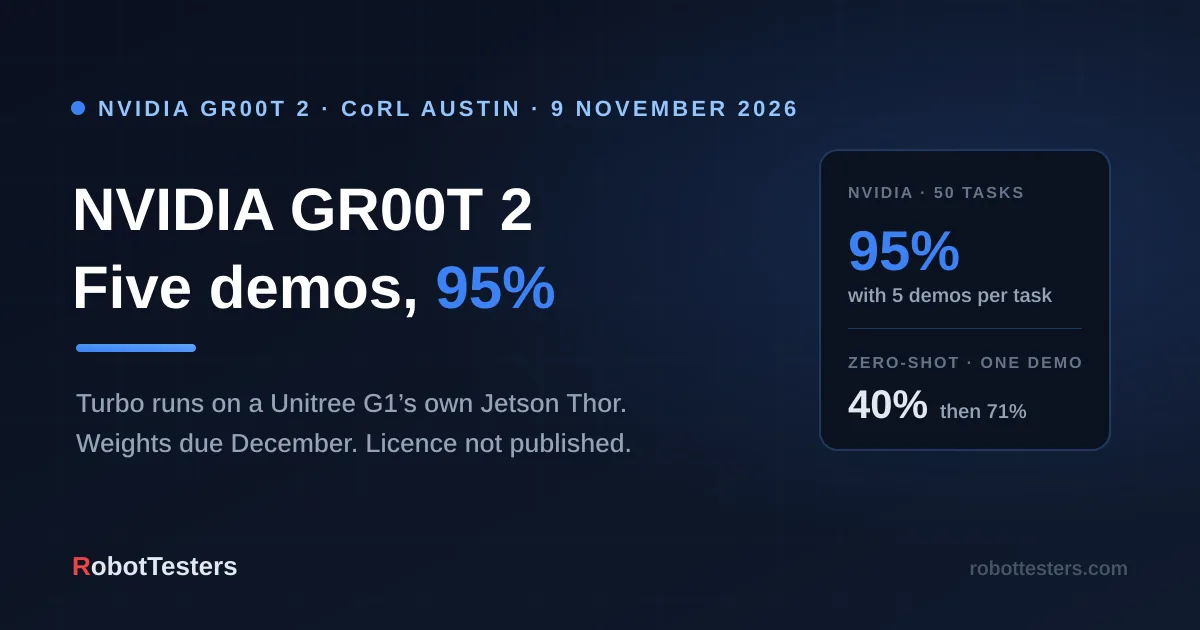
On 9 November 2026, at the Conference on Robot Learning in Austin, NVIDIA’s Jim Fan presented GR00T 2, the next generation of the company’s robot foundation model. A foundation model here means one large model trained on many robots and many tasks, which you then tune for your own robot instead of training from scratch. The figure that travelled was this one: with five demonstrations per task, under three minutes of robot data, NVIDIA says GR00T 2 succeeds 95% of the time on 50 tasks the target robot had never practised.
It was also the most talked-about robotics story of the week on X, and the obvious question behind the hype is a practical one: can someone with a robot actually use it? The short answer is not yet. The datasets and some of the tools are out now, the model weights are promised for December, and the licence hasn’t been published. This piece goes through what works today, what hardware the demos ran on, and which numbers I’d read twice before quoting them.
Key takeaways
- GR00T 2 is a world action model built on NVIDIA Cosmos: it predicts the next moments of camera video and the robot’s next actions together. It was presented at CoRL on 9 November 2026.
- Available now: 100,000 hours of egocentric human video (Human-1M-100K on Hugging Face), the SimFoundry 1.0 real-to-sim pipeline and hardware designs for NVIDIA’s capture devices. The weights for GR00T 2 and GR00T 2 Turbo are due in December 2026, with no exact date and no published licence.
- NVIDIA reports 40% zero-shot success on 50 unseen tasks, 71% with one demonstration and 95% with five, after a 30-minute fine-tune on a single RTX 5090. The 50 tasks haven’t been listed publicly.
- GR00T 2 Turbo runs on board a Unitree G1, on its Jetson Thor, at 124 ms per prediction. Foxconn, Siemens, Nexuni and MicroAGI are named as early users.
A model that imagines the next second before it moves
Earlier GR00T versions, like most robot models right now, were vision-language-action models: they look at the camera image, read the instruction and output a motion. GR00T 2 adds a step in the middle. It predicts what the cameras should see over the next moment, and the actions that would produce that view, in the same pass. NVIDIA’s project page describes a single diffusion transformer that “denoises future video and robot actions together”, then small heads per robot turn that plan into motor commands for each body. Fan put it more vividly during the talk, over a clip of generated footage: “Not a single pixel is real. We are watching the robot dreaming.”
Why bother predicting video? Because it lets the model learn physics from people. NVIDIA pretrained GR00T 2 on 402,730 hours of egocentric video of humans at work, 10,184 hours of demonstrations with a handheld gripper across 2,897 tasks, and 23,500 hours of robot teleoperation. Human video has no motor commands in it, but it does show how objects move when hands act on them, and a model that has to predict the next frame has to learn that. NVIDIA reports that adding more human video lifted real-robot task progress from 50% to 70% on its 72-task test set.
Fan frames GR00T 2 as “System 1”, the fast skill layer, with a bigger reasoning model deciding what to do and calling GR00T 2 through what NVIDIA calls the WAM API. That’s the same split as in our humanoid AI systems explainer, so I won’t repeat the comparison with Helix and others here. The one contrast worth making is with last week’s other big “robot brain”, Gemini Robotics 2.5 at Mercedes, which runs on cloud servers. Fan argued the opposite case: “You need to own System 1, untethered and free of the tyranny of conference Wi-Fi.”
What you can download today, and what waits for December
This is the part most people are searching for, so here it is plainly. The list below comes from Fan’s closing slide as reported by Humanoids Daily, checked against NVIDIA’s blog and project page.
| Release | Status |
|---|---|
| Human-1M-100K (100,000 h of egocentric human video) | Available now on Hugging Face, with a browser explorer |
| SimFoundry real-to-sim pipeline | Version 1.0 available now; 2.0 due in early 2027 |
| Hardware designs: UMI gripper, DexUMI exoskeleton, robot neck | Available now |
| GR00T 2 and GR00T 2 Turbo weights | “December 2026”, no exact date |
| Cross-embodiment transfer recipe | “December 2026”, with the weights |
| Licence for the weights | Not published |
The licence is the line I’d watch. NVIDIA and the press both describe GR00T 2 as open, and Fan said robotics “is no longer an elitist sport anymore”. But Humanoids Daily points out that NVIDIA’s Flora video-annotation models, released in October with similar “open-source” language, came under a noncommercial research licence. If GR00T 2 follows that pattern, a hobbyist or a lab can use it, and a company building a product on it would need a separate deal. Nobody outside NVIDIA knows yet.
The hardware behind the demos
NVIDIA hasn’t published minimum requirements, so the table below lists only the hardware it actually reports using. Treat it as “this is what worked for them”, not as a spec sheet.
| Job | Hardware NVIDIA reports | Figure |
|---|---|---|
| Turbo running on the robot | Unitree G1, on its Jetson (AGX) Thor | 124 ms per prediction |
| Whole-body control under Turbo | SONIC controller on a separate Jetson Orin NX | 50 Hz |
| Turbo on a desktop GPU | RTX 5090 | 38 ms per prediction |
| Few-shot fine-tune | A single RTX 5090, LoRA | 30 minutes per task |
| Arms and hands in the demos | YAM arm, Franka, 22-DoF Sharpa hands, Wuji and ROBOTERA hands | — |
The G1 line is the one that matters for most of our readers, because it’s a humanoid people can actually buy. Turbo plans about 1.6 seconds of whole-body motion roughly once per second, and the controller fills in the joint targets at 50 Hz in between. NVIDIA reports the G1 scooping and serving popcorn in all 48 of 48 trials and clearing a table of mixed objects in 93% of 30 trials. The 22-DoF Sharpa hands are worth a note too. A degree of freedom is one independent joint motion, and the same hand turned up on Apptronik’s Apollo at Mercedes last week.
One detail is still fuzzy. Humanoids Daily reports 2 billion parameters for the main model and says Turbo keeps the same count with four times fewer video tokens, while NVIDIA’s project page gives 2 billion for Turbo’s transformer and calls it the smaller one. I’d expect the December release to settle that, and it matters for anyone planning to fine-tune at home.
The 40, 71 and 95%, read slowly
Here is exactly what NVIDIA reports. The test is 50 tasks run on a two-armed robot with two Sharpa hands. None of the 50 appeared in that robot’s own training data; they only appeared in human video or in other robots’ data.
- Zero-shot, from the instruction alone: 40% average success, and at least one success on 40 of the 50 tasks.
- One demonstration per task: 71% average success.
- Five demonstrations per task, under three minutes of robot data: 95%, with 37 of the 50 tasks succeeding in every trial.
Two of those numbers are easy to mix up. NVIDIA’s blog headline says the model “completed 40 of 50 evaluated tasks at least once”, and that is a different claim from 40% success. A task counts in the 40-of-50 figure if a single attempt worked. TechTimes made this point on 10 November, and added that the announcement doesn’t name the 50 tasks or say how many attempts sit behind each average. It quoted NVIDIA’s own RoboLab team on why that matters: 90% measured over 70 attempts has a 95% confidence interval of roughly 80.5% to 95.9%. In other words, with few attempts, the true rate could be quite a bit lower or a little higher than the headline.
The 37-of-50 detail is the most useful number in the release, I think. It means 13 tasks still failed at least sometimes after five demonstrations, and an average of 95% can hide a few tasks that rarely work. For a robot at home or on a line, those are the tasks you’d notice.
NVIDIA also says GR00T 2 ranks in the top three, across both vision-language-action and world-action categories, on the RoboCasa365, RoboLab, RoboDojo and MolmoSpaces leaderboards. This month, three researchers (Bo Peng, Wenhao Chai and Zhifei Li) published an audit of RoboDojo, a 54-task benchmark for a two-armed robot built on NVIDIA’s Isaac Sim. They found that the friction values written into the tasks never reach the physics engine, which uses its 0.5 default for every object; that some toy cubes are as dense as osmium; and that some checks pass without the task being done: a xylophone task gives full marks to a mallet that never touches a key, and shoving bottles into a bin without picking any up can earn up to 40 points. The audit doesn’t test GR00T 2 or comment on its ranking. It does suggest that a top-three spot on that particular leaderboard says less than it sounds like, for every model on it. For more on why simulator physics matters, see our sim-to-real explainer.
Who is already using it
NVIDIA named four early users, and this is everything it has said about them. Foxconn is applying GR00T 2 to factory automation for server manufacturing. Siemens is evaluating it across industrial use cases. Nexuni is testing it for robotic laundry handling. MicroAGI has post-trained it with reinforcement learning to swap Ethernet cables with a YAM arm, building its simulation environments in Isaac Lab 3.0 and the Newton physics engine. None of them has published results of its own, so for now these are pilots described by NVIDIA.
NVIDIA’s own lab demos go further. With a reasoning model directing it through the WAM API, a YAM arm assembled three toys in 292 of 300 trials, recovering from dropped parts along the way. When the reasoning model marked where to grasp and where to release on the camera view, instruction following on YAM went from 40% to 92%. Those are NVIDIA’s numbers on NVIDIA’s setups, which is normal for a launch, and they’re the kind of claim the open weights will let other labs check.
What it means if you own, or want, a robot
If you have a Unitree G1, GR00T 2 Turbo is the first big foundation model shown running on that exact robot’s own computer, doing whole-body tasks. That is genuinely new. The catch is that you can’t try it until NVIDIA ships the weights, and even then you’ll need to collect your own demonstrations, which means a way to teleoperate the robot or one of the capture devices NVIDIA has open-sourced. Five demonstrations sounds small, and it is, but each one still has to be a good one.
If you’re shopping, I wouldn’t buy a robot because of GR00T 2 yet. A model that learns a task from five demonstrations is the step that home robots have been missing, and that’s why the hype is real. Until the weights, the licence and the task list are public, it’s a promise from a company with a very good track record in simulation and a strong interest in selling the chips it runs on. For a wider view of where it was announced, see our CoRL 2026 preview, and for every robot article we’ve published, the Robotics hub.
When the weights land: what we’ll check
NVIDIA has said December, with no date. When the weights for GR00T 2 and GR00T 2 Turbo are published, we’ll update this article with the licence terms, the exact model sizes, the hardware needed to run and fine-tune each one, and whether the 50-task list and attempt counts come with them. If any of the four early users publishes its own numbers, those go here too.
My read: GR00T 2 is the most practical robot-model launch of the year on paper, because it runs on a robot you can buy and learns from very little data. I’ll believe the 95% when someone outside NVIDIA reproduces it on tasks they chose themselves.
Sources
- NVIDIA Blog, Practice Makes Precise: At CoRL, NVIDIA and Partners Reveal How Robots Rehearse Delicate Work in Simulation, 9 November 2026. GR00T 2 built on Cosmos, 40 of 50 tasks at least once, 71% and 95%, top-three leaderboard claim, Foxconn, Siemens, Nexuni and MicroAGI.
- NVIDIA GEAR, GR00T 2: Scaling Robot Foundation Models for Generalization, Dexterity, and Adaptation, November 2026. Architecture, pretraining hours, 50-task protocol with 37 of 50 at 100%, 30-minute LoRA on an RTX 5090, Turbo latency (124 ms on Jetson Thor, 38 ms on RTX 5090), G1 results, 292 of 300 assemblies, visual steering 40% to 92%.
- Humanoids Daily, “Robotics Is No Longer an Elitist Sport”: NVIDIA Unveils GR00T 2 and Open-Sources the Stack Behind It, 9 November 2026. Jim Fan quotes, December release of weights and recipe, list of releases available now, unpublished licence and the Flora precedent, parameter counts, Jetson Orin NX for SONIC.
- TechTimes, NVIDIA GR00T 2 Robot Model Reports 95% Success While Leaving 50 Test Tasks Unnamed, 10 November 2026. Unnamed tasks, missing attempt counts, RoboLab confidence-interval example.
- Bo Peng, Wenhao Chai and Zhifei Li, What does RoboDojo really simulate?, November 2026. Independent audit of the RoboDojo benchmark’s physics and scoring.