
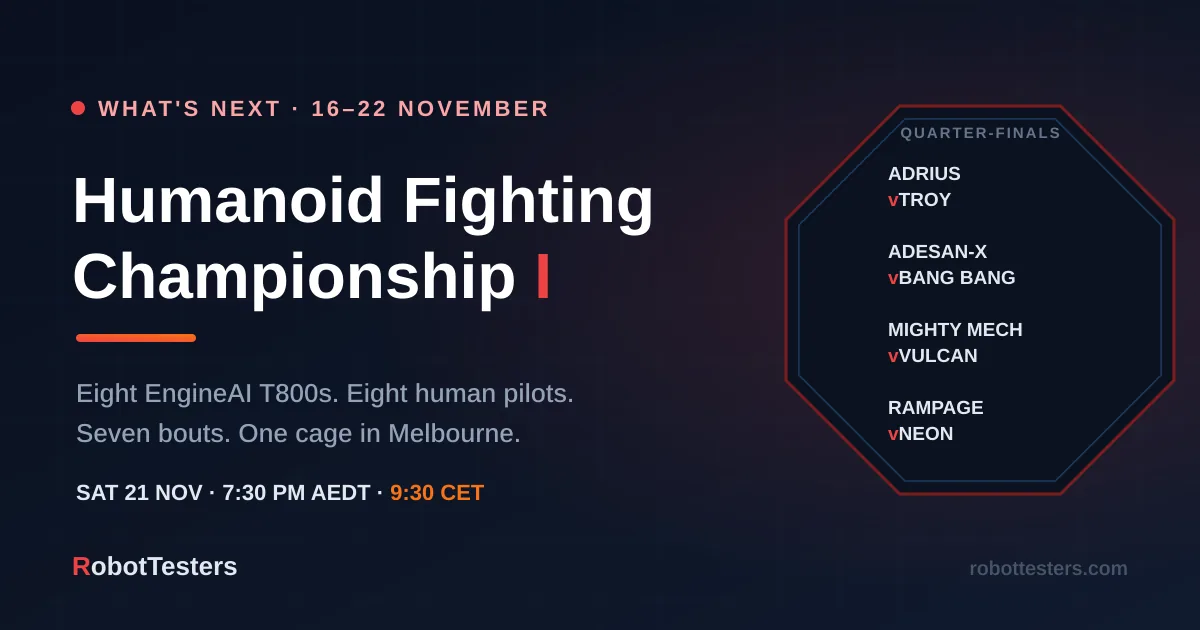
On Saturday 21 November, eight full-size humanoid robots walk into an eight-sided cage at Margaret Court Arena in Melbourne Park and fight until one of them is left. The event is HFC I, the first night of the Humanoid Fighting Championship, and the venue bills it as Australia's first humanoid fighting event. Every robot on the card is the same machine, an EngineAI T800, and every one of them is piloted live by a human operator. That last detail changes what you are actually watching, and it is most of what this preview is about.
I wrote this on Sunday 15 November from HFC's own site, its commentator announcement and the arena's event page. Nothing below is a result. I will update this page with what happened in the cage on 21 and 22 November.
Key takeaways
- When: Saturday 21 November 2026. First bout 7:30 pm AEDT in Melbourne. That is 9:30 am on Saturday in Madrid (CET), 8:30 am in London and 3:30 am on the US East Coast. HFC's FAQ lists doors at 6:00 pm; Margaret Court Arena still lists gate opening as TBC.
- Where: Margaret Court Arena, Melbourne Park. Tickets are sold through AXS, Melbourne Park's ticketing partner.
- Who: eight EngineAI T800s, built to one spec (85 kg, 1.73 m), each piloted live by a trained human operator with AI-assisted balance.
- Format: single elimination, seven bouts, three rounds per bout. Judges score damage and downtime, and corner teams can repair the robots between rounds.
- Quarter-finals: Adrius v Troy, Adesan-X v Bang Bang, Mighty Mech v Vulcan, Rampage v Neon. The semi-finals are set on the night.
- Also this week: ISRR in Malacca, the ISSA Show in Las Vegas, two robotics days on 17 November in Manchester and Cambridge (MA), ROBOT2026 in Barcelona and ICRAE in Nagoya.
A fight night with one robot model in every corner
Most robot competitions are about the machine. Teams bring different hardware, and the interesting question is whose design holds up. HFC removes that question on purpose. HFC says all eight fighters are EngineAI T800s built to the same specification, 85 kg and 1.73 m, so roughly the size of a heavy adult man. If you want the full spec sheet, the joint counts and the battery numbers, they are on our T800 page, and the story of why EngineAI built a robot with that name is in our earlier T800 piece. I will not repeat them here.
With identical hardware, two things are left to separate a winner from a loser. The first is the pilot. HFC's own description is that each machine is driven live by a trained operator, “think drone racing, but the drone is a full-size humanoid,” with AI-assisted balance and reflexes underneath. That split matters. Teleoperation, a person steering a robot remotely in real time, handles the intent: step in, throw, back off. The balance controller handles the part no human could do fast enough with a joystick, which is keeping 85 kg upright on two feet while it swings and gets hit. So when a T800 stays on its feet after a hard strike, that is mostly the controller. When it lands a combination at the right moment, that is mostly the person.
The second is the corner. HFC says armour panels crack, servos fail and machines go down, and that corner teams can repair between rounds. A servo is the motor-and-gearbox unit that moves a joint, and a humanoid has dozens of them. Swapping one, or deciding a damaged arm is good enough for one more round, is the robot version of a cut man working between rounds. I suspect the best corner on the night will matter as much as the best pilot, and that is the part of the broadcast I most want to see.
How the bracket and the scoring work
The format is short and unforgiving. Eight robots, seven bouts: four quarter-finals, two semi-finals and a final. Lose once and you are out. Each bout is scheduled for three rounds. HFC says the judges score on damage and downtime, meaning how much harm a robot does and how long its opponent spends on the floor. The bouts happen inside an octagonal enclosure with full-height impact shielding, which is there for the crowd as much as for the robots.
| Bout | Robot | Opponent |
|---|---|---|
| Quarter-final 1 | Adrius | Troy |
| Quarter-final 2 | Adesan-X | Bang Bang |
| Quarter-final 3 | Mighty Mech | Vulcan |
| Quarter-final 4 | Rampage | Neon |
| Semi-finals and final | Seeded on the night | |
The names are personas. HFC gives each robot a character and a story, the way a wrestling promotion would, while saying the results themselves are not written in advance. The winner takes the first HFC belt, and the arena's page adds that the Crystal Core trophy is on the line.
Real fights or choreography? What to look for
HFC answers this directly on its site: real machines, real impacts, real damage, and a result that is not written in advance. I have no way to verify that before Saturday, and I would rather give you a way to judge it yourself than tell you to trust anyone, including me.
Three things are worth watching. The first is falls and get-ups. A humanoid that goes down from a real, off-balance hit falls awkwardly, and getting 85 kg back up from an awkward position takes time. If every fall looks clean and every get-up takes the same few seconds, I would be suspicious. The second is strikes that actually move the other robot. A punch that lands and visibly shifts the opponent's centre of mass, so its feet have to scramble to catch it, is hard to fake. That scramble is the balance controller fighting to keep the robot upright, and you can see it. The third is repair time between rounds. If a corner team is working on a limb and the robot comes out the next round favouring one side, that is real damage changing a real fight.
None of this is a test I can run from a sofa with any certainty. But if those three things show up on Saturday, I will believe the organisers a lot more than I do today, and I will say so in the update. For a sense of what humanoids looked like competing for real, without a cage, our piece on the World Humanoid Robot Games records is the best comparison we have.
When to watch from Europe and the US
Melbourne is on daylight saving time in November (AEDT, UTC+11), so the evening card lands in the morning for most of Europe and in the middle of the night for the Americas.
| Moment | Melbourne (AEDT) | Madrid / Paris (CET) | London (GMT) | New York (EST) |
|---|---|---|---|---|
| Doors (HFC FAQ) | Sat 6:00 pm | Sat 8:00 am | Sat 7:00 am | Sat 2:00 am |
| First bout | Sat 7:30 pm | Sat 9:30 am | Sat 8:30 am | Sat 3:30 am |
HFC's FAQ lists doors at 6:00 pm. Margaret Court Arena still lists gate opening as TBC.
Michael Schiavello and Sandor Earl are calling the night. Schiavello is the Melbourne-born commentator known as The Voice from K-1 kickboxing, AXS TV and ONE Championship; Earl is a former NRL winger who played 56 games for four clubs. Putting a combat-sports voice and a contact-sport athlete on the mic tells you how HFC wants this to feel: a fight night, not a lab demo.
What I could not find is a broadcast. As of 15 November, hfc.global lists tickets on AXS and the arena page promises live commentary, giant screens and slow-motion replays inside the building, but neither names a stream or a TV channel for people who are not there. If you want to watch from home, hfc.global is the place to check during the week. I will add the official way to watch here as soon as HFC publishes it, and I will not link to anything unofficial.
Season 1: twelve cities on the planned route
HFC lists 12 events across 9 countries for Season 1, with the top four machines from each city moving on to face four new local challengers. After Melbourne, the site shows HFC II in Sydney in January 2027, with the arena still to be confirmed, then London, Rome and HFC V in Madrid in May 2027, followed by Cologne, Amsterdam, Paris, Berlin, Washington DC, Los Angeles and Rio de Janeiro. HFC itself calls this the intended route, with venues and on-sale dates confirmed city by city and the full calendar revealed at HFC I. Treat every date after Saturday as planned, not booked.
The site also teases three weight classes, four control options and a “Titan” debut in 2028. HFC has not said what those mean yet, so I will leave them as teasers. The phrase “control options” is the one I will be listening for on Saturday, because it hints that later seasons may not all be pure teleoperation.
Also this week
ISRR 2026, the International Symposium of Robotics Research, runs 16 to 20 November in Malacca, Malaysia. It is single-track and small on purpose, with about 40 papers, which makes it one of the few research meetings where every talk gets the whole room. In Las Vegas, the ISSA Show North America, the cleaning-industry trade show, has education sessions from 16 November and exhibits from 17 to 19 November at Mandalay Bay. Its education programme lists AI and robotics sessions, and the floor is where buyers of commercial cleaning robots see them side by side.
Tuesday 17 November has two one-day events. The Robotics Innovation Showcase 2026, “From potential to progress,” is at the University of Manchester's Sister building, and the MIT–Amazon Science Hub Robotics Research Day brings MIT researchers and Amazon Robotics together in Cambridge, Massachusetts, in the afternoon. From 18 to 20 November, ROBOT2026, the 9th Iberian Robotics Conference, is in Barcelona at UPC and CSIC, fully in person. And ICRAE 2026, the International Conference on Robotics and Automation Engineering, runs 20 to 22 November at Nagoya University. Last week's preview, with CoRL and the Humanoid Safety Summit, is here, and the rest of the year is on our events calendar.
HFC I results
This section is waiting for Saturday. I will fill in the bracket bout by bout after HFC I, with who won each round, how, and whether the three signs above showed up in the cage.
Sources
- Humanoid Fighting Championship, official site and questions. HFC I on Saturday 21 November 2026 at Margaret Court Arena; tickets on AXS; doors 6:00 pm, first bout 7:30 pm; piloted live by trained operators with AI-assisted balance; corner repairs between rounds; damage and downtime scoring; octagonal enclosure with full-height shielding; 7 elimination bouts; Season 1 route of 12 events in 9 countries. Read 15 November 2026.
- Humanoid Fighting Championship, “Commentators for HFC I announced”, 21 October 2026. Michael Schiavello and Sandor Earl; every machine an EngineAI T800 at 85 kg and 1.73 m; three rounds per bout; the four quarter-final pairings; semi-finals and final seeded on the night; first bout 7:30 pm AEDT. Read 15 November 2026.
- Margaret Court Arena, Humanoid Fighting Championship event page. Start 7:30 pm; Australia's first humanoid fighting event; single-elimination format; Crystal Core trophy; live commentary, screens and replays in the arena. Read 15 November 2026.
- ISRR 2026, official site. 16–20 November 2026, Malacca, Malaysia; single-track, about 40 papers.
- ISSA Show North America, official site. Education 16–19 November, exhibits 17–19 November 2026, Mandalay Bay Convention Center.
- Robotics Connected, Robotics Innovation Showcase 2026. Tuesday 17 November 2026, University of Manchester.
- MIT Schwarzman College of Computing, MIT–Amazon Science Hub Robotics Research Day 2026. Tuesday 17 November 2026, Cambridge, MA.
- ROBOT2026, 9th Iberian Robotics Conference. 18–20 November 2026, Barcelona, UPC and CSIC, in person only.
- ICRAE 2026, official site. 20–22 November 2026, Nagoya University, Japan.